Photos: Total solar eclipse darkens skies across Europe
the moon covered the sun over Spain, and a total solar eclipse returned to the mainland. (Photo: PTI) A total solar eclipse is seen from
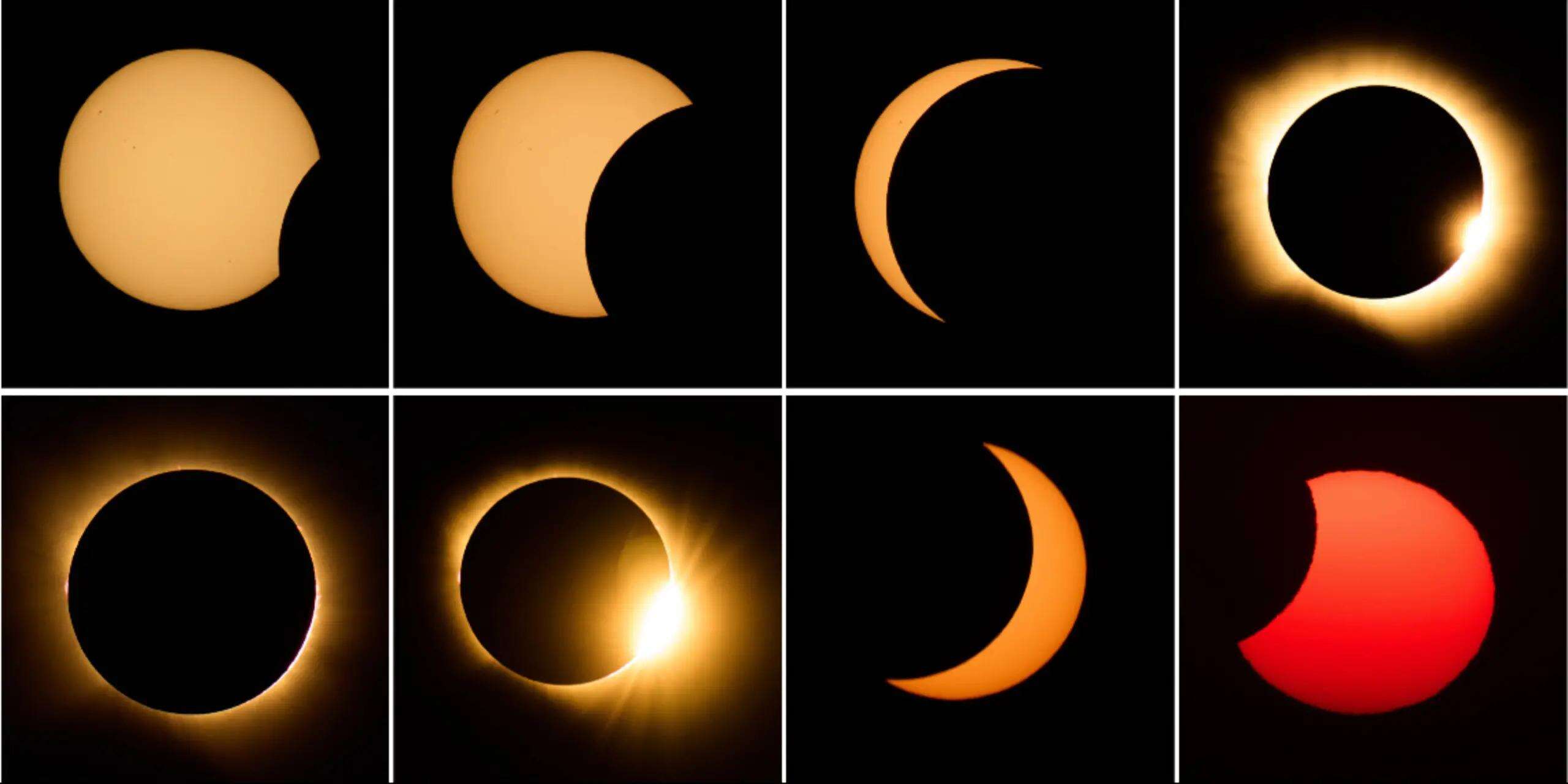
the moon covered the sun over Spain, and a total solar eclipse returned to the mainland. (Photo: PTI) A total solar eclipse is seen from Berlanga de Duero, central Spain, Wednesday. (Photo: AP) Sequence of the moon covering the sun in a total solar eclipse seen from Berlanga de Duero, central Spain, Wednesday, (Photo: AP) Europe watches daylight fade A couple talk during a solar eclipse on the shore of the Gulf of Finland in St. Petersburg, Russia, Wednesday. (Photo: AP) A partial solar eclipse is seen above the Houses of Parliament in London, Wednesday. (Photo: AP) Iceland becomes Europe’s first major stage for totality Stages of a solar eclipse before, during and after totality, as seen from Arija. (Photo: Reuters) Shadow reaches Spain as the sun begins to set The moon moves out of the sun during a total solar eclipse is seen from Berlanga de Duero, central Spain, Wednesday. (Photo: AP) The moon partially covers the sun during a solar eclipse over mountains near the northern Spanish town of Reinosa, Wednesday. (Reuters) After a century-long gap, Spain waits only a year People observe a partial solar eclipse with special protective glasses in Berlin, Germany, Wednesday.
(Photo: AP) A wait for more than a century came down to barely a minute: the moon covered the sun over Spain, and a total solar eclipse returned to the mainland. Near sunset on Wednesday, crowds watched the sky darken almost to night before sunlight briefly returned, leaving one of Europe’s rarest celestial events over almost as soon as it had begun.The rarity went deeper than Wednesday’s spectacle. Western Europe had not witnessed a total solar eclipse since 1999, while Spain’s own history carries an unusual qualification. News agency Associated Press reported that a hybrid eclipse produced only a few seconds of totality in 1912, leading some astronomers to regard 1905 as Spain’s previous full-scale total solar eclipse.From St Petersburg to Berlin, millions outside the narrow path of totality experienced a different version of the eclipse. People gathered along the Gulf of Finland in St Petersburg, while Berliners watched through protective glasses at Tempelhof and near the Molecule Man sculpture as the moon steadily covered more of the solar disc without completely blocking the sun.The effect grew stronger farther west. In Britain, more than 90% of the sun was obscured, leaving only a narrow strip of light visible at the eclipse’s peak.
At Greenwich Park in London, spectators watched the sky turn grey as hilltops, parks and other open viewpoints filled with people following the changing light towards evening.Cloud covered much of the sky over central Reykjavik, but it could not disguise what was happening below. Around Hallgrímskirkja, hundreds who had gathered despite the rain saw daylight fall sharply as totality arrived; many had only a limited view of the sun itself, yet the sudden darkness and the return of light drew cheers from the crowd.Conditions farther west gave a clearer measure of the eclipse. News agency Reuters reported that totality reached Iceland’s westernmost coast at about 5.44pm local time and lasted up to 2 minutes 13 seconds. Its maximum duration, about 2 minutes 18 seconds, occurred offshore west of Iceland before the moon’s shadow continued across the North Atlantic towards Spain.After crossing the North Atlantic, the moon’s shadow reached northwestern Spain at around 8.28pm local time, bringing places including A Coruña and Bilbao into totality shortly before sunset. The timing created an extraordinary natural sequence: the sun disappeared completely, returned briefly as the moon moved on and then sank towards the horizon as evening took over.Farther inland, totality lasted barely a minute in Buitrago de Lozoya, north of Madrid.
 The BriefWire