'Islamic NATO' Taking Shape? Who Could Be Next To Join Turkey-Saudi-Pakistan Defence Pact
News world 'Islamic NATO' Taking Shape? Who Could Be Next To Join Turkey-Saudi-Pakistan Defence Pact 'Islamic NATO' Taking Shape? Who Could Be Next To Join
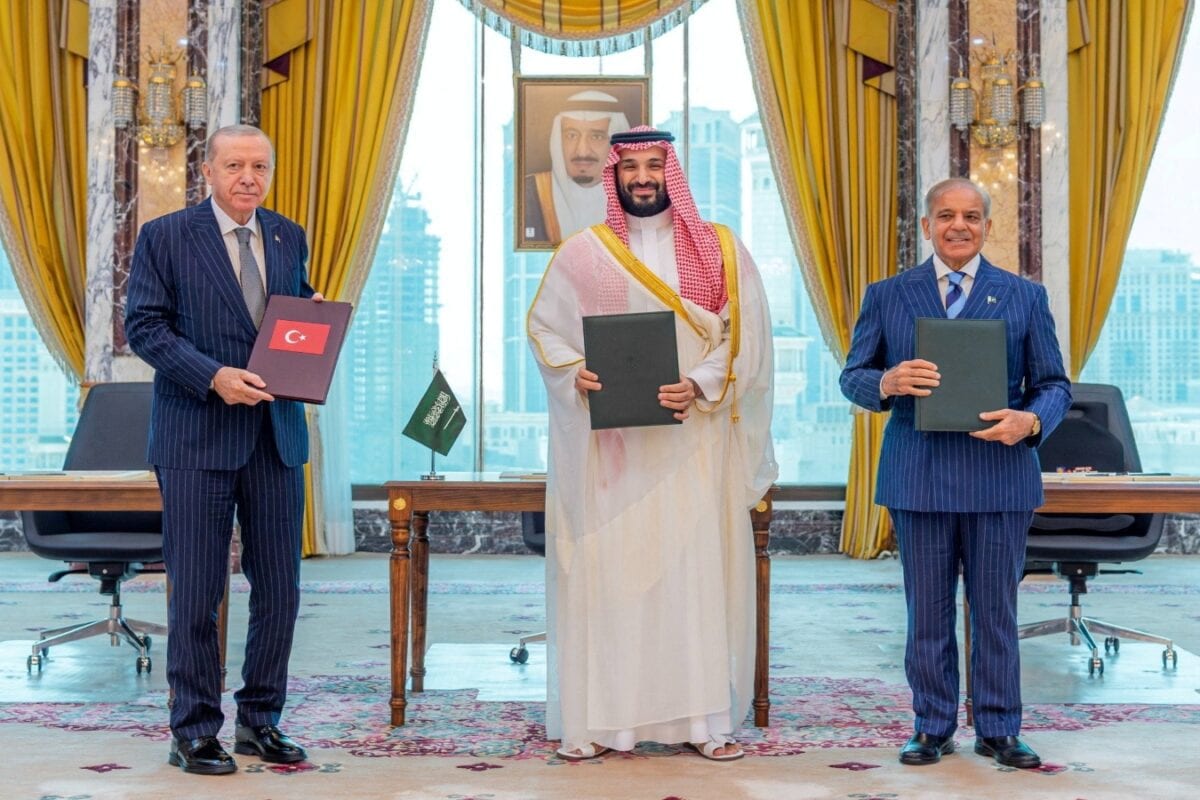
News world 'Islamic NATO' Taking Shape? Who Could Be Next To Join Turkey-Saudi-Pakistan Defence Pact 'Islamic NATO' Taking Shape? Who Could Be Next To Join Turkey-Saudi-Pakistan Defence Pact Published By, Last Updated: August 12, 2026, 15:52 IST The new alliance may not remain a three-country club for long, with Turkey signalling plans to widen its security umbrella. Turkish President Tayyip Erdogan, Saudi Crown Prince Mohammed bin Salman, and Pakistan's Prime Minister Shehbaz Sharif pose after signing a joint defence agreement in Mecca, Saudi Arabia, August 7, 2026. (REUTERS) Turkey, Saudi Arabia and Pakistan have signed a new defence pact built around a NATO-like collective security principle, and Ankara is already signalling that the arrangement could expand beyond its three founding members. The Mecca or Makkah Joint Defence Agreement, signed in Mecca on Friday by Turkish President Recep Tayyip Erdogan, Saudi Crown Prince Mohammed bin Salman and Pakistan Prime Minister Shehbaz Sharif, is intended to strengthen collective deterrence amid growing regional instability. Pakistan’s foreign ministry has said an attack on any one member would be regarded as an attack on all. But the precise nature of any military response remains flexible, with Turkish officials saying members would consult on the degree, form and format of assistance required. Turkey Wants The Pact To Expand Turkish Foreign Minister Hakan Fidan has made clear that Ankara does not see the three-country format as the end point. “Under our president’s vision, we should not remain limited to three countries. We should grow and, if necessary, bring [other] countries under this umbrella," Fidan told Turkish state news agency Anadolu. Fidan also said some countries had already expressed interest, although he did not name them.
A Turkish official cited by Reuters said the agreement was defensive in nature and open to regional countries that may want to join. The official also said it was not intended to replace existing bilateral or multilateral arrangements or target any particular country. Egypt Is The Clearest Candidate Fidan has openly said he wants Egypt to join the pact, calling Cairo a “natural partner" and indicating that its entry could come once certain “technical issues" are resolved. “I believe that at the next stage, Egypt will also be among us in the alliance," Fidan said. “We already act towards one another as if we were alliance members." Egypt already maintains working relationships with Saudi Arabia and Pakistan and has also strengthened ties with Turkey after years of tensions over the 2013 overthrow of President Mohamed Morsi, Libya and disputes in the Eastern Mediterranean. But formally entering a collective defence pact would be a more complicated decision. Karim Elgendy, associate fellow at Chatham House’s Middle East and North Africa Programme, told Al Jazeera that Cairo would want any agreement to protect its relationship with Washington, existing alliances and peace treaties, while allowing it to decide when and where its forces are deployed. “If the pact stays a political framework with room to calibrate each response, Cairo can live with it and may eventually sign. If it hardens into an obligation that could pull Egyptian forces into someone else’s war, the answer is likely to be negative," Elgendy said. Ahmed Aboudouh, also an associate fellow at Chatham House, told Al Jazeera that while Egypt broadly shares the trilateral pact’s security concerns, it may be reluctant to take on binding “security commitments".
 The BriefWire