Solar eclipse: What to look forward to
The last solar eclipse visible from the European mainland was in 1999. Here's what to expect, and how to prepare for this rare occasion. On
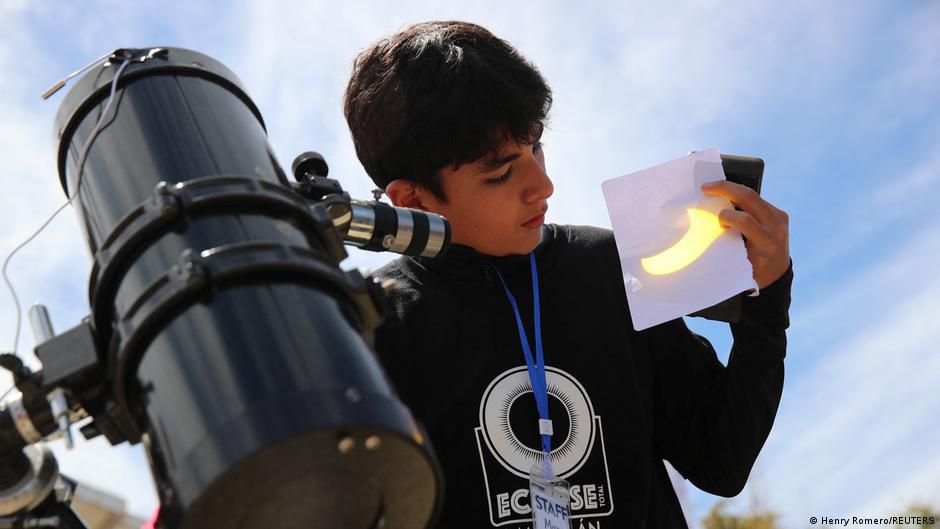
The last solar eclipse visible from the European mainland was in 1999. Here's what to expect, and how to prepare for this rare occasion. On Wednesday, about 980 million people across parts of the Northern Hemisphere will have the chance to observe this upcoming solar eclipse. They will be joined by hosts of researchers who will be taking advantage of the fleeting minutes when the sun's corona is visible from Earth to test specialized instruments and capture rare images. With them, they hope to gain a deeper appreciation of the material above the sun's surface. What's going to happen? During a solar eclipse, the moon orbits between Earth and the sun during the daytime, casting a shadow which temporarily darkens the sky and appears to blot out the sun. At the height of an eclipse, the moon's disk appears to align with the sun, revealing the sun's corona — its outermost atmosphere that flares outward like a crown (hence the name). As the moon approaches and the sky darkens, you might also notice the temperature dropping, shadows appearing crescent-shaped, the wind beginning to shift and animals behaving unusually.
Eclipse fever sweeps Spain ahead of rare spectacle To view this video please enable JavaScript, and consider upgrading to a web browser that supports HTML5 video Solar panels will be able to produce less energy in this time. In Germany, this is expected to lead to a brief surge in electricity prices. Right before the eclipse reaches its maximum point, known as totality, watch out for Baily's beads. These are the final rays of sun reaching Earth through valleys on the moon's surface. They appear as white specks encircling the moon like a string of pearls. As night closes in during totality, keep an eye out for the stars that appear. Some might even be able to catch a glimpse of auroras or passing meteors. Where will the eclipse occur? If you live in Greenland, Iceland, northern Russia, northern Spain or northeastern Portugal, you're in luck! Viewers in these locations will be able to observe a total solar eclipse. In most of Western Europe, as well as parts of northern Africa and northern America, astronomy enthusiasts will still be able to watch a partial solar eclipse. And this is just the first of two eclipses in August.
The second will take place on August 27-28, when Earth moves between the sun and the moon to create a lunar eclipse. The next solar eclipse will happen February 2, 2027, over much of Africa, South America, as well as parts of Antarctica. While eclipses themselves are fairly frequent occurrences, it's not that often that a total solar eclipse is visible on inhabited parts of the globe. The last solar eclipse visible for most of mainland Europe, for example, was in 1999. What time is the eclipse happening? The spectacle will begin at 15:34 GMT, with the moon slowly dimming the sun's light as it creeps into position. About two hours later, at 17:46 GMT, the eclipse will reach totality for about two minutes. But where on the globe you are watching from will make a difference. While Icelanders will be able to observe the eclipse's totality at 17:48 GMT, viewers in Spain will have to wait until 18:27 for their chance. Where can I watch the eclipse? Since the eclipse is happening relatively late in the day, viewers are recommended to watch from high places to catch a good view of the sun as it dips toward the horizon.
 The BriefWire