Lessons From The Warzone: Indian Navy Eyes 1,000-Km Strike Drones To Counter Threats
News india Lessons From The Warzone: Indian Navy Eyes 1,000-Km Strike Drones To Counter Threats Lessons From The Warzone: Indian Navy Eyes 1,000-Km Strike Drones
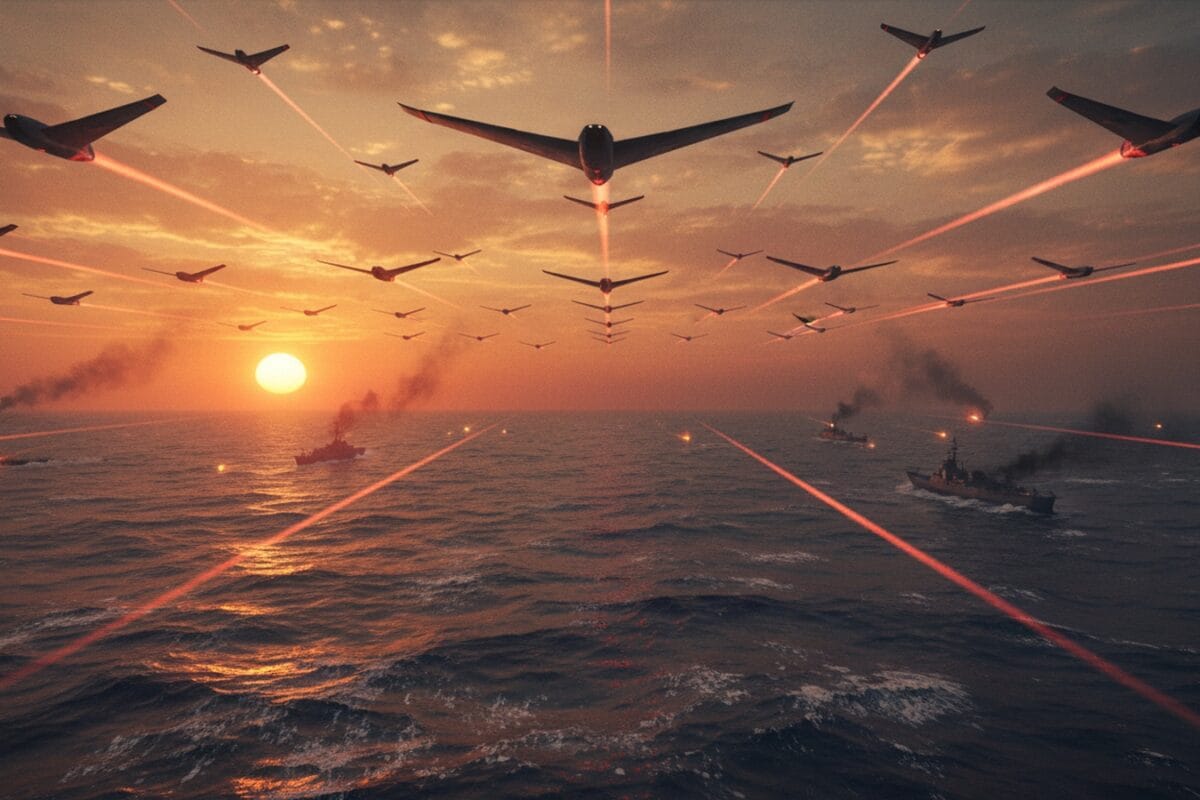
News india Lessons From The Warzone: Indian Navy Eyes 1,000-Km Strike Drones To Counter Threats Lessons From The Warzone: Indian Navy Eyes 1,000-Km Strike Drones To Counter Threats Reported By, Edited By Last Updated: August 12, 2026, 08:31 IST Recent drone strikes in the Red Sea have forced global navies to rethink fleet defence and strike capabilities. Rapid Read Control of the airborne drones can be transferred seamlessly between multiple ships or land-based stations. (AI generated image) The Indian Navy is seeking ship-launched loitering munitions with a 1,000-kilometre range to counter asymmetric threats and engage coastal targets. Recent drone strikes in the Red Sea have forced global navies to rethink fleet defence and strike capabilities. The Ministry of Defence has now issued a formal requirement for these medium-range systems to give Indian warships an independent offensive drone capability.
A 1,000-kilometre strike range expands the operational reach of the surface fleet. This allows warships to dominate strategic areas in the Indian Ocean Region and execute inland strikes while staying safely out of range of adversary shore-based missiles. The new naval requirement asks for indigenous munitions that can loiter for nine hours and dive at speeds exceeding 200 knots. The system will carry electro-optical and infrared seekers to hunt targets day and night. The weapons must deliver precision strikes with a circular error probable of less than one metre. Modern combat assumes standard satellite communications will be jammed. Thus, the Navy has also stipulated that these drones must function without degradation even when satellite navigation signals are spoofed or denied. Further, a single ship-based operator will manage up to 10 munitions simultaneously through a modular control console.
Control of the airborne drones can be transferred seamlessly between multiple ships or land-based stations. The maritime environment demands rigorous equipment standards. Vendors must prove their systems can survive extreme conditions through mandatory Environmental Stress Screening. The drones must launch in 50-knot winds and 95 percent humidity. All critical components require a guaranteed service life of at least 10 years, which can be extended to 20 years. The defence ministry plans to acquire the equipment under the Buy Indian-IDDM or Buy Indian categories to ensure the intellectual property and manufacturing remain domestic. This naval acquisition aligns with a broader tri-service push for long-range autonomous weapons. The requirement is aligned with thought process of military planners where they say that long range autonomous weapons and platforms will play a major role in future battles.
 The BriefWire