Colombia earthquake: Rescuers race to find thousands missing
Thousands remain unaccounted for, with many buried under rubble and rescuers yet to reach more isolated communities. The true scale of the destruction is emerging
Thousands remain unaccounted for, with many buried under rubble and rescuers yet to reach more isolated communities. The true scale of the destruction is emerging only slowly, with the death toll likely to rise steeply. Rescuers and volunteers searched through collapsed buildings across western Colombia on Tuesday after a magnitude 7.4 earthquake caused widespread destruction across several major cities a day prior. The Colombian Association of Capital Cities, known as Asocapitales, put the confirmed death toll at 169 on Tuesday, with 668 people injured. What do we know about the western Colombia earthquake? The quake struck near the community of San Jose del Palmar in the western region of Choco on Monday, causing widespread destruction in the cities of Cali, Pereira, Manizales, Quibdo and Buenaventura. Cali accounted for 85 deaths and Pereira 66, according to the association. The figures remain incomplete because they largely cover major cities and do not yet include the full toll from rural communities.
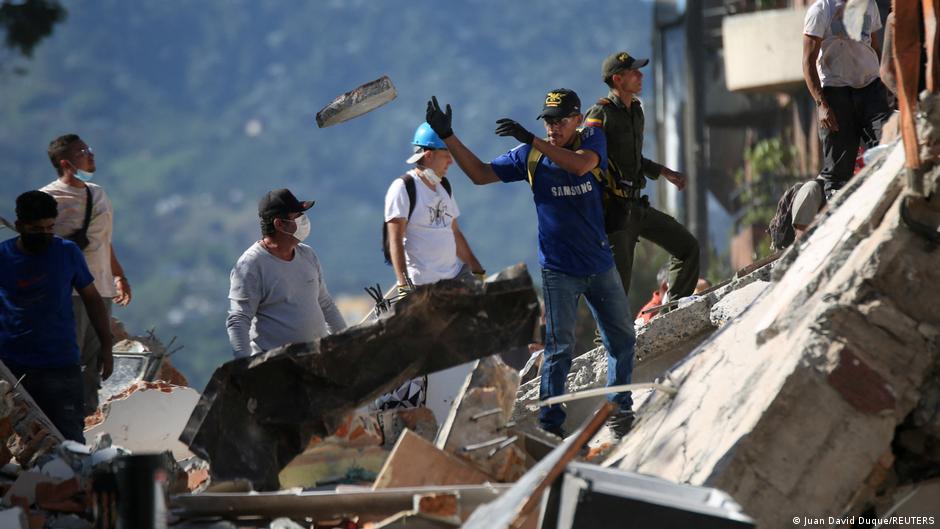
More than 3,000 people have been reported missing, with many feared trapped beneath collapsed buildings. Around 1,600 buildings have been damaged or destroyed. Soldiers, emergency teams and relatives have been clearing debris in dozens of towns and cities, with volunteers forming lines to pass chunks of concrete by hand. The cities of Pereira, Cali, Quibdo and Manizales remain on red alert because of the scale of the damage. At least 165 buildings completely collapsed in those cities alone. Hospitals, airports, public utilities and transport systems have also been damaged across several western departments. The epicenter was near one of Colombia's poorest and most isolated regions. Large parts of the area can be reached only by boat, aircraft or through jungle routes, while damaged roads and other infrastructure are complicating access. That means the full extent of casualties and destruction near the epicenter remains unclear. How has the world responded?
The United States has offered $15.5 million (€13.42 million) in emergency assistance, while the European Union has activated its Copernicus satellite service to support rescue operations. The EU has also begun providing emergency assistance following the earthquake, including €100,000 in initial aid through the German Red Cross. Israel, Mexico, Chile, Argentina and El Salvador have also offered assistance. The earthquake was felt beyond Colombia, including in parts of Venezuela, Ecuador and Panama. More than 100 dead in Colombia after major earthquake To view this video please enable JavaScript, and consider upgrading to a web browser that supports HTML5 video Why was such a deep quake so damaging? The scale of the destruction was striking because the earthquake struck at a depth of around 100 kilometers (62 miles), where surface shaking would normally be expected to be weaker. Geologist Raul Perez of Spain's Geological and Mining Institute told EFE news agency that the magnitude 7.4 quake was a particularly complex subduction event involving the Nazca and South American tectonic plates.
 The BriefWire