Spacewalks explained: How humans learned to work outside Earth
Nasa astronaut Anil Menon's Aug 6 spacewalk continues a si decade evolution from near-disastrous first attempts to routine orbital maintenance.(Image credit: Nasa) Anil Menon's first
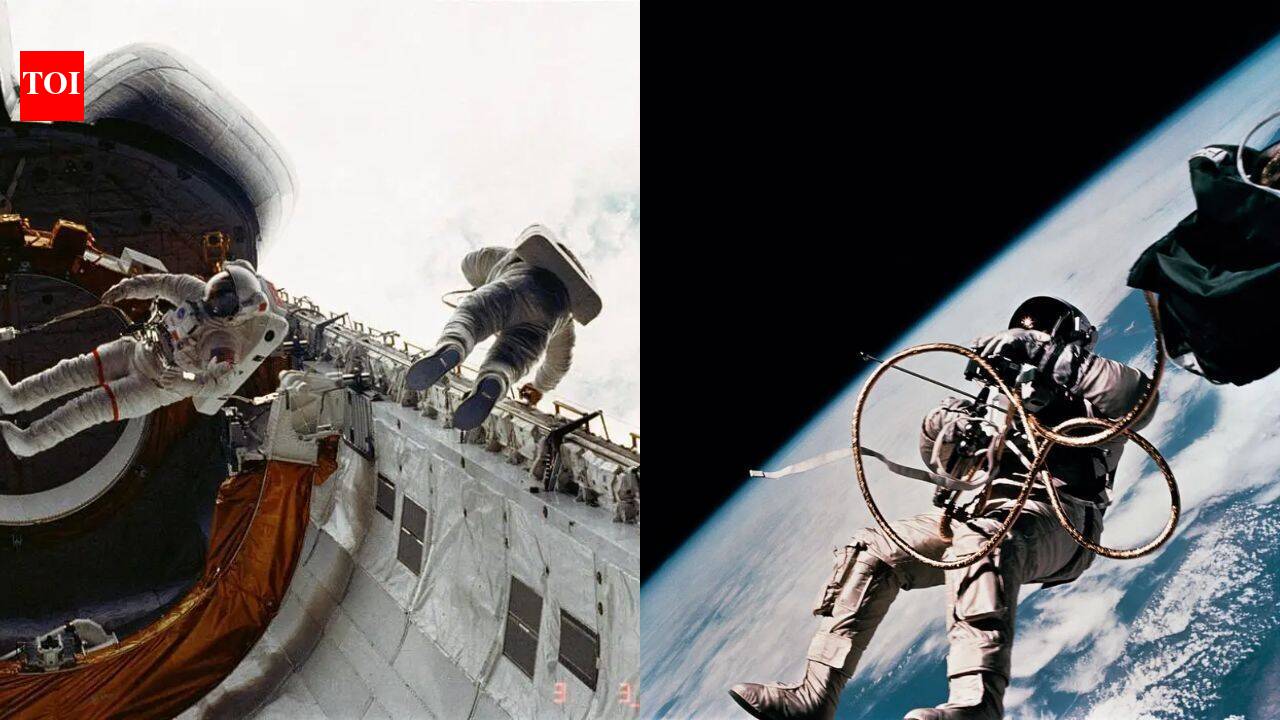
Nasa astronaut Anil Menon's Aug 6 spacewalk continues a si decade evolution from near-disastrous first attempts to routine orbital maintenance.(Image credit: Nasa) Anil Menon's first spacewalk From survival to skill Spacewalk by the numbers Why space never gets easier A Spacewalker's Lifeline When spacewalks became construction work The next frontier Three Spacewalks scheduled in August BENGALURU: Imagine opening the hatch of the International Space Station. A few minutes earlier, the airlock around you was full of air. Now it is a vacuum. Your white spacesuit is no longer just clothing. It is your spacecraft. Every breath, every heartbeat, every drop of cooling water keeping your body from overheating depends on the backpack strapped to your shoulders.A steel tether is the only thing connecting you to the station travelling around Earth at nearly 28,000 kmph. There is no up. No down. No sound. You reach for the first handrail and pull yourself outside. For the next six hours, there is no room for improvisation.This is a spacewalk, or extravehicular activity (EVA). And when Nasa astronauts Anil Menon and Jessica Meir stepped out of the Quest airlock on Aug 6 to prepare the ISS for another roll-out solar array, they were taking part in something that has taken more than six decades to perfect.The remarkable thing about modern spacewalks is that they rarely look dramatic. Astronauts appear to glide effortlessly around the station, swapping cables, installing equipment and replacing antennas as though they were electricians working atop a very tall building.That illusion is the product of thousands of lessons learned, many of them painfully. The first person to discover just how unforgiving space could be was Soviet cosmonaut Alexei Leonov.On March 18, 1965, Leonov became the first human to leave a spacecraft. His historic excursion lasted barely 10 minutes, but almost ended in disaster. The vacuum caused his suit to balloon until it became so rigid that he could hardly move.
Returning through the hatch proved nearly impossible. Desperate, he deliberately lowered the suit's pressure, accepting significant risk just to squeeze back inside.Leonov answered humanity’s first question about spacewalking: could a person survive outside a spacecraft? The answer was yes. The next question proved harder. Could they actually work? Only months later, American astronaut Ed White floated outside Gemini 4, producing some of the most iconic images of the early Space Age.But later Gemini missions revealed an uncomfortable truth. Floating gracefully was one thing; tightening bolts, connecting cables or carrying tools while wearing a pressurised suit was something else entirely. Even simple tasks became exhausting.Nasa’s answer came not in space but underwater. Astronauts spent countless hours inside giant neutral-buoyancy pools, rehearsing every movement they would later perform in orbit. The training transformed spacewalks from symbolic demonstrations into carefully choreographed engineering operations.That choreography begins long before the hatch opens. Inside the station, astronauts spend hours breathing pure oxygen. The process removes nitrogen from their bloodstream and prevents decompression sickness, much like divers ascending too quickly from deep underwater. Only then is the airlock gradually depressurised.Every tool has a designated location. Every movement is rehearsed. Every handrail has already been chosen. Mission controllers on Earth know precisely where the astronauts should be every minute of the journey.Even then, the real challenge only begins outside. A spacesuit is often described as a miniature spacecraft shaped like a human body. It must provide oxygen, remove carbon dioxide, regulate temperature, shield against radiation and tiny high-speed debris, power communications and maintain pressure in an environment where there is none.Ironically, the very pressure that keeps astronauts alive also works against them. A pressurised glove behaves less like fabric and more like an inflated balloon. Closing your fingers around a wrench requires constant force. Turning a stubborn connector can feel like exercising with resistance bands for hours. A typical ISS spacewalk lasts between five and eight hours, making fatigue a serious concern.Then there is orientation.
 The BriefWire