Why the Rhine drought is bad news for Germany’s recovery
Germany’s inland waterways still move around 5% of the nation’s goods. With the Rhine at a critically low level, DW explores how the drought is
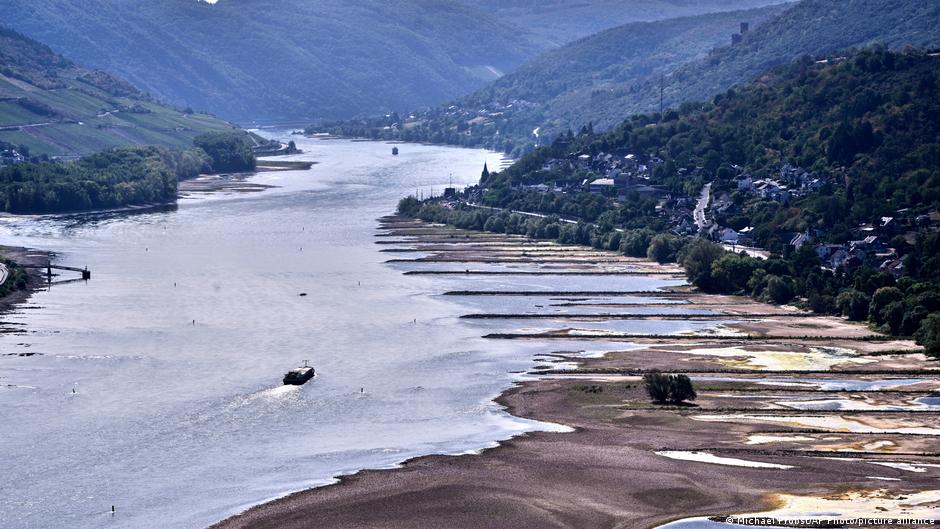
Germany’s inland waterways still move around 5% of the nation’s goods. With the Rhine at a critically low level, DW explores how the drought is hitting the economy where it hurts most. How bad is the Rhine water level? Water levels on the Rhine River — a small but critical artery for goods vital to Germany’s industry — remain critically low as a result of weeks of drought. At one of the river's shallowest stretches, Kaub — between Mainz and Koblenz — the water level stood at around 16 centimeters at Monday lunchtime, according to the Federal Waterways and Shipping Administration (WSV). Although the real navigable channel is roughly a meter deeper, 40 centimeters is regarded as the lowest for standard commercial vessels at Kaub. Ship operators use the reading at Kaub to decide how much cargo their barges can safely carry and whether a passage is feasible at all. According to local media, in recent weeks, carriers have significantly cut their cargoes along the Rhine — in many cases to as little as one-fifth of normal capacity. The problem isn't just limited to the Middle Rhine, the 130-kilometer (80-mile) stretch between Mainz and Bonn that is the narrowest and shallowest section of the river. Areas around Cologne, Düsseldorf, Duisburg-Ruhrort and Emmerich are also at historic lows. Jens Schwanen, the head of the BDB association of inland shipping, told the Rheinische Post newspaper on Monday that the Rhine may become impassable at Kaub before the end of the week.
This would effectively split the river in two for commercial traffic. What effect will the drought have on the German economy? The drought could not come at a worse time for Germany’s economy, which is already grappling with weak growth, high energy costs and fading industrial competitiveness. Germany still relies on its long rivers and waterways to transport some 5% of goods around the country, most of them bulk materials, including iron ore, coal, sand and petroleum products. Out of 3.28 billion tons of goods transported in 2024, 173 million tons were carried by inland water, including the Rhine, according to BDB. Eurostat, the European Union's statistics agency, calculated in 2023 that the Rhine corridor — from the Port of Rotterdam in the Netherlands to the German-Swiss border — accounts for around 40% of freight by ton-kilometers. After two previous droughts, the Kiel Institute for the World Economy calculated in 2023 that for every 30 days of low water on the Rhine, Germany's industrial production declines by about 1%. In an economy that has barely grown for the past two years, even a temporary 1% hit to industrial output is highly damaging. The German Economic Institute (IW) now predicts a 0.4% drop in gross domestic product, effectively wiping out this year's economic growth, which was expected at 0.5%. "A prolonged disruption of navigability on the Rhine could completely stifle the tiny seed of growth we have," warned IW economist Thilo Schäfer in an interview with Bild newspaper last week.
 The BriefWire