Which country is the new Mecca defense pact targeting?
Observers suggest the new alliance between Saudi Arabia, Turkey and Pakistan won't result in any of the countries fighting for each other. Instead it's about
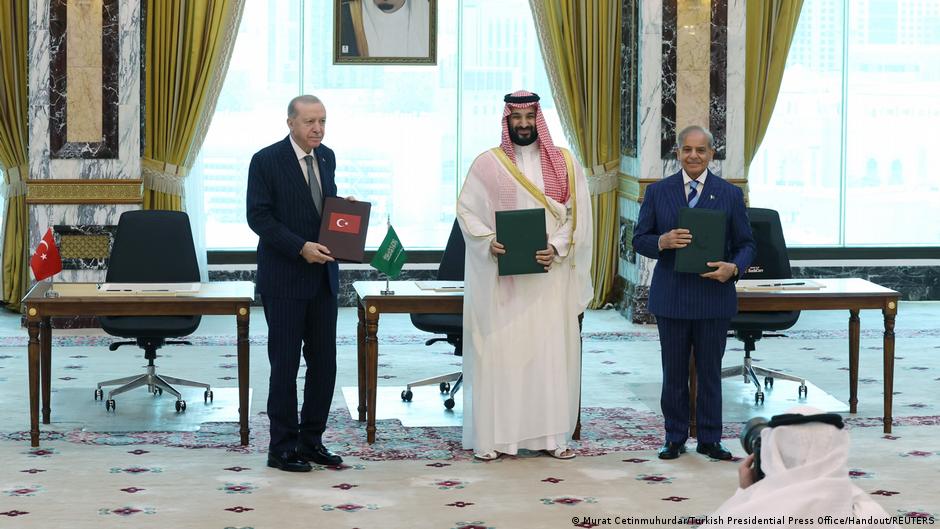
Observers suggest the new alliance between Saudi Arabia, Turkey and Pakistan won't result in any of the countries fighting for each other. Instead it's about preventing Iran and Israel from regional dominance, they say. Turkey, Pakistan and Saudi Arabia sealed a historic defense pact on Friday, signing an agreement "intended to strengthen collective deterrence against any act of aggression." The so-called "Mecca Joint Defense Agreement" between the three Sunni Muslim-majority states is meant to increase cooperation during regional uncertainty and threats from the Iran war. The agreement was signed in Mecca, Saudi Arabia, by Saudi Crown Prince Mohammed bin Salman, Turkey's President Recep Tayyip Erdogan and Pakistan's Prime Minister Shehbaz Sharif. The alliance has been likened to a NATO-style alliance and on Friday, the Pakistani foreign ministry said that an attack on any member would be regarded as an attack on all. But experts and analysts have been quick to point out that the deal is unlikely to work that way — at least at first. On Saturday, Yemen's Houthi group targeted Saudi Arabian oil facilities in Jizan. A July attack on the same facility is seen here Image: Social Media/REUTERS For example, on the weekend the Houthi rebel group in Yemen fired at Saudi Arabian oil facilities again. The Houthis consider Saudi Arabia their enemy and are also aligned with Iran. The latter has also targeted Saudi Arabia after the US and Israel attacked it, starting a war in late February, because it sees the Saudis as a US ally. But following the Houthi attack on the weekend, neither Turkey nor Pakistan sprang to the Saudis' defense. Nor are they likely to attack Iran, analysts say. In fact, Pakistan is acting as a mediator between Iran and the US currently.
Mecca agreement an 'elastic defense pact' This arrangement is meant as more of a deterrent and as an "elastic defense pact," Dania Thafer, executive director of the Washington-based think tank the Gulf International Forum, or GIF, told DW late last week. "If you look at the parties in this agreement, you have Saudi Arabia, which is in the middle of this conflict. But you also have Turkey and Pakistan, who both have relations with Iran and both have relations with the US. So I think it's an extra layer of deterrence, if you will, for Saudi Arabia," Thafer explained. "I think Saudi Arabia is looking at a layered deterrence approach to regional threats as they emerge." This new alliance is likely to work out in various stages with the short-term goal being a "stabilized region," Kamran Bokhari, a senior fellow at the Middle East Policy Council in Washington, told DW. Technology transfer and investment Longer term goals will involve defense cooperation rather than fighting, other experts have said. "The three countries complement each other unusually well," Andreas Krieg, a lecturer in security at King's College London, told news agency Agence France-Presse last week. Saudi Arabia has oil wealth but limited defense technology and has been reliant on the US up until now. Meanwhile Turkey and Pakistan need investment and have strong armed forces, and in Turkey's case an advanced defense-industrial sector, Krieg explained. Pakistan is the only one with nuclear weapons of the three. "Turkey has technology and production capacity but needs markets and investment. Pakistan has a workforce, military institutions and nuclear deterrent, but needs financing and industrial capabilities," Krieg noted. Who does the Mecca pact target?
 The BriefWire