World’s largest solar telescope spots tiny vortices on the Sun at 19-km scale
The observations were made with the Daniel K. Inouye Solar Telescope (DKIST), a powerful 4-metre class solar telescope operated by the US Science Foundation. A
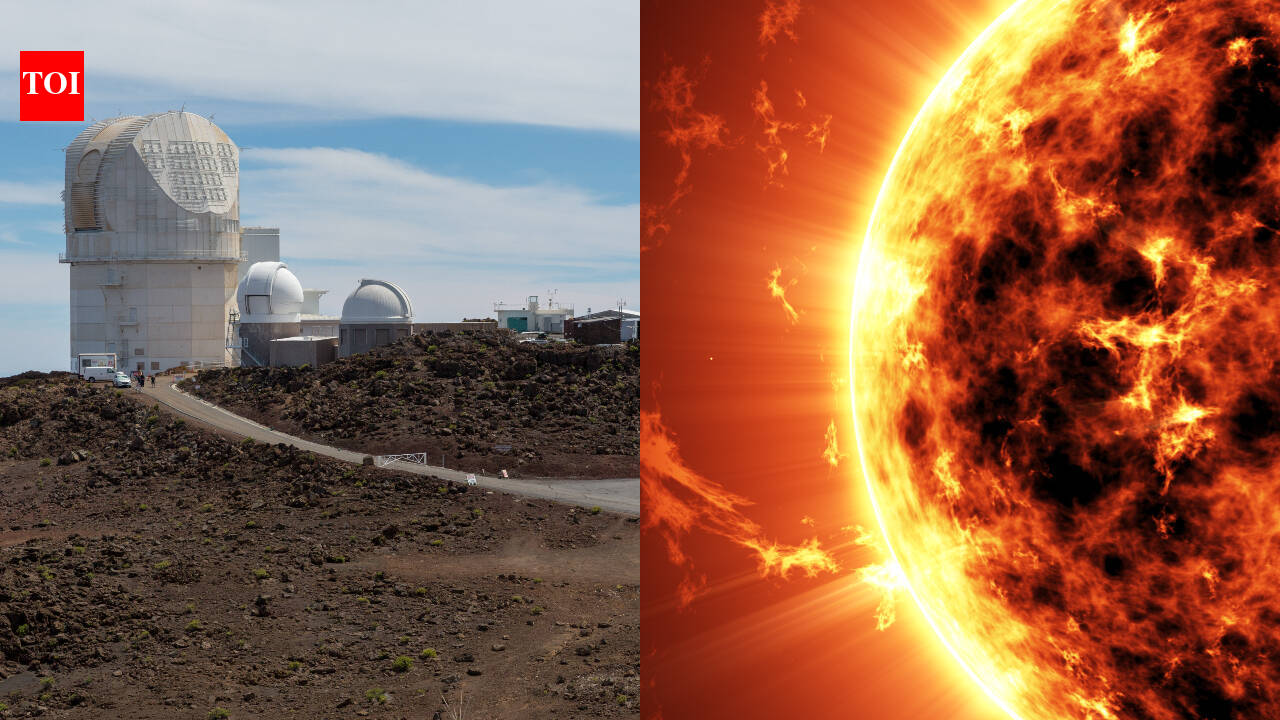
The observations were made with the Daniel K. Inouye Solar Telescope (DKIST), a powerful 4-metre class solar telescope operated by the US Science Foundation. A closer look at the Sun Miniature vortices on the Sun’s surface What is Kelvin-Helmholtz instability? The Kelvin–Helmholtz instability is an instability that occurs when two layers of fluid or plasma are moving past each other at different speeds. How magnetic fields create conditions The discovery is confirmed by computer simulations Why this discovery matters The Sun may appear to us on Earth as a glowing ball of plasma, but its surface is far more active and turbulent than it looks, which has been proven time and again through research. According to a latest report by Nature, observations from the world’s largest solar telescope have now provided an incredibly detailed view of the Sun's surface, showing tiny swirling structures that could help scientists understand how energy and magnetic fields flow through the solar atmosphere. The article clearly mentions that the observations were made with the Daniel K. Inouye Solar Telescope (DKIST), a powerful 4-metre class solar telescope operated by the US Science Foundation. It could examine parts of the Sun on the order of 19 kilometers, letting researchers see features that were too small for solar telescopes to detect before.The photosphere - the visible surface of the Sun - is never still.
It is proven to have hot plasma which rises, cools, and then sinks again in a process known as convection. These movements create patterns like boiling water. Magnetic fields are also present across the whole solar surface. They interact with these turbulent plasma flows creating an ever-changing environment. Some of the smallest details of this interaction had been hidden until now because existing telescopes could not see them clearly.But DKIST has changed that view. The high-resolution images show that the edges where magnetic regions meet the surrounding plasma are not smooth. Rather, they are filled with little vortices and swirls.When scientists looked at a series of images, they saw vortices forming and changing around magnetic areas. The smallest structures were near DKIST’s theoretical limit of resolution, about 19 kilometers. A study of 47 vortices showed they generally manifested at roughly 65 kilometers apart and individual vortices ranged from around 25 to 170 kilometers in size. They also seemed to move across the Sun at speeds between about 0.67 and 3 kilometers per second. According to scientists, these small swirls are important because they are associated with a physical process called the Kelvin--Helmholtz instability, or KHI.The Kelvin–Helmholtz instability is an instability that occurs when two layers of fluid or plasma are moving past each other at different speeds.
 The BriefWire