When German Catholics and Protestants share a church
Each year, dozens of churches are decommissioned, demolished or repurposed in Germany. But there is a new, unique development. From the outside, the Catholic church
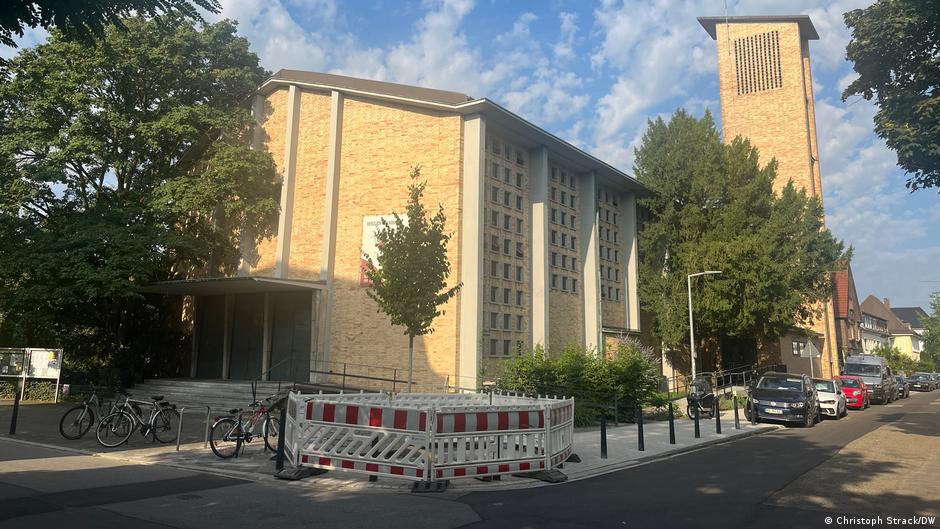
Each year, dozens of churches are decommissioned, demolished or repurposed in Germany. But there is a new, unique development. From the outside, the Catholic church in Mannheim's Neuostheim district appears to be a typical 1950s church building: a relatively simple structure, nothing particularly remarkable about it. Yet St. Pius is truly unique. In this place of worship, Catholic and Protestant Christians celebrate services sharing the same space and taking turns in gathering around the same altar for Communion and the Eucharist. "It actually began in the early 1970s," Annette Hübner, a Catholic parishioner, told DW. The 57-year-old has lived in the district with her family for more than half a century and is a member of the parish team. At the time, the parish priest of St. Pius was committed to fostering cooperation with the Protestant community and began holding ecumenical services in 1970. Then, at the end of 2009, the nearby Protestant St. Thomas Church sustained extensive water damage, and the building was found to be beyond repair. What began as a temporary arrangement gradually evolved into a lasting solution. That lasting solution, in turn, grew into a genuine ecumenical friendship. "It became increasingly clear that it made sense to continue working together," Hübner recalled. A banner on the facade of St. Pius proclaims: "One Lord, one faith, one baptism." What may sound like a theological phrase from a Sunday sermon is part of everyday life here, on weekdays as much as on Sundays. Annette Hübner feels that the Catholic and Protestant congretations in St.Pius are on a long journey that is well worth the effort Image: Christoph Strack/DW Catholics and Protestants under one roof: Germany is home to 65 so-called Simultankirchen (shared churches). Their joint use was mandated by secular rulers soon after the Reformation and the resulting division of the Church. In some cases, detailed regulations even specified who was allowed to enter the church and at what times.
The best-known examples are Altenberg Cathedral near Cologne and St. Peter's Protestant Cathedral in the eastern German city of Bautzen in Saxony. In hospital and airport chapels, shared use by different Christian denominations is now almost taken for granted. A similar trend, however, is increasingly emerging in ordinary parish communities. Protestant and Catholic churches in Germany's most populous state of North Rhine-Westphalia had already begun addressing the issue in 2017, during the commemorations marking the 500th anniversary of Martin Luther's Reformation. "What If We All Moved In Together?" is the title of the Practical Guide to the Ecumenical Use of Churches and Parish Halls. The publication presents examples from the dioceses of Cologne and Aachen, as well as Essen, Münster and Paderborn. The guide repeatedly points to the "accelerating reduction in church buildings." According to official church statistics for 2025, Germany had 24,500 Catholic and 21,100 Protestant churches, ranging from small chapels to grand cathedrals. Each year, dozens of churches are decommissioned, demolished or repurposed. A new life for Germany's deconsecrated church buildings To view this video please enable JavaScript, and consider upgrading to a web browser that supports HTML5 video Attending a Protestant church was once considered 'a sin' Examples of new shared church spaces can be found in both western and eastern Germany. In Schildow, on the northern outskirts of Berlin, only one church is expected to remain in use in the future: the larger and more prominent Protestant church. The Archdiocese of Berlin's press office describes the initiative as "an ecumenical project with exemplary character." Its statement also hints at the significance of this development: "For all the ecumenical openness that is now taken for granted," the Catholic participants still remember "earlier times when even attending a Protestant church was considered a sin." Small congregations in the East Catholic bishops in eastern Germany are quite accustomed to celebrating Mass in Protestant churches. For major occasions such as confirmations or parish anniversaries, the generally smaller Catholic churches are often unable to accommodate everyone.
 The BriefWire