Atal Canteen: Why Delhi needs Rs 5 meals
A bag of salt is nearly emptied into a vat of boiling water, full of red lentils softening and plumping, as the staff mops, wipes
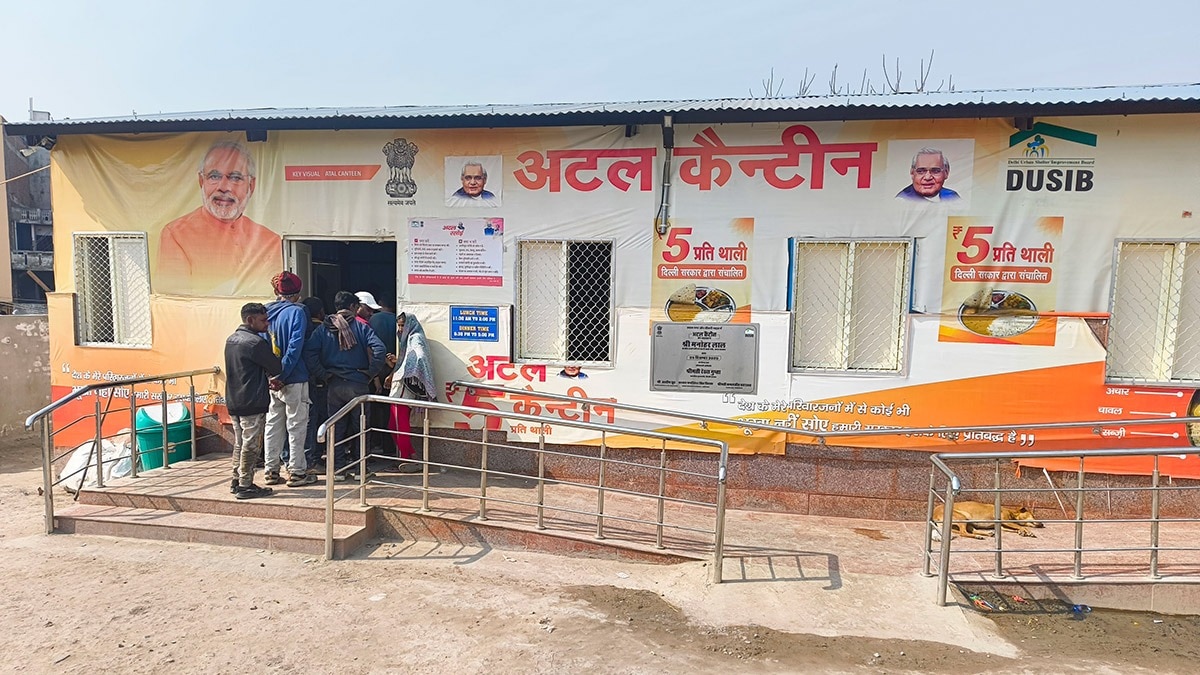
A bag of salt is nearly emptied into a vat of boiling water, full of red lentils softening and plumping, as the staff mops, wipes, peels, chops. Bouffant caps are on and aprons tied—this kitchen in South Delhi has been clattering since sunrise. The manager, Manoj, 34, walks in at 1 pm in pyjamas and talks to his deputy before going to the whiteboard to wipe out the lunch items and write in the dinner ones. Read Full Story He starts roaming the facility with his head down, texting van drivers who would soon come back from the canteens, and inspects the roti machine running the length of a wall, the potato-peeler grunting with each load expelled, the toothed tray mashing ginger, garlic, chillies into paste. Manoj is unfazed. His previous job was in a similar line at a railway canteen in Mathura, and this is just another day in the life of the Atal Canteen. His work, moreover, is only half done. Crossing the boys rinsing rice and lentils, he says, “I’m going to come back quickly after a shower,” adding, with a smile, running a hand through his hair: “It’s going white before my age...” His patrons, meanwhile, will be unrelenting in their criticism. Some of them, if told about the liberally used bags of salt, would be surprised. “I think the dal needs a little more,” a preteen boy who frequents a North Delhi branch would say, smiling down at his plate; maybe a disproportionate amount went to the potato, then, which he finds over-salted. Some, like a twenty-something janitor at a West Delhi canteen, would say the kidney beans are good but a little more oil and masala would’ve been nice: “We get bored eating this.” Older patrons would like precisely the minimal use of those two ingredients while others yet, like some teenage boys at the branch, would refrain from criticism and spice up their meal with store-bought french fries. Toddlers, like the ones in the North Delhi branch, may not get the chance to complain at all, content with free biscuits and chips as their parents shove dal-chawal into their mouths—a marketing move thought up by the staff. Kitchen staff in Mohan Estate, Delhi The Atal Canteen is Delhi’s latest attempt to improve the city’s nutritional status by setting up 100 branches that serve 100,000 meals daily—50,000 each for lunch and dinner—for Rs 5.
The latest iteration of such a scheme in the capital—both Sheila Dikshit and Arvind Kejriwal attempted it without much success—the canteen follows hugely popular counterparts in states such as Tamil Nadu, Rajasthan and Karnataka. Almost all branches up and running, they don’t come close to the coverage of India’s free dry ration scheme for the working-class—Delhi alone has 7.2 million beneficiaries—but they aren’t meant to replace it. According to a 2024 India Forum piece by economist Reetika Khera, these canteens are largely to serve those without the time, facilities or skills to cook, such as male migrant workers or the elderly; to reduce women’s labour in the kitchen by providing hot meals safe for daily consumption; and to create a place for the working-class to socialise without censure from the city’s elite. Not to mention the big savings on money. They can be a haven for men who otherwise would have gone hungry or availed unhygienic and pricier street stalls for far less food. Kishan, 57, who has been eating at the Nand Nagri branch since he lost his local job selling motor parts earlier this year, is one such patron. He has been unable to face his wife and son ever since that day. “Both of them eat at home. The house runs on my son’s salary now,” he says. Kishan has been looking for jobs and even asked the canteen staff if there’s a vacancy, but to no avail. Employers don’t want to pay more than Rs 10,000 a month and if he were to start looking for jobs in the affluent or central parts of Delhi, he would not be able to afford the commute—in time or money. “It’s my majboori that I have to live like this. I just do time-pass outside the house when I’m not here.” Buying his own meals and eating among others gives him respite—from both hunger and shame. Staff at the Metro Vihar branch of the Atal Canteen The scheme has also afforded first-time employment for many, including young people and women. Mintu, 36, is among them, deciding to look for work to pay off the Rs 2-2.5 lakh she and her husband had borrowed for their daughters’ marriages. Three down, one to go, and her husband’s income as a mason won’t cut it. “Today’s my first day,” she says, sitting on the floor of the South Delhi kitchen and cutting green chillis.
“The guard said there’s work but I said I won’t clean floors as I’m not of a lower caste.” She opts to stay even through the dinner service because she has been told she’d need to come back afterwards to wash utensils. Atal kitchens and canteens often see such coincidence of duties—servers and cashiers enlisting the help of idle drivers, janitors joining hands with patrons to handle security issues. Over at the Vishnu Garden branch, for instance, Parasnath, the 55-year-old guard, is known for his kindly nature and going beyond the call of duty by shepherding queues and taming hyperactive toddlers. He eats at the canteen regularly, has diabetes and avoids potatoes when it’s served. When there’s trouble at dinner, though, and drunk men come doddering in to push around boys or harass women, he says, “We try to resolve the problem with pyaar”, not mentioning what he does when that approach fails. At an East Delhi branch, Pawan, a 52-year-old manager who has become a father figure of sorts, has a heavier hand due to the absence of a guard. He opts to snatch the collar of disruptors and throw them out, reserving especial anger for a man who comes every night hoping for a stack of rotis to go with the chicken he buys nearby. “I also drink on the job to handle such people,” slurs Pawan. “Otherwise, how can you manage?” Parasnath Singh, 55, a guard at the Vishnu Garden canteen P.K. Jha, CEO of the Delhi Urban Shelter Improvement Board (DUSIB), the government agency handing out contracts for managing the canteens, acknowledges security issues, saying he has put up a proposal for full-time guards at all canteens and requested police officers to patrol them. “But even you know Who can stop a drunken man? Such areas are troublesome,” he says. Security is far from the only issue plaguing these canteens. In her 2024 piece, Khera asserts that government canteens all over India need more funds, not least because of the absence of protein-rich items such as eggs, curd, yogurt or buttermilk on the menu. The Atal Canteen suffers from the same deficiency, with each plate costing Rs 30 and the government footing Rs 25. Rs 100 crore have been allocated for the entire network so far, which is comparable to annual funds in other states, but there is scope for more canteens to be set up.
Khera points out that Chennai, for instance, has nearly four times the number of government canteens that Delhi does, for a smaller population. Moreover, costs change. What started out as each Atal Canteen’s construction costing some Rs 17 lakh has gone up to Rs 23 lakh due to market forces, according to Jha. Within this budget, says Ashish Sood, Delhi’s minister for urban development, there are also plans to build toilets and rest areas for staff. “There are currently no plans to expand the menu,” he says, adding that a security audit will be done, feedback mechanism instituted, and food safety guidelines finalised. Yashpal, 52, a tailor, and Aakash, 14, a school droppout, at the Vishnu Garden canteen The scheme’s longevity potentially faces the same issue as of its counterparts in Tamil Nadu, Karnataka, Rajasthan, Madhya Pradesh and Andhra Pradesh—politicking among parties can lead to funds mysteriously drying up as regimes change hands. Enshrining government canteens into the Food Security Act, like the dry ration scheme, could check against that. But the likelihood of that happening soon is low—in a 2024 ruling, the Supreme Court refused to direct the opening of government canteens in every state. Meanwhile, even more patrons turned to the Atal Canteen in recent months as LPG cylinder supplies ran short across the country due to the US-Israel-Iran war. At the South Delhi kitchen, though, there are no deficiencies. Manoj returns from his bath, hair dye plastered to his scalp, and sees that the food is nearly all cooked and ready to be loaded into insulated containers and then the vans. “Once the drivers take off, we’ll wash and dry our clothes, maybe go for a walk in the nearby park, then clean the kitchen once more before shuttering it,” he says. Shower stalls, clotheslines, mattresses—it’s all there on the same premises. As they sleep, Delhi will eat the food they cooked. Will everyone be satisfied? Not really—debates about salt and spice and oil will continue—but that’s just the nature of the job. Everyone’s a critic. Subscribe to India Today Magazine Ends
 The BriefWire