'Paper agreement will not bring security’: Iranian lawmaker attacks Saudi defence pact
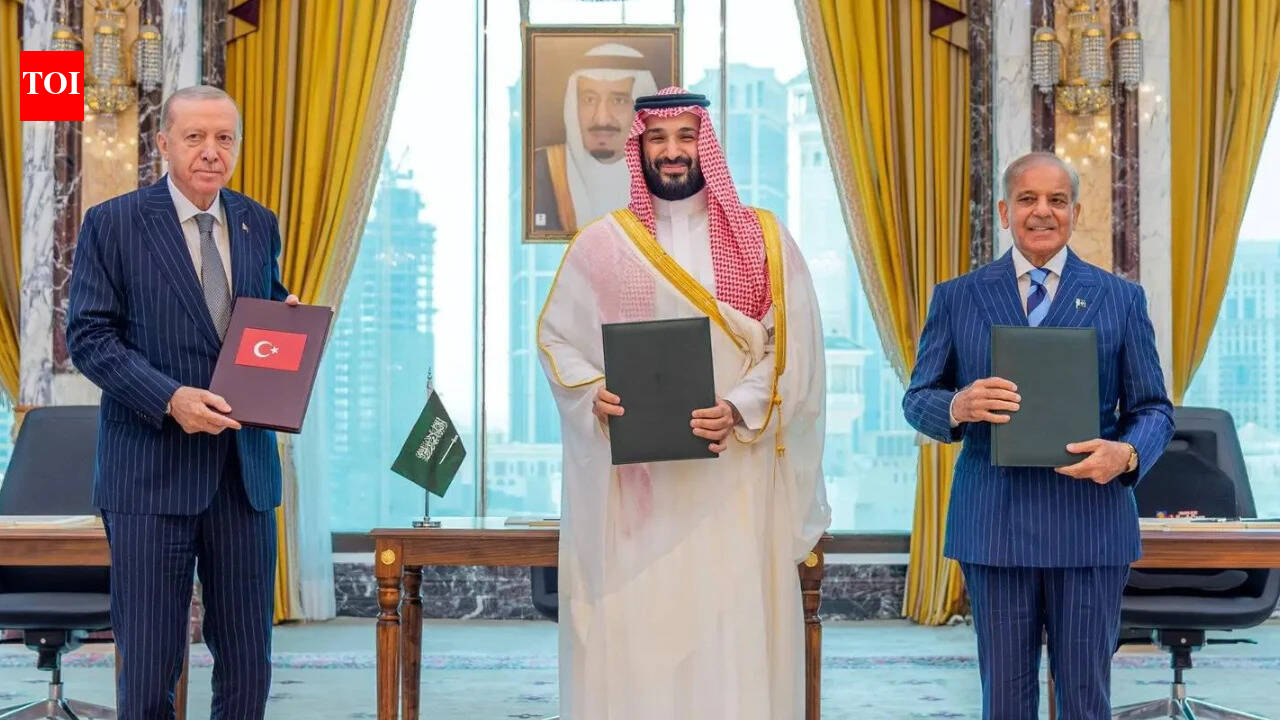
The criticism came after Saudi Crown Prince Mohammed bin Salman, Turkish President Recep Tayyip Erdogan and Pakistani Prime Minister Shehbaz Sharif signed an agreement that
The criticism came after Saudi Crown Prince Mohammed bin Salman, Turkish President Recep Tayyip Erdogan and Pakistani Prime Minister Shehbaz Sharif signed an agreement that would treat an attack on one country as an attack on all three Saudi Arabia, Turkey and Pakistan formalise defence cooperation An Iranian lawmaker on Friday criticised the new defence agreement signed by Saudi Arabia, Turkey and Pakistan, saying the pact would not guarantee Saudi security and urging Riyadh to change its policies rather than depend on external powers for protection.Ebrahim Rezaei, a member of the Iranian Parliament’s Security and Foreign Policy Commission, attacked the agreement in a post on X shortly after the three countries announced the deal in Mecca.“The Saudis should know that a paper agreement with Turkey and Pakistan will not bring them security, just as years of one-sided milking’ by the Americans did not bring them security. Change your policies so that you do not have to #BegForSecurity from others,” he wrote.The criticism came after Saudi Crown Prince Mohammed bin Salman, Turkish President Recep Tayyip Erdogan and Pakistani Prime Minister Shehbaz Sharif signed an agreement that would treat an attack on one country as an attack on all three, according to statements from the three governments.The agreement brings together oil-rich Saudi Arabia, nuclear-armed Pakistan and Turkey, which possesses NATO’s second-largest army and a rapidly expanding defence industry.The three countries said the arrangement is intended to strengthen cooperation and deterrence amid growing regional security concerns.Saudi Arabia insisted that the agreement does not amount to a military pact and would not affect its existing partnerships.“The agreement does not represent any orientation toward building a military axis or sectarian/religious bloc, and it is not linked to nuclear endeavours or an arms race, but rather to building sustainable self-reliant capabilities,” a Saudi statement said.“The agreement does not come at the expense of the Kingdom’s strategic and strong relations at the Gulf, Arab, and international levels.”A Turkish government official, speaking on condition of anonymity, described the agreement as “purely defensive in nature”, saying the countries had pledged mutual support only for defence and that the arrangement was “not against any specific actor”.The official said the agreement would not replace any existing bilateral or multilateral commitments and remained open to other regional countries that wished to join.Another Turkish official said the pact would also deepen defence industry cooperation and military coordination among the three states.Ozgur Unluhisarcikli, director of the Ankara office of The German Marshall Fund, said the agreement reflected shared concerns over regional fragmentation, civil conflict and armed non-state groups.“This is a reflection of their growing desire for greater regional stability,” he said. “They see state fragmentation, civil conflict, an environment of non-state actors as sources of instability.”He added that while Saudi Arabia and Turkey both viewed Iran and Israel as sources of instability, Riyadh was generally more concerned about Iran and Ankara more concerned about Israel.“At the end of the day, all three countries are concerned about instability,” Unluhisarcikli said.
 The BriefWire