The ‘vampire woman’ whose 17th-century grave is rewriting burial fears in Poland
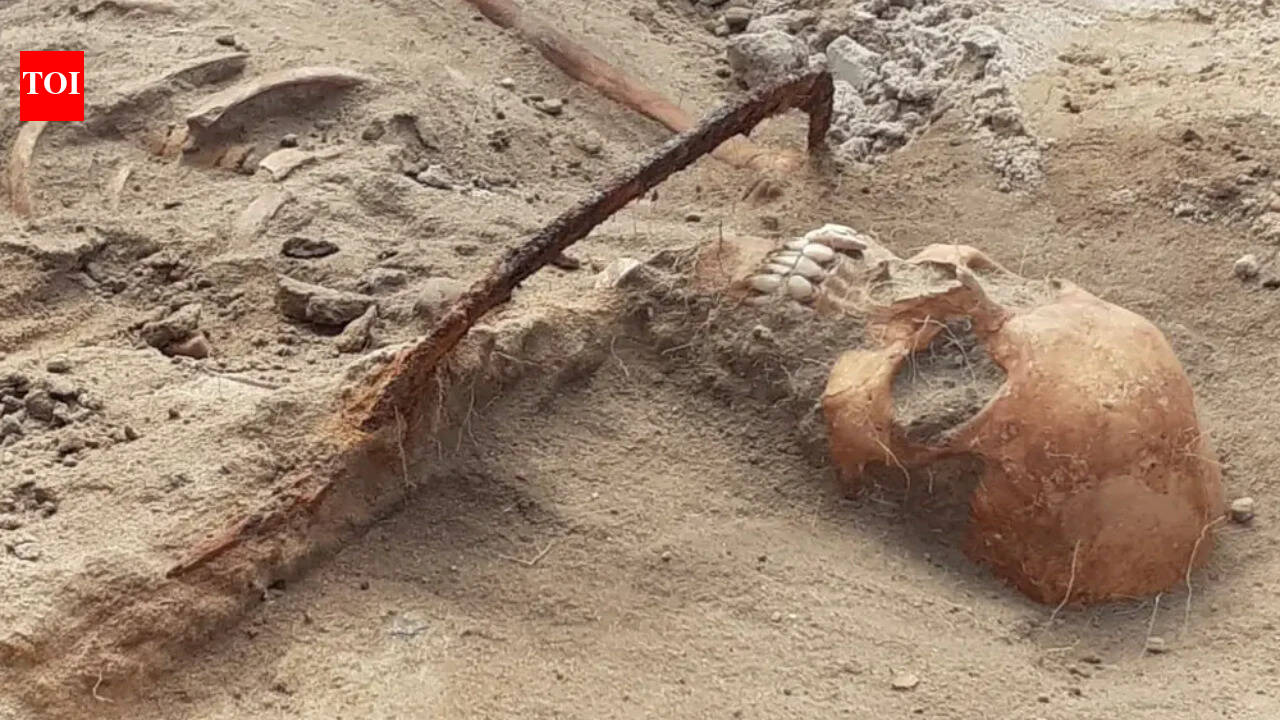
The female "vampire" with a sickle across her throat found in Pień, Poland PC: Mirosław Blicharski What anti-vampire burial practices actually meant Why a sickle
The female "vampire" with a sickle across her throat found in Pień, Poland PC: Mirosław Blicharski What anti-vampire burial practices actually meant Why a sickle was placed across one woman's neck How researchers rebuilt her face more than three centuries later Why a young child received the same kind of restraint Why archaeologists think fear of disease may explain some of these burials What the scale of the cemetery reveals Since 2005, archaeologists have been excavating an unmarked 17th-century cemetery near Pień, close to Ostromecko in Poland, uncovering more than 100 human burials, at least 30 of which show deliberate signs that the dead were pinned down, locked in place or positioned specifically to stop them from rising. Among the most striking finds are a young woman buried with an iron sickle laid across her neck and a triangular padlock fastened to her toe, and a child buried face down with a similar lock placed near the feet. Led by Dariusz Poliński of Nicolaus Copernicus University, the excavation has become one of the most detailed physical records anywhere of what archaeologists call anti-vampire burial practices, measures rooted not in the blood-drinking figure of modern fiction but in an older, more localised fear of revenants, the dead believed capable of returning to harm the living.According to Nicolaus Copernicus University's own account of the excavation, Poliński has described the measures found at Pień as activities protecting the living against the dead, a description that reframes what these burials actually represent. Rather than any belief in vampires as commonly understood today, communities in this period sometimes took specific physical precautions against certain individuals they feared might return after death, embedding those fears directly into how a body was buried.The triangular padlocks recovered at the site were not incidental grave goods.
Their consistent placement near the feet or toes tied them directly to the body itself, and Poliński has explained that a lock positioned beneath the foot was meant to symbolise the definitive end of a person's earthly life, a physical seal against any possibility of return. The same treatment appears across burials of both an adult woman and a young child, suggesting a repeated, deliberate pattern rather than an isolated or accidental choice.Discovered in 2022, the young woman whose grave included both a toe padlock and an iron sickle laid across her neck has since become widely known as the vampire woman, though the label describes the fears of those who buried her rather than any identity she held in life. The sickle's curved blade was positioned so that any upward movement of the body would press the metal directly into the throat, seemingly intended to injure or decapitate her should she attempt to rise. Combined with the padlock, her grave contained two entirely separate physical restraints, a level of precaution that sets her burial apart even within a cemetery already defined by this kind of practice.Poliński has offered several possible explanations for why she in particular was buried this way, including a visible physical difference, mental illness, sudden death or violent death, though no surviving historical document has been identified that explains the specific reasoning behind her treatment. Her burial also included traces of a silk headdress woven with precious metal thread, an object clearly associated with social status, complicating any simple reading of her grave as one of purely fearful rejection.In 2024, Swedish archaeologist and sculptor Oscar Nilsson produced a full facial reconstruction of the woman using a three-dimensional copy of her skull.
 The BriefWire