'Power Banks' for satellites? Bengaluru Company builds tech to keep ageing spacecraft alive
Aule On-screen setup running multibody dynamics simulations and tracking system capturing hardware test data for position and velocity for correlation Aule 2: Dark room hardware
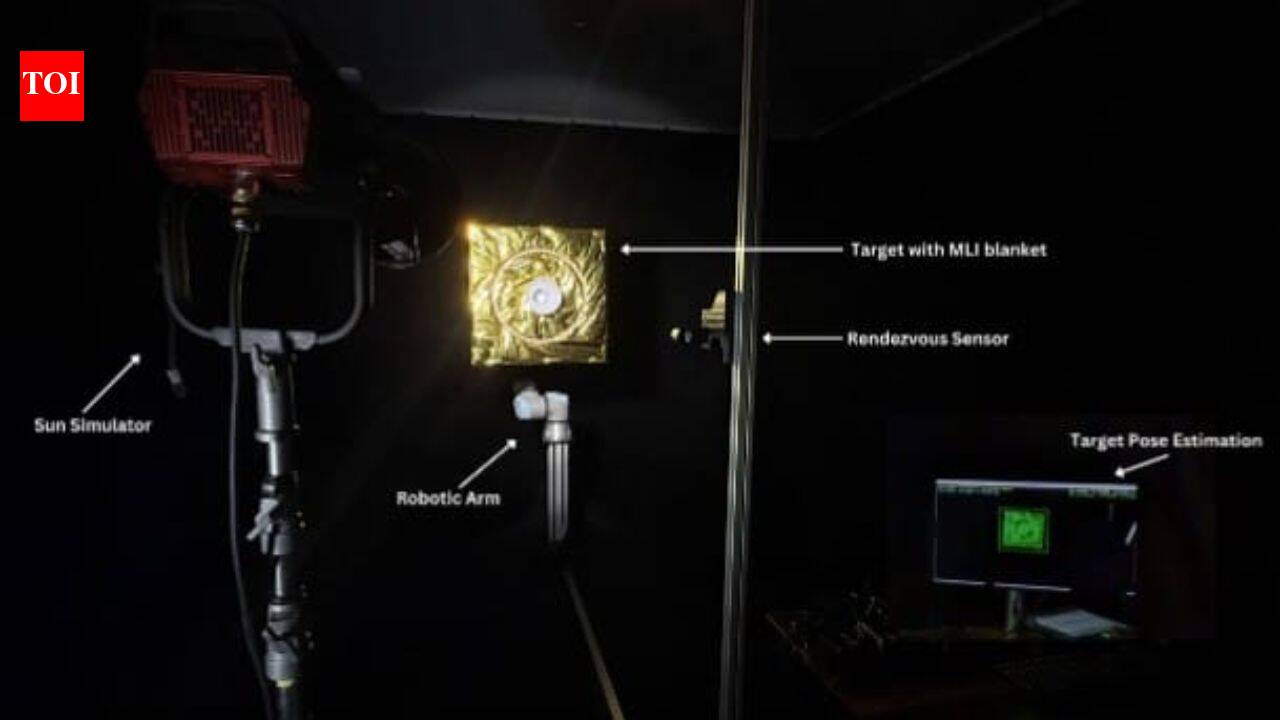
Aule On-screen setup running multibody dynamics simulations and tracking system capturing hardware test data for position and velocity for correlation Aule 2: Dark room hardware test setup where the team recreated on-orbit lighting conditions with a sun simulator and a target mounted on a robotic arm to simulate the target’s motion. Join conversation View All Comments → Share your thoughts in the comments Insightful Agree Disagree Skeptical Concerning Promising Worth Reading Big Development Post Comment Be respectful · TOI community guidelines BENGALURU: What if satellites could simply plug into a power bank instead of drifting away when they run out of fuel? That’s the idea driving a Bengaluru startup building “jetpack” satellites designed to latch onto ageing spacecraft, take over their propulsion duties and keep billion-dollar assets working years longer.After recently validating a key part of its technology at an Isro facility used for India’s SpaDeX docking mission, Aule Space is now preparing for what could become one of the world’s most ambitious private satellite docking demonstrations.For satellite operators, running out of fuel doesn’t necessarily mean spacecraft have reached the end of life.
In many cases, expensive communication satellites remain fully functional, but can no longer maintain their assigned orbital positions because they have exhausted the propellant needed for station-keeping. Once that happens, operators are forced to retire assets worth hundreds of millions of dollars.Aule has found another way. “We’re trying to build satellites which can go and dock to existing satellites in space which don’t have any installed ports... and extend their life so that they can keep generating revenue,” CEO Jay Panchal, told TOI. “It’s like a power bank,” he added.Instead of attempting the far more complicated task of refuelling satellites in orbit, Aule’s approach is to send a smaller “jetpack” spacecraft that docks with an existing communications satellite and assumes responsibility for station-keeping using its own propulsion system.The company plans to target geostationary communication satellites, many of which cost more than $300 million to build and generate significant annual revenues.The challenge lies in docking with satellites that were never designed to be serviced.
Rather than relying on dedicated docking ports, Aule will attach its spacecraft to the liquid apogee motor (LAM) nozzle, a standard external feature found on most geostationary satellites.If successful, the technology could help operators extract years of additional service from satellites that would otherwise become orbital relics. Panchal said each docked “jetpack” could extend a satellite’s operational life by up to 5 years.*Key Test Done*The startup recently completed a major milestone by testing its camera-based guidance, navigation and control system at the Rendezvous Simulation Laboratory (RSL) at Isro’s ISITE — the same lab where critical elements of the SpaDeX were validated.“We were the first non-govt entity to access RSL. This is the best kind of on-ground testing we can do for these capabilities,” Panchal said.One of Aule’s differentiators is its reliance on computer vision instead of multiple specialised sensors. Current docking systems typically use LiDAR, infrared cameras and other sensors.
 The BriefWire