Rs 1.33 crore cash, no ITR; yet wins tax case
Before you continue reading How financially free are you? Most people overestimate their financial freedom. Discover your Financial Freedom score through a quick survey Calculate
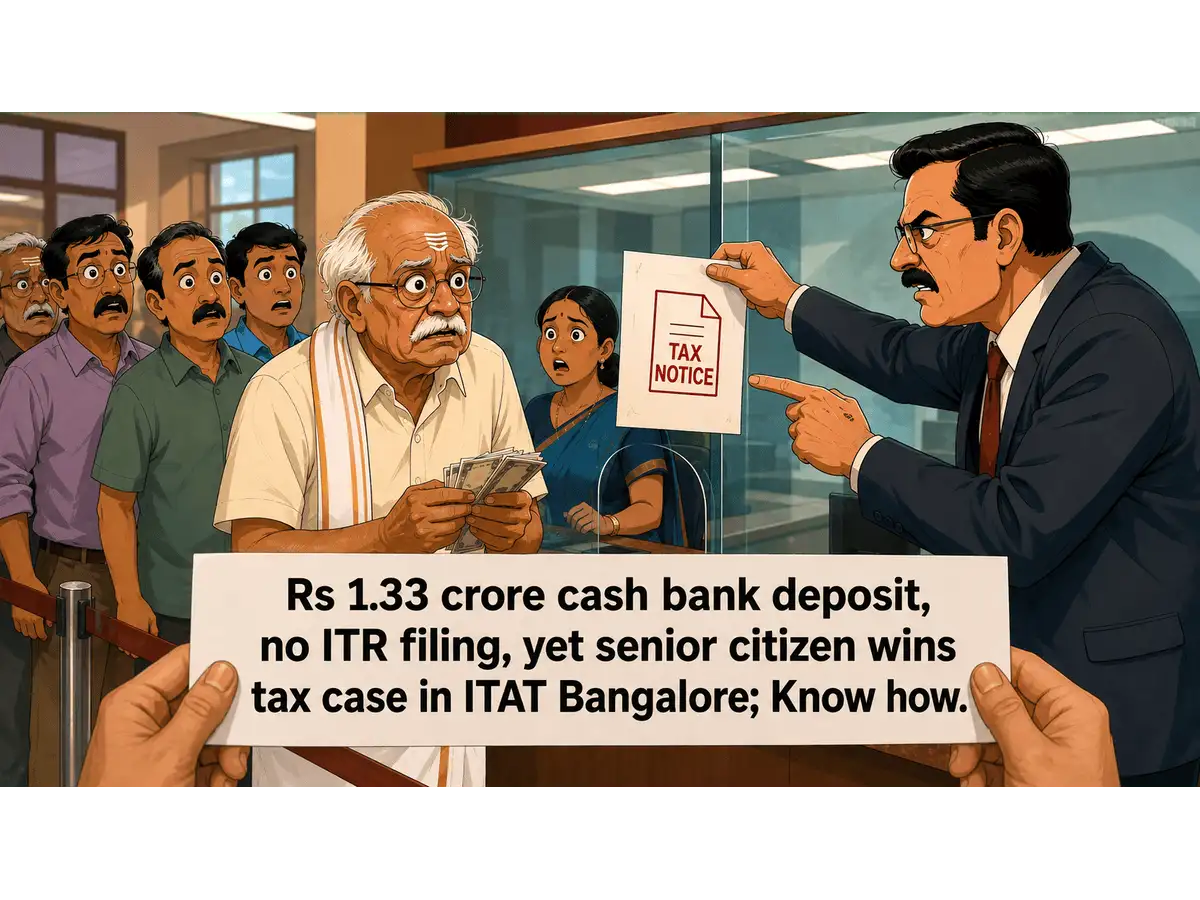
Before you continue reading How financially free are you? Most people overestimate their financial freedom. Discover your Financial Freedom score through a quick survey Calculate My Score SI no. Description No. of transactions Amount (in Rs) 1. Deposited cash of Rs 10 Lakh or more in a saving bank account-Bank of Baroda 1 Rs 13 lakh 2. Deposited cash of Rs 10 Lakh or more in a saving bank account-Canara Bank ET &T sec 1 Rs 60 lakh 3. Cash deposits of Rs 50,000 and above 2 Rs 60 lakh 4. Interest other than Interest on Securities- Section 194A- Bank of Baroda 1 Rs 12,701 Total Rs 1.33 crore (1,33,12,701) Why did Marathikyathanahalli win the case? Summary of the judgement When Mr Marathikyathanahalli, a retired teacher from Mysore, deposited Rs 1.33 crore in cash into his bank account, it triggered the red flag risk management strategy (RMS) established by the Central Board of Direct Taxes (CBDT). Moreover, Marathikyathanahalli had not filed any income tax return (ITR) leaving the Income Tax Department in the dark about his earnings for the year.The only thing the Income Tax Department knew was that Marathikyathanahalli's primary source of income was farming and interest on his savings bank accounts, but they had no clue about the actual amounts he made from these sources.This led the Income Tax Department to suspect that Marathikyathanahalli might have some undisclosed income that had slipped through the cracks for the AY 2015-16. Consequently, they decided to investigate his case and initiated the process by sending him a tax notice.The CBDT's RMS system showed that Marathikyathanahalli had made the following transactions during the AY 2015-16:-The first tax notice was sent to him under Section 148A(b) on March 26, 2022. He didn't respond to this notice or ask for more time to comply with it.Then, on April 26, 2022, the Income Tax Assessing Officer (AO) initiated the Section 148A(d) process, by holding that this is a fit case for issuing notice under Section 148 for the AY 2015-16.
On the very same day, on April 26, 2022, the AO also issued a notice under Section 148, directing him to submit an ITR for the AY 2015-16 within 30 days from the service of notice.In reply, Marathikyathanahalli filed an ITR but did not e-verify it and so the ITR was treated as invalid. Thereafter, the AO issued notices under Section 142(1) as well as show-cause notices on various dates, but he only partially complied. Eventually, the AO passed a re-assessment order under Section 147 in conjunction with Section 144 on February 29, 2024, determining his total assessed income to be Rs 48.85 lakh.Dissatified with the outcome, Marathikyathanahalli decided to take legal action by appealing to CIT (A), who after hearing his case dismissed it. Then he filed an appeal in ITAT Bangalore. ITAT Bangalore's SMC Bench heard his case on April 15. 2026 and passed an order in his favour on July 10, 2026.Chartered Accountant Athul C.J. and Chartered Accountant Siddesh N Gaddi represented him in ITAT Bangalore.The main reason he won the case is because the last date to send the tax notice was March 31, 2022 but it was sent after 26 days on April 26, 2022. ITAT Bangalore observed that the tax notice was issued 26 days after the limitation period had expired.Keep reading to know the details of what happened here and how he won.Chartered Accountant Suresh Surana explained to ET Wealth Online that Marathikyathanahalli won the case because the ITAT Bangalore decided the matter on the jurisdictional issue of limitation. Once the notice under Section 148 was held to be time-barred and invalid, the entire reassessment process based on that notice became void.The tax tribunal relied on earlier coordinate bench decisions as well as the principles laid down by the Supreme Court in case of Rajeev Bansal and the Karnataka High Court case in case of Mohammed Yaseen, which clarified that for AY 2015-16, reassessment notices issued beyond the old si year limitation period could not be sustained.Accordingly, the notice issued under Section 148 and the reassessment order passed under Section 147 were quashed, and the assessee's appeal was allowed.Surana says that if a reassessment notice is issued after the statutory time limit, the Assessing Officer has no valid jurisdiction to reopen the case.The tax tribunal clarified that Section 148A is a procedural safeguard, but compliance with that procedure cannot override the substantive bar under Section 149.Surana says "Therefore, even if the Department had initiated Section 148A proceedings before March 31, 2022, the final notice under Section 148 had to be issued within the legally permissible limitation period.
 The BriefWire