From the India Today archives (2021) | Toughest thing to know is the mood on the ground: Prashant Kishor
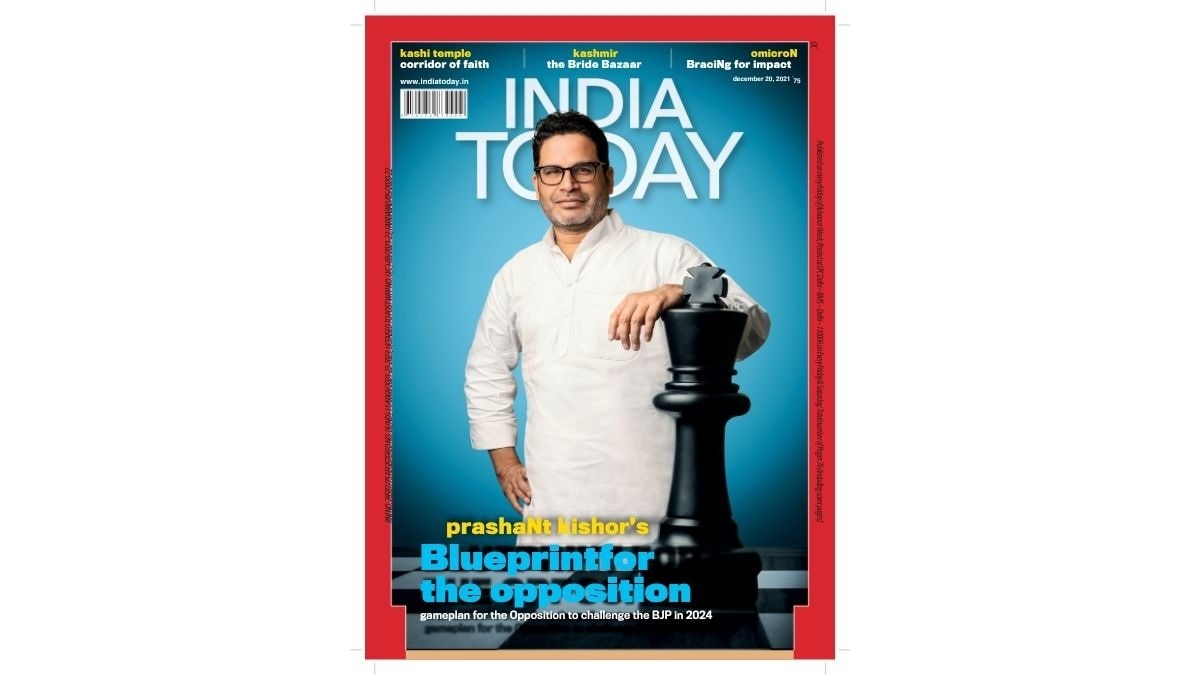
(NOTE: This article was originally published in the India Today issue dated December 20, 2021) For an accidental political strategist, Prashant Kishor has an impressive
(NOTE: This article was originally published in the India Today issue dated December 20, 2021) For an accidental political strategist, Prashant Kishor has an impressive track record. He has advised leaders across the political spectrum, from Narendra Modi to Mamata Banerjee, Nitish Kumar, Rahul Gandhi, M.K. Stalin, Jagan Mohan Reddy, Arvind Kejriwal and Captain Amarinder Singh. Of the nine election campaigns that he has helped strategise, eight resulted in victory. Read Full Story The latest being the May 2021 assembly election in West Bengal where Mamata Banerjee won a landslide to be re-elected chief minister for a third stint despite the BJP throwing everything it had in the game. As well as M.K. Stalin’s win in Tamil Nadu. The only campaign Kishor lost was an effort to get the Congress to win the 2017 Uttar Pradesh assembly election. The 44-year-old former UN public health specialist stumbled into the hazardous profession of poll advocacy when he met Narendra Modi in 2010 while the latter was the chief minister of Gujarat. What began as advice to the forward-looking chief minister on health issues turned into campaigns for nutrition for the Gujarat government to writing Modi’s speeches. “One thing led to another,” says Kishor, “and I got involved in his political campaign.” He helped Modi in his highly successful re-election campaign in 2012 and then got formally involved in his 2014 campaign to become prime minister. Kishor formed the Citizens for Accountable Governance (CAG), a poll advisory group that at the peak of Modi’s prime ministerial campaign had 1,200 employees working for it across 13 states. Kishor was credited for coming up with Modi’s memorable Chai Pe Charcha campaign. After the victory, Kishor parted ways with Modi and the BJP over differences on the role he was to play. The CAG then morphed into I-PAC or Indian Political Action Committee, a cross-party political advocacy group, that saw Kishor emerge as the country’s premier political advisor. Asserting that he is no longer formally involved with the I-PAC, Kishor says he is busy these days helping build a political formation that can effectively challenge the BJP in the 2024 general election. In an exclusive interview with INDIA TODAY, Kishor spoke for over two hours, laying out the gameplan to mount a credible challenge to the BJP in 2024. Excerpts Q. In a recent tweet, you said “the idea and space the Congress represents is vital to a strong Opposition. But Congress leadership is not the divine right of an individual, especially when the party has lost more than 90 per cent of the elections in the last 10 years. Let the Opposition leadership be declared democratically”. Clearly, you are attacking the Congress leadership and not the party. What prompted you to do so? A. The idea is not to attack anyone. The whole debate recently is whether an effective Opposition means one with or without the Congress. In my tweet, I am very clear that the idea and space the Congress represents is vital for an effective Opposition in this country. But the Congress party, the idea, or the space it represents, is not the same as the Congress in its present formation. Under the present leadership, the Congress has not done very well. In the past 10 years, in the more than 50 elections, both state and general, it has lost almost 90 per cent, except the 2012 Karnataka state polls, the 2017 election in Punjab and the 2018 elections in Chhattisgarh, Madhya Pradesh and Rajasthan. It tells us that there is something fundamentally wrong with the way the Congress has organised itself in the present context, the way it approaches elections, the way it engages with people. I am not suggesting who the leader of the formation should be. The Congress party alone is not the full Opposition, you have other parties as well. So, let them decide together who should lead rather than someone just saying that xyz should be the president. What is wrong with my tweet? Q. Given the fact that the Congress-led UPA (United Progressive Alliance) ruled the Centre from 2004 to 2014, the party could argue that the losses were just an anti-incumbency blowback. Rahul Gandhi can say, look, we won four states in the midst of the Modi wave, a sign that the Congress is recovering. So why attack the leadership? A. The Congress’s decline is a not a recent phenomenon. The last time it won this country was in 1984 (when it won 404 seats). After 1984, the party has not won a single general election. Yes, it has ruled in the interim for 15 years, once as a minority government and twice as a coalition government, but, as a party, it hasn’t necessarily won the country. For example, in the 1989 general election, it lost power, winning only 198 seats. But, in 2004, it won only 145 seats and formed a coalition government. So, as a political party, its decline is secular. Q. Except in 2009 when the party won 206 seats. A. Yes, but again, it didn’t have a majority on its own. A better gauge is its performance in assembly constituencies. The Congress, at its peak, used to be No.1 or a close No.2 in about 3,500 assembly constituencies (there are 4,121 currently). Today, that number is down to 1,500-1,600. Their graph has been on the decline, especially after 1984. My point is: the decline in the Congress is not a temporary phenomenon. It is not linked to any individual or episode; it is far deeper. It is structural and any Congress revival plan must take these factors into account, or they won’t get results. Q. Many in the Congress assert that since you were supposed to advise the party on strategy and it didn’t work out, you’re vengefully attacking them. A. No one can invite themselves to the house of the Gandhis or the leadership of the Congress and say, okay, please hear my strategy. They asked me and I gave them what I thought was the right approach. They are within their rights to accept what I put on the table or reject it. I am within my rights to do what is right. I have been in talks with the Congress leadership for the past two years but, post the Bengal election, it was a much more structured, intensive engagement. I almost joined the party. But for a few issues where we realised that coming together would be counterproductive for both sides rather than be of help, we parted amicably. So, there was no acrimony at all. Q. What does the Congress need to do? A. The Congress needs to change the way it is structured as a party, the way it functions and the way it takes decisions. I will give you one example: a political party of the size, scale and legacy of the Congress is functioning with an interim president or a stopgap arrangement for the past three years. Is this a smart move? You do not need a Prashant Kishor or, for that matter, anyone to advise. Whoever you choose should be a full-time president. Q. What else? A. Apart from the leadership issue, it needs to have faster decision-making, empower local leaders, and not centralise all the decision-making and keep it in the hands of a few individuals in Delhi. India is too big and too vast to have all the knowledge and expertise centralised in the hands of a few individuals. If you look at the glory days of the Congress, it was not necessarily run by a set of general secretaries who sat in Delhi. The party was strong because it had very strong regional leaders. I am not saying it does not have strong leaders now, but given the way the Congress works currently, the real power is centralised in the hands of general secretaries and what people call the party high command. That is the biggest stumbling block to any real revival of the Congress from the grassroots. Q. West Bengal chief minister and Trinamool Congress (TMC) leader Mamata Banerjee recently declared that the UPA is dead, and even attacked the Congress leadership, particularly Rahul Gandhi, saying leaders cannot spend so much time abroad. A. Only she can explain what she meant, but it is logical because the UPA was brought into existence in 2004 to form and run the central government. It was not an arrangement to have a political coalition in a situation when you are not in government. Even if you assume that it was for both, it is time to relook at its formation, its functioning, because its components have changed; many who were a part of the UPA have gone out, many who were not a part of UPA have come in, the dynamics have changed. So, you cannot have a UPA as it was in 2004 and keep on saying that the same formation exists, with the same proponents and the same working mechanics. There is a need to relook at the UPA and its formation. Q. You have also said that no one has a divine right to the Congress leadership. Clearly, you were referring to its dynastic predilections. A. No, it is not directed towards any individual.
 The BriefWire