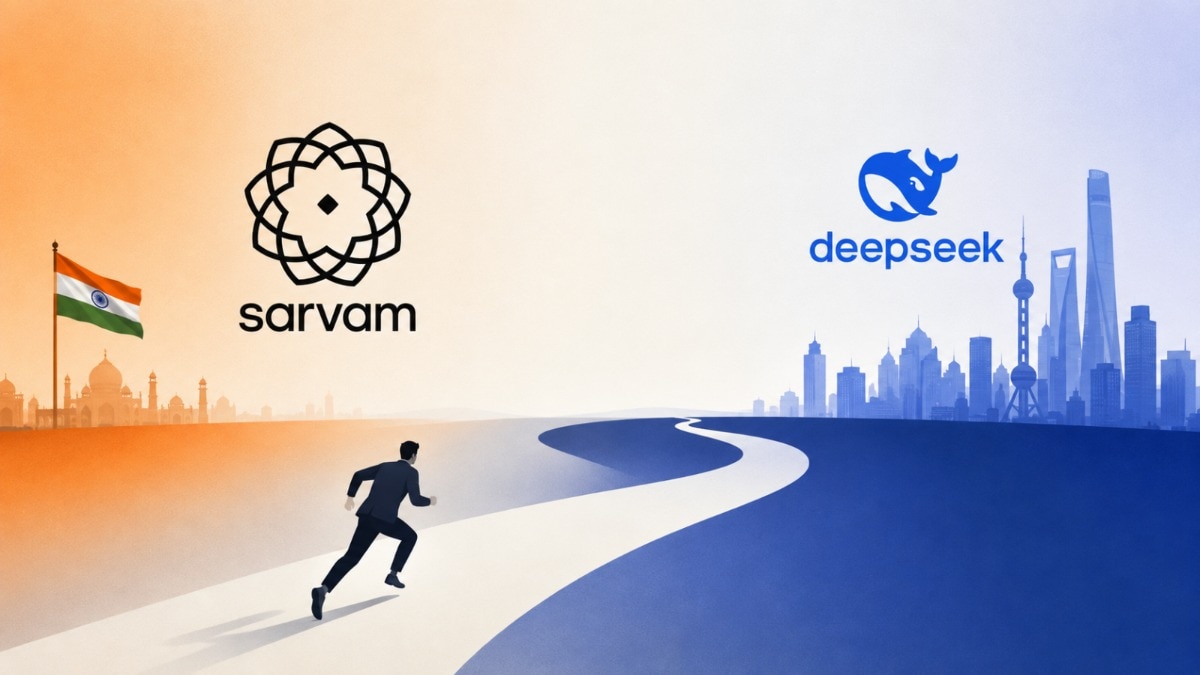
How Sarvam is helping India seek its DeepSeek moment and what it needs to do next to get there
At Epoch 2026, Sarvam co-founder Pratyush Kumar made a big announcement. He claimed that the AI startup was building a foundational AI model with over
At Epoch 2026, Sarvam co-founder Pratyush Kumar made a big announcement. He claimed that the AI startup was building a foundational AI model with over a “trillion-plus” parameters in India from scratch. Parameters refer to the dataset used to train AI. The more the parameters the stronger the AI can perform. If Sarvam manages to have its own trillion-plus parameter model, it could bring the Indian startup closer to leading AI labs like Anthropic and OpenAI. But to understand how Sarvam has reached this stage, we must first understand what the startup has done so far. Read Full Story What Sarvam has done so far You see, Sarvam wants India to have sovereign AI models that are designed for local use cases. For this, there are models like Saaras V4 that can detect speech clearly, not just in Indian languages, but in English too. Saras V4 comes with a multi-speaker mode that Sarvam says is the “best-in-class speech recognition model that accurately captures overlapping conversations and multi-speaker interactions.” That is, even in English, it is billed as the best model out there when it comes to speech recognition. Then there’s Vision 2.0. It is designed for digitising documents, and in particular Indian documents. Already, over 35 million documents have been digitised with Vision 1, and now the Odisha government is also using the model. You also have the flagship Sarvam 105B AI model that now works with AI agents. According to benchmarks shared by Sarvam, this model is better at certain tasks, such as voice call capabilities and instruction following when compared to OpenAI’s GPT-5.4 Mini and Google’s Gemini 3.5 Flash. Why Sarvam’s work matters for India Clearly, Sarvam is doing a lot of work when it comes to AI. And this becomes particularly important today when there is growing debate around AI sovereignty. Ever since the US temporarily banned Anthropic’s Mythos 5 and Fable 5 models for all foreigners, there have been growing concerns among companies that were using foreign-made AI models. "Given the growing geopolitical, supply chain and national security risks, the case for sovereign AI models is becoming increasingly compelling,” Deloitte India Partner Vijay Gopalakrishnan tells India Today Tech.
“The risks are real.” Till now, Indians really had to use AI models from US companies like OpenAI and Anthropic, or go for Chinese alternatives like Kimi K3 and DeepSeek V4. Some AI pioneers like OpenAI’s Sam Altman even declared that building AI was not for Indian companies. “You (Indians) can try to build AI like ChatGPT, but you will fail,” he said in 2023 though he later clarified his comment was taken out of context. But Sarvam’s work shows that India too can join the big leagues of AI. “Sarvam’s progress means infrastructure (in India) exists. Models can be built, Compute is available,” cybersecurity firm eScan’s CEO Govind Rammurthy tells India Today Tech. Shivam Rajput, CEO of tech startup ElectraWireless adds, “Companies like Sarvam are helping strengthen India's AI capabilities, and a diverse ecosystem of specialised AI companies will ultimately benefit the country's innovation landscape.” But there is a catch But just making a model is not enough, suggests Gurleen Khurana, the co-founder of AI consulting firm SimplifyGenAI. Rather, the Sarvam models will have to be the ones people actually use. “Sovereign AI shouldn't quietly become second-best AI. The actual test is whether Indian companies choose these models on merit, when nobody's watching. That's the bar,” he tells India Today Tech. As we mentioned earlier, Sarvam is seeing user adoption when it comes to its Vision model for documents. The Indus by Sarvam app on the Google Play store has over 1,00,000 downloads. While we don’t have Sarvam’s userbase numbers, it is likely that they still pale in comparison to AI behemoths like OpenAI or Google. And the reason for this may be that tools like Claude Code or OpenAI’s ChatGPT Work simply do some things better. “If you're building Indian language applications, Sarvam becomes relevant, which I believe is their strength. Most techies in India work in English-first environments,” Govind Rammurthy explains. “The market Sarvam is targeting doesn't yet overlap with people choosing tools. That gap takes years to close." Gurleen Khurana insisted that there was no real reason for you to switch to a Sarvam model unless you really wanted something specific. “Sarvam doesn't have anything close to frontier today, and pretending otherwise helps nobody.
 The BriefWire