‘Heavens Won’t Fall If 6 Stanzas Are Sung’: Calcutta HC On Mandatory Vande Mataram Rendition In Madrasas
News india ‘Heavens Won’t Fall If 6 Stanzas Are Sung’: Calcutta HC On Mandatory Vande Mataram Rendition In Madrasas ‘Heavens Won’t Fall If 6 Stanzas
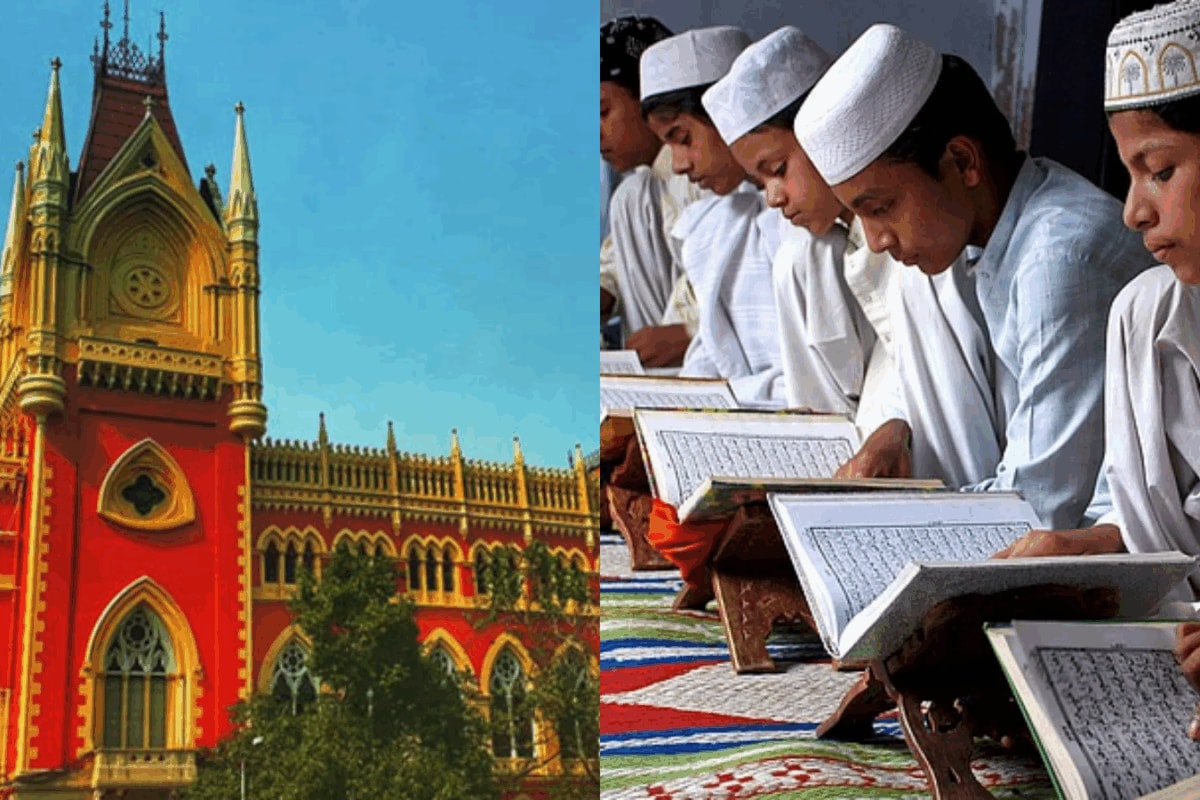
News india ‘Heavens Won’t Fall If 6 Stanzas Are Sung’: Calcutta HC On Mandatory Vande Mataram Rendition In Madrasas ‘Heavens Won’t Fall If 6 Stanzas Are Sung’: Calcutta HC On Mandatory Vande Mataram Rendition In Madrasas Published By, Last Updated: August 05, 2026, 12:00 IST The High Court also drew a comparison with practices followed in educational institutions run by other religious communities. The Calcutta high court heard a public interest litigation challenging mandatory Vande Mataram stanzas. The Calcutta High Court has observed that “heavens will not fall" if all six stanzas of Vande Mataram are sung in madrasas, while hearing a Public Interest Litigation (PIL) challenging a government notification making the complete national song mandatory in such institutions. A Bench comprising Acting Chief Justice Tapabrata Chakraborty and Justice Partha Sarathi Sen made the observation while hearing the petition which argued that singing of Vande Mataram could not be imposed on children studying in Madrasas, LiveLaw reported. Addressing concerns over students being asked to sing verses that may not be part of their religion, the Acting Chief Justice said, “Heavens will not fall…today if I am asked to utter a quote that is not in my religion…what will happen?
I will become a person not belonging to that religion?" The High Court further drew a comparison with practices followed in educational institutions run by other religious communities. “There have been thousands of Christian schools where all students are asked to pray to the Lord. Then, do students belonging to a particular community ask why they are being asked to sing certain things which are in the Christian religion?" the Bench observed. It further said that being asked to recite a religious quote outside one’s faith would not necessarily mean that a person would cease to belong to that religion. Appearing for the petitioners, Bhattacharyya argued that while Vande Mataram has been adopted as the national song, its rendition could not be imposed on students in madrasas. “If somebody wants to sing on their own, I have no difficulty. But it cannot be forced," he submitted, arguing that compulsory singing could affect communal harmony. He also submitted that the national anthem stood on a higher constitutional pedestal than the national song.
The Bench questioned whether any punitive action had actually been taken against those who had not complied with the notification. “Has anybody suffered yet?" the Acting Chief Justice asked. The petitioners’ counsel responded that the authorities had not yet enforced any punitive action against those refusing to sing the song. The High Court also raised questions over the jurisdictional aspect of the notification and asked whether the authorities had taken any coercive steps to implement it. Senior advocate Kalyan Bandopadhyay, appearing in another PIL, pointed out that the issue had been debated extensively in Parliament in 2025 but no resolution could be reached. “It was a very contentious issue. Ultimately the Parliament could not take any resolution. When no resolution could be passed in Parliament, this is how they are trying to enforce it," Bandopadhyay submitted. Additional Solicitor General Dhiraj Kumar Trivedi, appearing for the State, opposed the plea for an interim stay and requested time to obtain instructions and file a report before the court.
 The BriefWire