Fifth pellet gun victim says he knows of a sixth protester who was shot in Delhi
Prashant Kumar Singh, a painter trained in pastel, watercolour, oil and visual arts, started documenting the Gen Z protest at New Delhi's Jantar Mantar visually
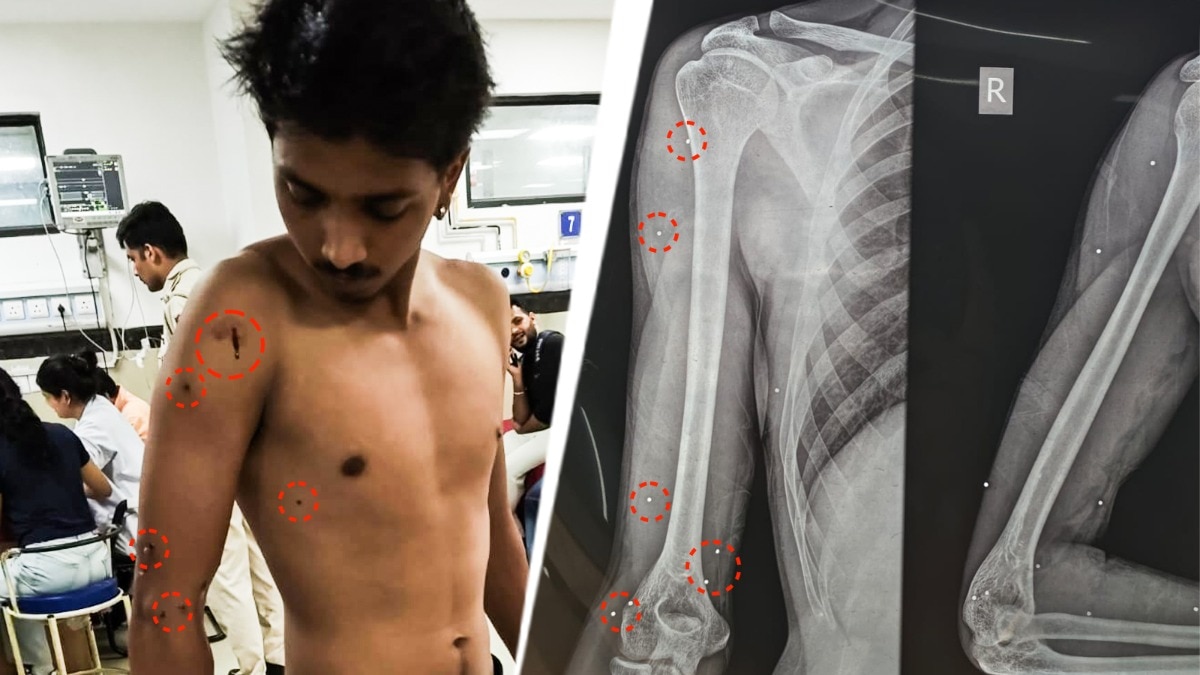
Prashant Kumar Singh, a painter trained in pastel, watercolour, oil and visual arts, started documenting the Gen Z protest at New Delhi's Jantar Mantar visually, through his art, from day one. He was also among the protesters who, on July 20, marched towards Parliament. A painter who has spent years using his right hand to create strokes on canvas, now lives with metallic pellets lodged in it after he was hit when the Rapid Action Force (RAF) opened fire at the protesters. Read Full Story Until now, there were five documented people who sustained pellet injuries during the New Delhi protests. But Prashant says there was at least one more. He told India Today Digital that another injured protester arrived at Lady Hardinge Hospital around the same time he did — around 4.30 pm on July 20 — suggesting the number of those hit may be higher than previously documented. Prashant has seen the images of the four other documented pellet victims, and says the sixth person isn't the one whose name has surfaced in media. Today, Prashant can feel the pellets when he presses against the flesh of his right arm and chest. Doctors have told him that removing the remaining ones would require cutting tendons and muscle. The risk, they said, is lasting damage. "If they operate, many muscles will be damaged and that will affect me in future," he told India Today Digital. Some of the pellets extracted on the day of the firing were discarded as medical waste. He never saw them. But the rest remain with him, possibly for life. India Today Digital has accessed his medico-legal certificate from Lady Hardinge Medical College and Hospital, which records "pellet" injury. His THE MARCH TO PARLIAMENT THAT CHANGED PRASHANT'S LIFE Prashant was not a first-time protester. An artist based in Delhi's Mayur Vihar, originally from Bihar, he had been following the agitation from its first day.
He went to the site on alternate days, sketching the unfolding moments. "I was documenting through my sketches that a particular moment is happening," he said. His toolkit — pastels, watercolours, paper — stayed with him even on July 20, the day of the Chalo Sansad March. That afternoon he was near the last barricade, roughly 50 metres from Parliament. Chandrashekhar Azad of the Azad Samaj Party had just finished addressing the crowd and said he would return in 15-20 minutes. Prashant was at the front. The atmosphere, he insisted, was not violent. People were standing, listening. Then the Rapid Action Force (RAF) and Delhi Police began pushing the crowd back towards Connaught Place, into the inner circle near Mahatma Gandhi Road. Tear-gas shells, which he described as "bomb shells", came first. Prashant referred to them as such as they sounded like bombs. Then, lathi charges followed. "They were really brutal," he said. "Within a few minutes, the force opened fire with shotguns on the crowd," he said. No clear warning that live pellets would be used, he claimed. "In the beginning, they were warning us that do not come closer. They didn't want us to cross the barricade. The crowd wasn't going to cross," he said. Then came the shotgun burst, hitting him, and one more person near him. The warning, in his account, never explicitly signalled metal pellets. Prashant fell. Pellets struck his right arm and chest. Around him, others went down too because of tear gas, and possibly, shotgun wounds. One man, whose name Prashant never learned, was hit at the same time. The two reached Lady Hardinge Hospital together, he told India Today Digital. Media reports have spoken of five pellet victims, including Prashant. Prashant believes there is a sixth, who isn't among the victims documented by the media. Of the known pellet gun victims, one is a woman and four are men.
 The BriefWire