Ancient Roman women left more than 120 inscriptions inside a hidden cave in Spain dedicated to a mysterious goddess
Image: Universities of Alicante and Zaragoza Why the 120 newly discovered Roman inscriptions make Cova Dones unique in the Roman Empire How archaeologists discovered that
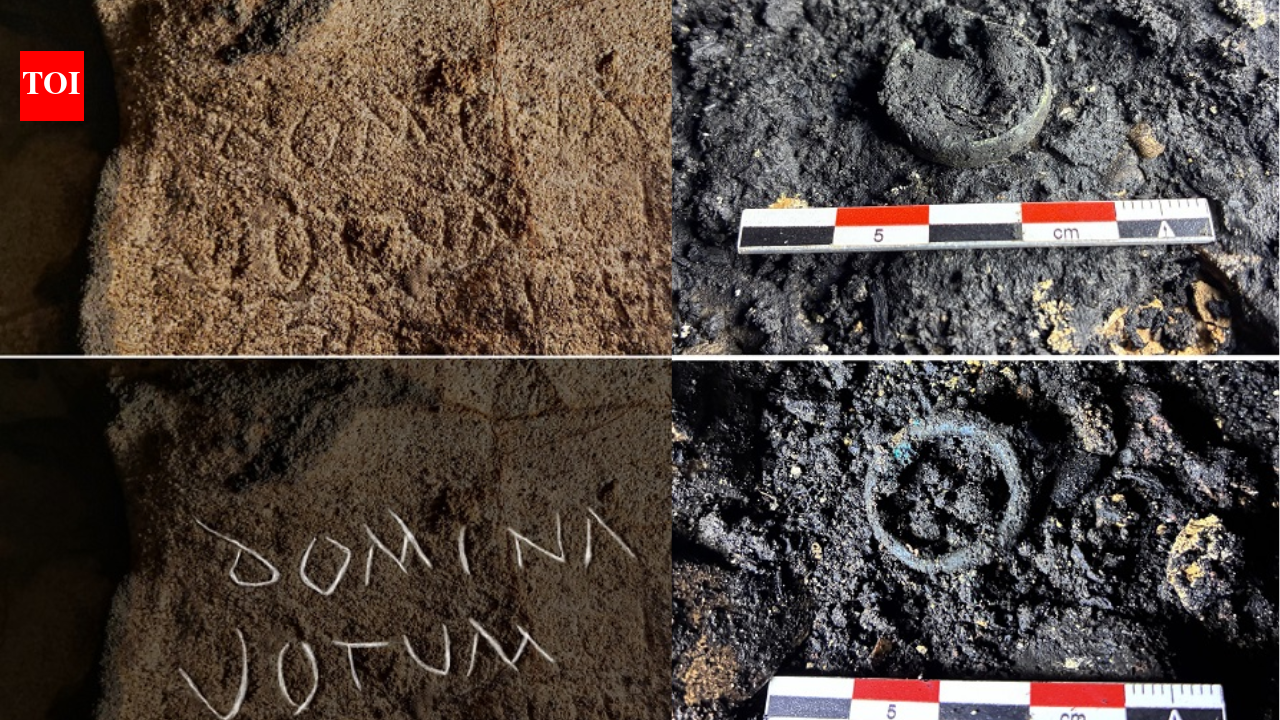
Image: Universities of Alicante and Zaragoza Why the 120 newly discovered Roman inscriptions make Cova Dones unique in the Roman Empire How archaeologists discovered that women were at the centre of rituals inside Cova Dones Who was the mysterious goddess 'Domina' and why the name 'MALACI' has puzzled archaeologists Why spindle whorls, jewellery and natural pools played an important role in Roman cave rituals How a cave famous for Ice Age art became a sacred Roman sanctuary thousands of years later Why the discoveries inside Cova Dones are changing what historians know about Roman religion Deep inside a cave in eastern Spain, archaeologists have uncovered one of the largest collections of Roman cave inscriptions ever found. Hidden more than 200 metres from the entrance of Cova Dones near Millares, Valencia, the inscriptions reveal that the underground chamber was not simply a place of worship; it was a sanctuary where women played a central role in rituals dedicated to a mysterious goddess whose name has been lost for nearly two millennia.During excavations in May and June 2026, researchers documented at least 120 Latin inscriptions, a dramatic increase from the roughly 15 previously known. The discovery has transformed Cova Dones into what may be the Roman cave sanctuary with the highest number of Latin inscriptions in Hispania, and possibly across the entire Roman Empire. The findings were led by Virginia Barciela of the University of Alicante and Aitor Ruiz-Redondo of the University of Zaragoza, and were first reported by La Brújula Verde, based on the universities' announcement.Until this year's archaeological campaign, only around 15 Latin inscriptions had been identified inside Cova Dones.The latest fieldwork increased that number to at least 120, making the cave one of the richest repositories of Roman cave inscriptions ever discovered.
Most of the graffiti have been dated to the first and second centuries A.D., when the Roman Empire controlled the Iberian Peninsula.According to the research team, the sheer number of inscriptions could make Cova Dones the cave sanctuary with the greatest concentration of Latin inscriptions known anywhere in Hispania and possibly throughout the Roman world.The inscriptions were carved across the walls and ceiling of a secluded chamber located deep inside the cave, indicating that the site remained an important place of worship over multiple generations.Perhaps the most remarkable aspect of the discovery is what the inscriptions reveal about the people who visited the cave.Many of the newly documented texts contain female names, leading researchers to conclude that women were frequent visitors and active participants in the sanctuary's ritual life. Rather than serving merely as spectators, they appear to have played a leading role in ceremonies conducted within the underground chamber.Epigraphic specialists Silvia Alfayé of the University of Zaragoza and Sergio García-Dils of UNED-Seville analysed the inscriptions and found compelling evidence that women dedicated prayers, left offerings and invoked a female deity inside the cave.This makes Cova Dones one of the clearest archaeological examples of women occupying a central role in Roman religious practices within a natural cave sanctuary.Five of the newly deciphered inscriptions invoke a goddess using the title "Domina", meaning "the Lady."Even more intriguing, three of these inscriptions also contain the word "MALACI." Researchers believe this is not a personal name left by a worshipper but rather an unknown epithet, or possibly the name, of the goddess herself.According to Silvia Alfayé, the title appears to refer to a previously undocumented goddess, whose specific role is still being investigated.
 The BriefWire