Why was Singapore flight turbulence severe? | Explained
The story so far: On May 20-21, a Singapore Airlines flight, SQ321, with 211 passengers and 18 crew, from London’s Heathrow Airport to Singapore encountered
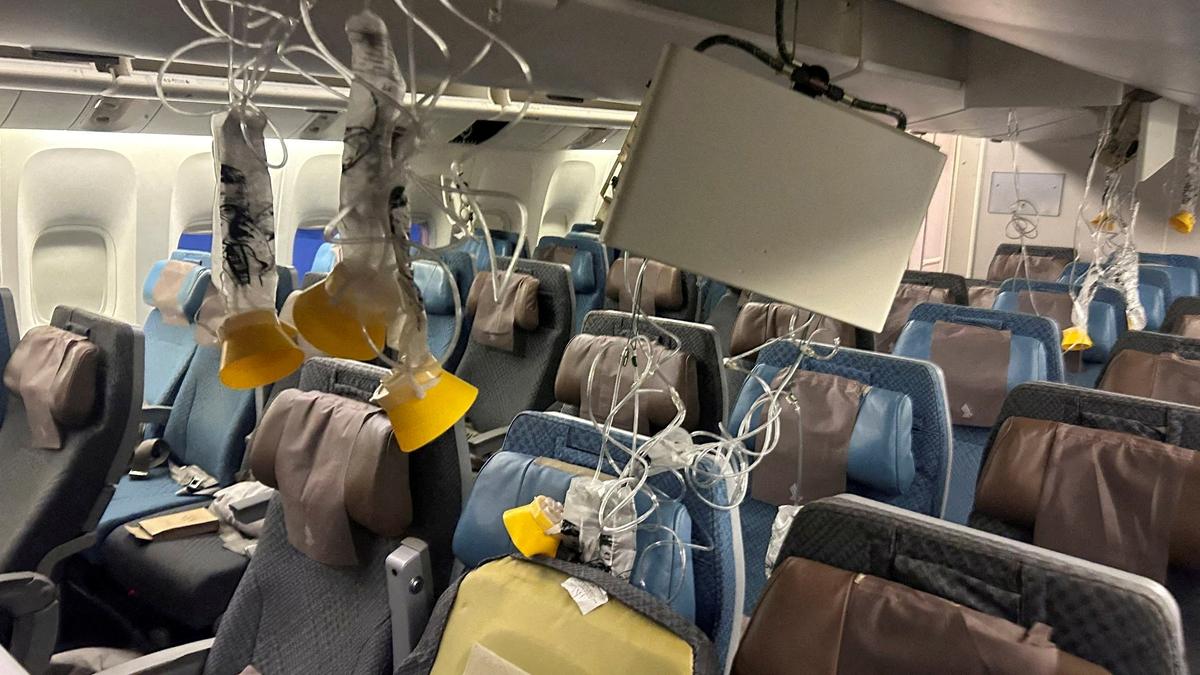
The story so far: On May 20-21, a Singapore Airlines flight, SQ321, with 211 passengers and 18 crew, from London’s Heathrow Airport to Singapore encountered severe turbulence while over the Andaman Sea/Bay of Bengal near the Irrawaddy Basin, Myanmar. A passenger passed away and several others suffered injuries of varying degrees. The crew decided to divert the Boeing 777-312ER to Bangkok, Thailand. The United States Transportation Safety Board (NTSB) is to assist Singapore’s investigation — also because the aircraft is a Boeing jet. What do we know about the incident? Granular flight data shows the aircraft dropping rapidly before the crew began (“controlled”) descent from 37,000 feet to 31,000 feet. It also shows the aircraft had had an altitude deviation prior to this. Air India Phuket-Delhi flight encounters turbulence; few passengers, crew sustain minor injuries There has been much focus on ‘turbulence’. What have experts told The Hindu? Turbulence occurs “by the relative movement of disturbed air through which an aircraft is flying”. It could be thermal or mechanical and can happen “either within or when it is clear of cloud”. Its severity depends on the “rate at which the speed or the direction of airflow/or both changes”. According to Professor Guy Gratton, Associate Professor of Aviation and the Environment at Cranfield University, U.K., turbulence is basically what happens when there is friction between airflow or wind flowing in different directions. When it involves aviation, there are two main forms, which are Clear Air Turbulence (CAT), which happens around jet streams, and the other being inside or around cumulonimbus clouds. These clouds have very strong upwards air currents in the middle and downwards air current around the outside, he explains, which can result in quite serious turbulence.
The faster an aircraft is, the more severe the response to the turbulence. Richard Dale, Senior Lecturer in Aviation and Tourism at the University of West London, says turbulence consists of changes in the movement of air which the aircraft is moving through over a short distance. For example, there might be updrafts that are quickly followed by downdrafts, but also changes in the horizontal movement of the air. The movement of the air, to some degree, is random and unpredictable, although the location where turbulence will be encountered is more certain. These changes cause the lift produced by the aircraft wing to change for a short time, forcing the aircraft up or down, suddenly and unexpectedly. According to A.D. Ravishankar, former Director, Aviation Meteorology, India Meteorological Department, CAT is turbulence suffered by an aircraft above 18,000 feet. Paul Williams, Professor of Atmospheric Science, University of Reading, U.K., says that turbulence fatalities on commercial flights are, fortunately, very rare. Turbulence on flights can be caused by storms, mountains, and strong air currents called jet streams. In this last case, it is called clear air turbulence, and can be difficult to avoid because it does not show up on the weather radar in the flight deck. He adds that a detailed analysis of the meteorological circumstances and the type of turbulence that affected the Singapore Airlines flight will take some time. He also says that there is strong evidence that turbulence is increasing because of climate change. “We recently discovered that severe clear air turbulence in the North Atlantic has increased by 55% since 1979. Our latest future projections indicate a doubling or trebling of severe turbulence in the jet streams in the coming decades, if the climate continues to change as we expect.” Will passenger injuries lead to litigation?
 The BriefWire