Scientists in Iceland are turning carbon dioxide into stone by injecting it into volcanic rock, and it could redefine the fight against climate change
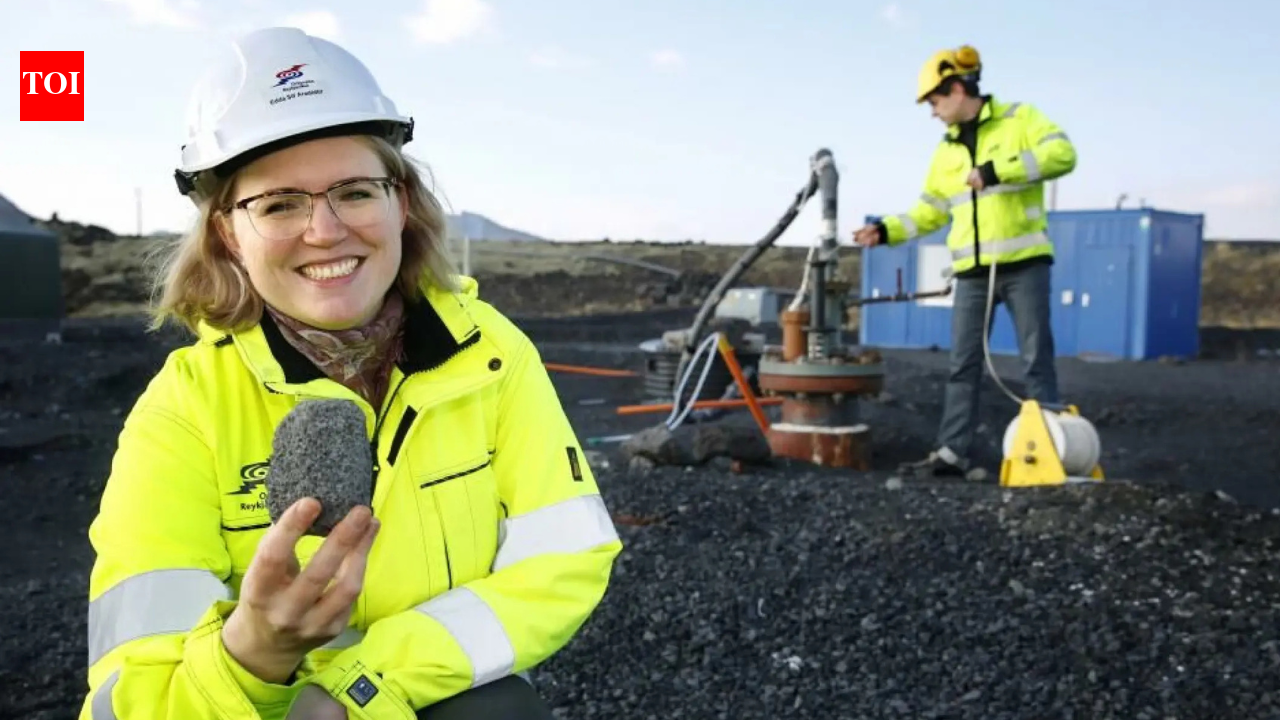
Edda Sif Pind Aradottir, a chemical and reservoir engineer and CEO of Carbfix, holds a sample of basalt rock at the Carbfix site in Iceland
Edda Sif Pind Aradottir, a chemical and reservoir engineer and CEO of Carbfix, holds a sample of basalt rock at the Carbfix site in Iceland. Inside Iceland's Carbfix project turning carbon dioxide into stone Illustration of the Carbfix process, which turns captured CO₂ into stone inside underground basalt. Why basalt plays a crucial role From greenhouse gas to solid rock in just two years A safer alternative to conventional carbon storage Scaling up the technology A new frontier in permanent carbon removal Scientists in Iceland are demonstrating a groundbreaking way to tackle climate change by permanently turning carbon dioxide (CO₂) into stone deep beneath the Earth's surface. Instead of storing captured CO₂ as compressed gas, researchers dissolve it in water before injecting it into porous basalt, a volcanic rock rich in minerals. Once underground, the dissolved carbon reacts naturally with calcium, magnesium and iron in the basalt to form stable carbonate minerals, effectively locking the carbon away for geological timescales. The process, developed through the Carbfix project, has already shown that more than 95% of injected CO₂ can mineralise within two years, offering one of the most secure and durable forms of carbon storage currently available.Carbfix is an Icelandic carbon mineralisation project launched in 2007 as a collaboration between Reykjavík Energy, the University of Iceland, CNRS in France and Columbia University in the United States.
The technology is based at the Hellisheiði Geothermal Power Plant near Reykjavík, where carbon dioxide captured from industrial emissions is dissolved in water and injected into underground basalt formations.What began as a research initiative has since grown into one of the world's leading demonstrations of permanent carbon storage through mineralisation.The process starts by capturing carbon dioxide before it enters the atmosphere. Instead of compressing the gas for underground storage, scientists dissolve it in water, producing carbonated water similar to sparkling water. This solution is then injected hundreds of metres below the surface into porous basalt rock. Because the carbonated water is denser than CO₂ gas, it naturally sinks through the rock rather than rising. As it moves through the basalt, it reacts with naturally occurring calcium, magnesium and iron to form solid carbonate minerals, permanently trapping the carbon inside the rock.Basalt is one of the most abundant volcanic rocks on Earth and contains large amounts of calcium, magnesium and iron, the essential ingredients needed for carbon mineralisation. These minerals readily react with dissolved carbon dioxide to create stable carbonate rocks such as calcite, magnesite and siderite. Basalt also contains tiny pores and fractures that allow carbonated water to circulate through the rock, speeding up the chemical reactions. Scientists estimate that basalt formations around the world have the potential to store thousands of gigatonnes of CO₂, making them an attractive long-term solution for carbon storage.Before the Carbfix project, many scientists believed that mineralising carbon dioxide underground would take hundreds or even thousands of years.
 The BriefWire