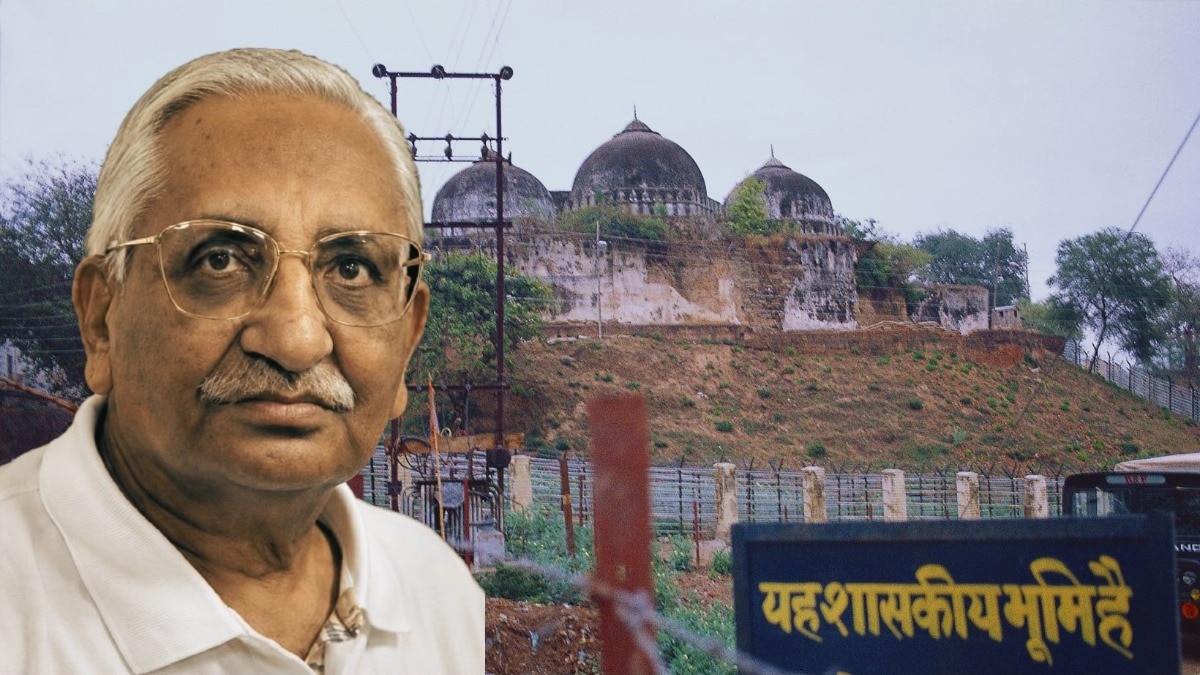
Justice Liberhan, whose inquiry found Babri demolition was pre-planned, dies
Justice Manmohan Singh Liberhan, the former Chief Justice of the Madras and Andhra Pradesh High Courts who headed the Liberhan Commission that investigated the 1992
Justice Manmohan Singh Liberhan, the former Chief Justice of the Madras and Andhra Pradesh High Courts who headed the Liberhan Commission that investigated the 1992 Babri Masjid demolition, died on Sunday at the age of 87, news agency PTI reported. According to PTI, Punjab and Haryana High Court Bar Association President Rohit Sud announced Justice Liberhan's death in Chandigarh on Sunday. His cremation was held on Monday. Read Full Story A veteran jurist, Justice Liberhan led the longest-running commission of inquiry into the demolition of the Babri Masjid by a crowd of kar sevaks on December 6, 1992. In its report, the Liberhan Commission described the demolition as a "meticulously planned" act and said BJP leader Uma Bharti had "categorically" taken responsibility for the incident. MS LIBERHAN: FROM CHANDIGARH TO AYODHYA MS Liberhan began his legal career at the Punjab and Haryana High Court in 1964 and was elected to the Punjab and Haryana Bar Council in 1970, later serving as its secretary from 1976 to 1983. He went on to serve as Additional Advocate General of Haryana before being appointed Advocate General of the state in August 1986.
In February 1987, he was elevated as a judge of the Punjab and Haryana High Court. Justice Liberhan was appointed Chief Justice of the Madras High Court in July 1997 and later became Chief Justice of the Andhra Pradesh High Court in February 1998, a position he held until his retirement in 2000. However, what truly cemented his place in the public consciousness was his appointment by the then Prime Minister PV Narasimha Rao-led government to investigate the 1992 demolition of the Babri Masjid in Uttar Pradesh's Ayodhya. JUSTICE LIBERHAN LED THE ONE-MAN LIBERHAN COMMISSION, CALLED BABRI DEMOLITION PRE-PLANNED Ten days after the demolition of the Babri Masjid on December 6, 1992, the P V Narasimha Rao government appointed Justice Liberhan, then serving as Judge of the Punjab and Haryana High Court, to head a one-man Commission of Inquiry into the demolition. The probe, which was initially supposed to last no more than three months, ended up stretching over 17 years, received 48 extensions, held at least 315 sittings, and examined around 100 witnesses. In its final report, submitted to then Prime Minister Manmohan Singh on June 30, 2009, the Liberhan Commission reconstructed the events of December 6, 1992.
It said more than 1.5 lakh kar sevaks had gathered in Ayodhya under the leadership of senior BJP leaders, including LK Advani and Murli Manohar Joshi. According to the report, as the day progressed, a mob of around 5,000 kar sevaks overwhelmed the police and security forces, scaled the Babri Masjid, and demolished the structure using hammers, pickaxes, shovels and crowbars. LIBERHAN COMMISSION BLAMED BJP LEADERS FOR BABRI DEMOLITION More importantly, the Liberhan Commission squarely laid the blame for the demolition on senior BJP leaders, including Uma Bharti, LK Advani, Murli Manohar Joshi, Atal Bihari Vajpayee and then Uttar Pradesh Chief Minister Kalyan Singh. The report described that the mobilisation of kar sevaks in Ayodhya was neither "spontaneous nor voluntary" but "orchestrated and planned." Although the Liberhan Commission recommended further investigation into those it indicted, the CBI later concluded that the report contained no fresh evidence warranting new charges, and no additional cases were registered on the basis of its findings. The criminal trial continued on the basis of the 1993 CBI charge sheet, which had already named leaders such as LK Advani, Murli Manohar Joshi, Uma Bharti, Sadhvi Ritambhara, Ashok Singhal and others on charges including criminal conspiracy and promoting enmity.
 The BriefWire