Fact check: Russian disinformation targets German elections
Ahead of four elections in Germany this fall, dozens of fake posts are circulating online aimed at discrediting candidates and portraying Germany as divided. Analysts
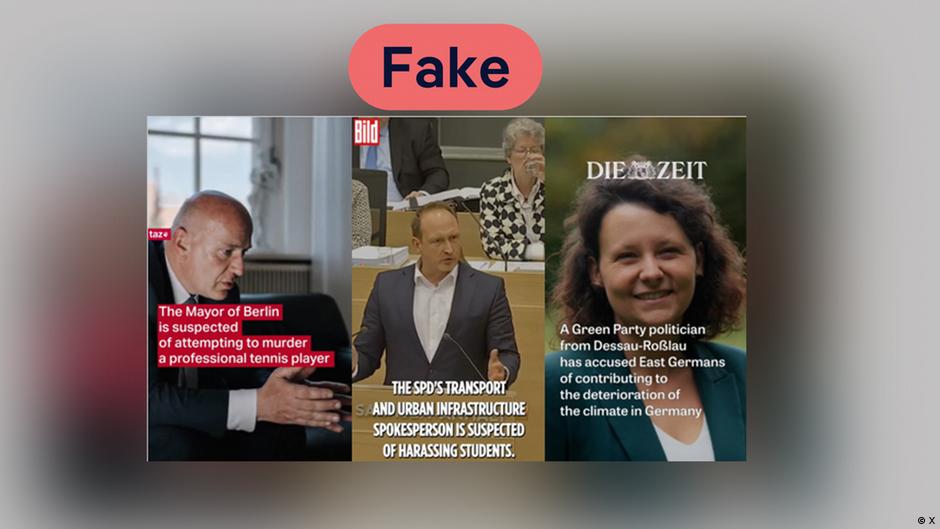
Ahead of four elections in Germany this fall, dozens of fake posts are circulating online aimed at discrediting candidates and portraying Germany as divided. Analysts warn that Russia is now targeting local candidates. Eric Stehr was unsure what to think when he first saw fake videos about himself. He describes his reaction as "mixed feelings," somewhere between amusement and concern, laughter, and helplessness. "I don't want something like that online," he told DW. "But at the same time, I know there's nothing I can do about it." A German student, Stehr is running for the state parliament in Saxony-Anhalt as a candidate for the socialist Left party. Being second on the party list, he has a good chance of winning a seat in the election on September 6. But social media posts about him have falsely claimed that The false reports have been cleverly designed so that they appear to come from major German media outlets, including the Frankfurter Allgemeine Zeitung, Stern TV, ARD and Spiegel TV. But the videos are as false as the allegations they make. Fake videos on X are making false allegations against Stehr, the Left Party candidate running in the Saxony-Anhalt state election Image: Screenshot: X.com A spokesperson for the police confirmed to DW that Stehr is not under investigation and has not been suspected of murder. Meanwhile, a Bauhaus University Weimar spokesperson confirmed to DW that there are no reports of alleged university sex parties or an alleged grading scandal. More than 180 fake posts ahead of elections According to DW Fact Check findings, the videos are part of the Russian influence operation known as Matryoshka, also referred to as Operation Overload. DW Fact Check has identified more than 180 fake posts on X, Bluesky and TikTok ahead of the upcoming elections. The data comes from a detailed archive maintained by the anonymous investigative collective Antibot4Navalny, which was originally founded to expose disinformation targeting late Russian opposition leader Alexei Navalny and now tracks Russian influence operations online. DW reviewed several fake posts published since June 24. Notably, the campaign operates only on weekdays, with disinformation activity dropping off on weekends. Many of the posts target candidates running in the upcoming German elections in Saxony-Anhalt, Mecklenburg-Western Pomerania, Lower Saxony and Berlin, all scheduled for September.
The votes are seen as an indicator of Germany's political mood and a test for the country's recently reshuffled federal government. Operation Matryoshka reaches new level Observers were not surprised to see Germany become a target of the campaign, but the scale of the operation has raised concerns. "This influence campaign has been active across multiple platforms since September 2023," said Julia Smirnova, researcher at the Berlin-based Center for Monitoring, Analysis and Strategy (CeMAS). "Its targets have included Germany's federal election, elections in Moldova and Armenia, and the Olympic Games in France." Operation Matryoshka, named after the traditional Russian nesting dolls, seeks to manipulate public opinion through fabricated media content Image: Sascha Steinach/IMAGO What is new, Smirnova said, is the focus on relatively obscure individual candidates in local elections. "It is unusual for Russian influence campaigns to target specific candidates in regional elections." According to her observations, candidates from all parties have been targeted, except for the far-right Alternative for Germany (AfD) and the left-wing populist Sahra Wagenknecht Alliance (BSW). "What we're seeing now ahead of the state elections is a continuation of Russia's long-term strategy: Supporting parties perceived as more Russia-friendly while discrediting other parties and candidates," said Smirnova. Pablo Maristany de las Casas, a specialist in foreign information manipulation and interference campaigns at the London-based Institute for Strategic Dialogue (ISD), sees similar patterns. Like Smirnova, he says the narratives mirror earlier Russian influence operations. The messages, he argues, are once again "pro-Russian, anti-German and anti-EU." Who is behind Operation Matryoshka? While no definitive link to the Russian state has yet been established, there is evidence that Russian-speakers are behind some of the posts, according to Maristany de las Casas. For example, a Spanish-language post on X was found to contain a revealing clue: The post, which targeted candidates Lydia Hüskens and Andreas Silbersack of the Free Democratic Party (FDP), abbreviated their party's name as "SvDP," which would the Russian version: Svobodnaya Demokraticheskaya Partiya. A revealing clue lies in the abbreviation: in this post, the Free Democratic Party is referred to by the Russian abbreviation "SvDP" Image: X The OSINT research group Gnida Project, which investigates Russian disinformation campaigns, has previously linked Matryoshka to Russian actors. According to its findings, the operation is technically and operationally connected to Storm-1516, a well-known unit reportedly controlled by Russia's military intelligence agency, the GRU, and which was also active in the lead-up to Germany's federal election in 2025.
 The BriefWire