6-7 and the First World War: How Internet absurdism became Dada's unlikely heir
Exploring Internet memes as a cultural off-shoot of Dadaism Alfred Stieglitz photograph of the Fountain, 1917 (Source: NGA) Understanding Dadaism Excerpt from The Onion September
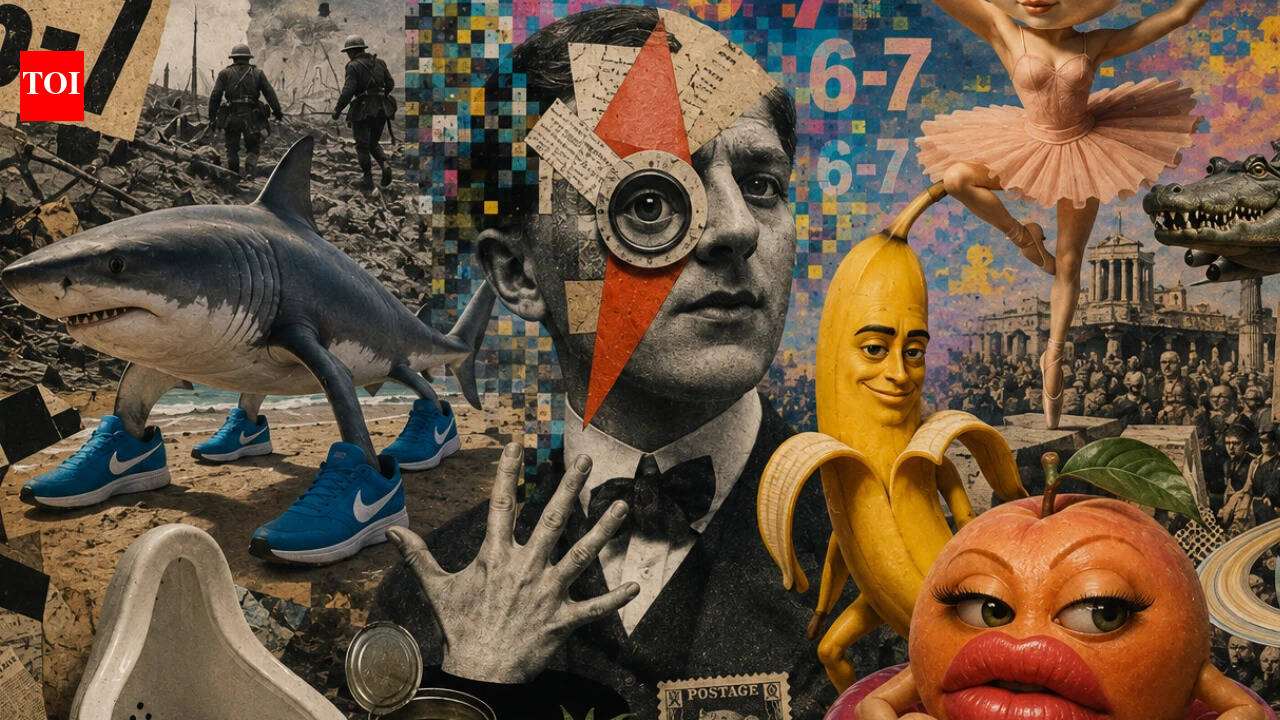
Exploring Internet memes as a cultural off-shoot of Dadaism Alfred Stieglitz photograph of the Fountain, 1917 (Source: NGA) Understanding Dadaism Excerpt from The Onion September 11th Issue (Source: theonion.com) Ways to make nonsense 1984 Does this even count? Tralalero Tralala (Source: Wikimedia Commons) During a time when boundaries had not been drawn onto maps, when man still looked like beast instead of only acting like one, our ancestors developed speech. Over millennia, language emerged, empires rose and fell over it, wars were fought over single words and whose god had the right one — all so that, in the 21st century, we could use this ancient tool to say '6-7'.Finding meaning in the memes that come out of the internet in this day and age is nothing short of the 13th Herculean task. What can you attribute to a shark that wears sneakers on the beach? Or a high society cup of cappuccino that can break into ballet?It is easy to dismiss this as childish, ‘Gen Z’, brainrot humour that doesn’t serve a purpose. But what if its very purpose is that it does not serve one? What if its lack of meaning is its entire meaning?Long before the internet was reigned by the likes of a grotesque talking toilet, there was Cabaret Voltaire.In 1916, in a small performance space in Zurich, a handful of artists and poets gathered nightly to read poems built from invented syllables, paste together newspaper scraps into collages, and generally refuse to make sense — on purpose.Dadaism was born within these walls. In a time ravaged by senseless wars and irrational slaughter, why was art supposed to make sense?Tristan Tzara's 1918 Dada Manifesto stated: Dada does not mean anything – and the refusal to mean was itself the argument.Marcel Duchamp signed a urinal and called it Fountain, relocating the definition of art from the object to the choice. Elsa von Freytag-Loringhoven wore tomato cans as earrings and postage stamps as makeup, treating absurdity as something to be lived rather than merely exhibited.Scholars who study the movement, have argued that Dada's chaos was never really chaotic — that beneath the nonsense sat a deliberate, coordinated set of tactics: abstraction, chance, contradiction, performance, all aimed at a specific target, namely the rational, bourgeois order that had just marched Europe into the trenches.Dada meant nothing, but it meant nothing at something.Dada wasn't a one-off movement born out of the First World War.
In it’s own unique way it has shaped dissent, emotion, rage and countless other emotions into meaningful nonsense.Whenever a society's confidence collapses faster than its ability to process the collapse, elements of Dadaism naturally grow out of our own need to cope.Post September 11th, American comedy went quiet – talk shows went dark, comedians unsure if irony had just become obscene. Then, on September 26th, The Onion returned from its own two-week silence with a special issue built entirely around the attacks, running headlines like "Hugging Up 76,000 Percent", "US Vows to Defeat Whoever It Is We're at War With" and "Hijackers Surprised To Find Selves In Hell". The last headline even featured one attacker who complained of being promised paradise and being fed honeyed cakes by 67 virgins, only to find himself in hell's lowest tier instead. The "end of the age of irony" lasted less than a month.We are witnessing the loss of meaning once again as the world around us keeps changing. We have built an information environment so saturated, so algorithmically accelerated, and increasingly so AI-generated, that no single rational narrative can keep up with it. Jean Baudrillard's old warning that media could become more "real" than reality itself reads less like theory now and more like a weather report.Dada responded to a irrational world by making meaningless art inside it. The internet is responding to a world where you can no longer even verify what's real by making content that doesn't ask you to."Vasteguna Huiya," a phrase with no dictionary meaning in any language, became a slogan to come out of the recent CJP protests. Protesters leaned into total nonsense partly because meaninglessness is hard to prosecute. It's a small, telling sign that the internet's nonsense-logic isn't sealed off in memes anymore; the same way Dada's absurdism eventually hardened into overt political photomontage in Berlin.Not all internet absurdism is built the same way.Some of it is fully authored, in the old Dada sense. But most internet absurdism has increasingly lost traceability to a single author.‘6-7’ itself started from a drill rap song used to make edits about a basketball player’s height. It then moved into a space of internet virality after a kid yelled the term at a basketball game, accompanying it with a hand gesture. For months, post-that, you would hear children and maybe even some adults say the phrase incessantly.Italian brainrot at its core started with a singular author who had an AI tool at his disposal.
 The BriefWire