Phone turns hot as lava in your hand? IIT Madras has a fix for the overheating
You have felt it. The phone left on the charger, picked up 20 minutes later, almost too hot to hold. Not warm but scalding, like
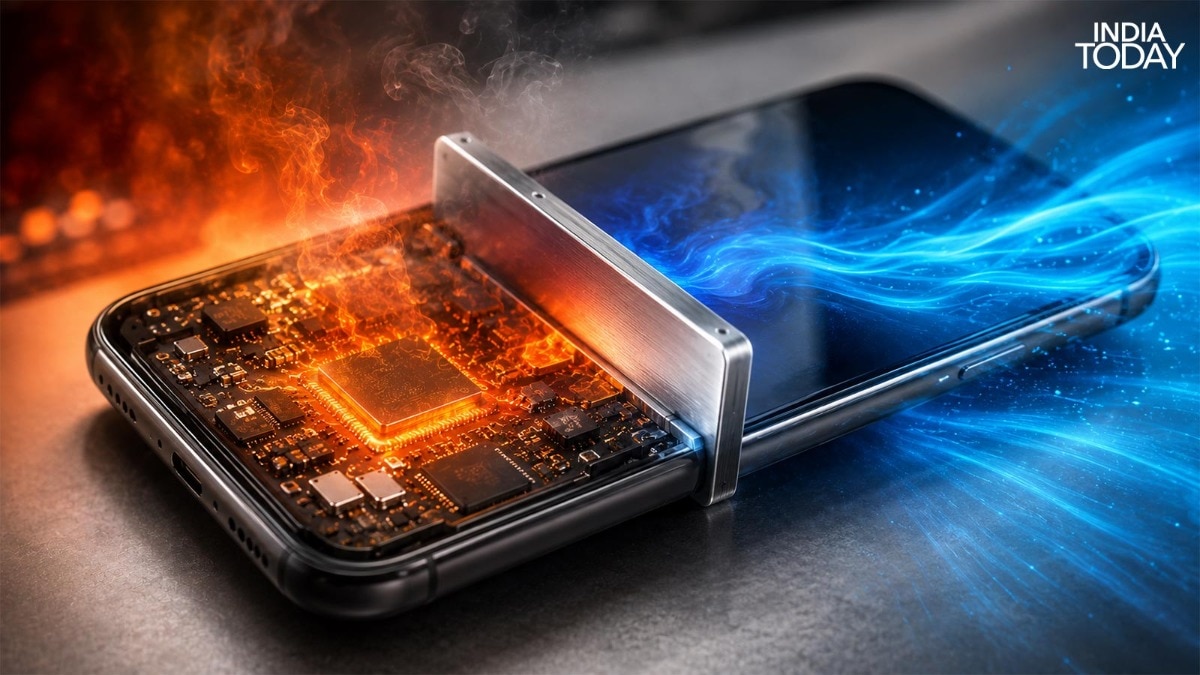
You have felt it. The phone left on the charger, picked up 20 minutes later, almost too hot to hold. Not warm but scalding, like something with a fever. You turn it over in your hand, faintly alarmed, and wonder whether it is about to die. And it is not only the charger, and not only games. Scroll for a while, message a friend, sit on a video call, and the phone still warms in your palm with nothing plugged in and nothing demanding about the task. Play a heavy game or shoot a long video and it grows hotter still. The charger only adds to it. The heat comes from somewhere deeper, and it is there whether the cable is in or not. Read Full Story Because heat wants only one thing: it wants out. Every warm object you have ever touched was heat in the act of leaving, and given the smallest crack, the thinnest thread of metal, the faintest difference in temperature, it will always find its way to the door. Except in one place. In the sliver of space beneath the screen you are reading this on, thinner than a coat of paint, heat has been quietly trapped. That fever in your palm is the sound of heat hammering to get out. And the story of how a team at the Indian Institute of Technology Madras finally set it free is stranger and more elegant than it has any right to be. THE FIRE WITH NO FLAME A processor smaller than a fingernail is running billions of calculations every second, and each one leaves behind a faint warmth. One is nothing. Billions, all at once, in a room with no windows, become an inferno with no flame. The chip begins to cook itself. On the charger, worst of all, the battery pours in its own heat alongside two fires in one sealed room. When it grows too hot, the microprocessor does the only thing left to it. It surrenders. It slows down. Engineers call this thermal throttling. You know it as the moment a game stutters and the phone turns sullen just as the action begins. The whole drama turns on a single question. How fast can the heat get out? For decades, the device that answers it has obeyed one silent rule: the heat went in and came out on the very same face of the plate. A processor sheds heat with every calculation, and in a sealed device with nowhere to vent, that warmth builds until the chip slows itself down to survive. (Photo: Gen AI/India Today) The IIT Madras team, led by Professor Arvind Pattamatta at the Heat Transfer and Thermal Power Laboratory, working with SSN College of Engineering and the DRDO's Instruments Research and Development Establishment in Dehradun, broke that rule. Their work appears in the journal Experimental Heat Transfer under a title that hides its daring completely: a novel antiparallel flat plate pulsating heat pipe. It reads like something you would skim past, and yet folded inside those flat words is a bold idea about where heat should be allowed to leave. THE ENGINE THAT ISN'T ONE To understand the new door, meet the old one, almost certainly living inside your laptop right now, working a miracle in silence. A heat pipe has no motor, no pump, no moving part at all. Take a flat plate of metal, carve into it a labyrinth of channels each slimmer than a grain of rice, seal it beneath a second plate, draw out all the air, and let in a few millilitres of liquid. Not just any liquid. The team used a blend of three parts ethanol to one part water, and the ratio is a quiet compromise. The ethanol, boiling easily and flowing loosely, coaxes the pulse to life; the water, holding far more heat per drop, does the heavy carrying once it is moving. “Long-term composition stability, corrosion and seal compatibility still need extended thermal-cycling tests,” Professor Pattamatta tells India Today Digital. Inside a heat pipe, a liquid boils at the hot end and condenses at the cold, pulsing back and forth through channels thinner than a grain of rice, with no pump or moving part. (Photo: Gen AI/India Today) Now, press one end of the sealed plate to a hot chip, and leave the other in cool air.
 The BriefWire