In the AI era, why flaw is not a failure
Garry Kasparov lost to IBM's Deep Blue, and our belief in human supremacy over machines took a big blow.The ancient game of chess, created in
Garry Kasparov lost to IBM's Deep Blue, and our belief in human supremacy over machines took a big blow.The ancient game of chess, created in India and perfected by other civilisations, was al-ways regarded as the highest theatre of pure human intelligence. But now it was conquered by a machine. Since then, the machine has only become more powerful.Today a decent chess engine on a mobile phone can defeat the strongest human grand master. Magnus Carlsen or R Praggnanandhaa is not better than Stock fish, and no human being ever will be.And yet, playing chess has become even more popular.An increasing number of people watch Carlsen and Pragga play They watch because the point of human chess is not only the perfect move, but the vulnerability of two hu mans like us who would hesitate, mis calculate, panic and improvise, get tired and then suddenly find a move that feels like magicIt is human drama, and machine-like perfection of two computers playing each other will leave them cold, the very antithesis of drama. This peculiar quest for imperfection may be come the defining truth of the Alage.Also read | After making inroads into healthcare, private equity players are targeting India's schoolsWe have spent the last few years asking whether Alcan write, draw.code and create as well as human beings. Increasingly, the answer seems to be yes, or at least close enough, for most practical purposes.Al can write a clean LinkedIn post, generate a hummable song, produce a perfectly structured memo, make a McKinsey-like slide and finish off by summarising all of it in a competent email.
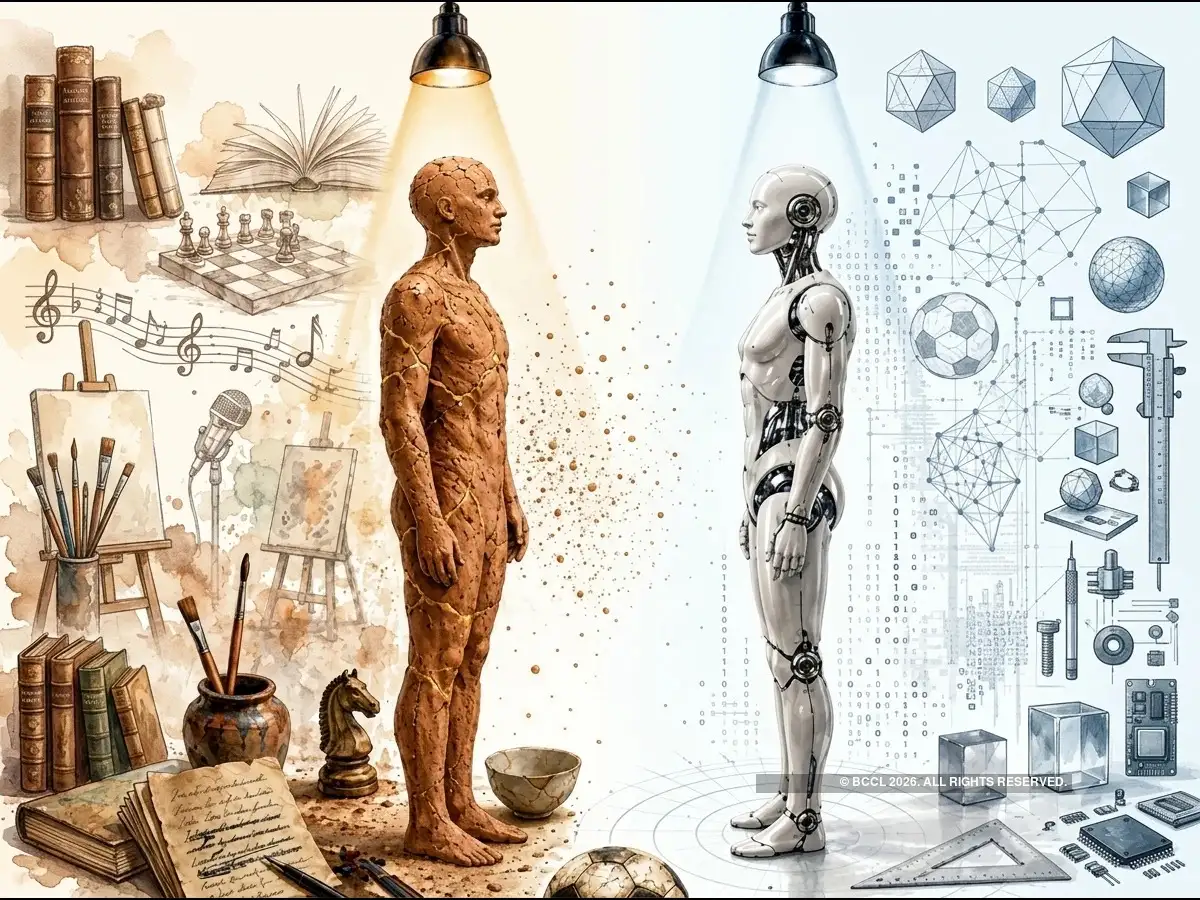
It is fluent, smooth, tireless, often near perfect; 10 out of 10, almost.The problem is that we may soon become sick of 10 out of 10.MARK OF THE HANDWe are already seeing this in the plague of AI slop on LinkedIn. You can spot it from a mile away: the smooth opening line, the neat three lessons, the inspirational paragraph, the carefully balanced humility, the "here is what it taught me" ending.It is grammatically correct and emotionally dead. In response, we have started hunting for posts that are messy, opinionated, oddly structured, perhaps even badly punctuated, but unmistakably written by someone who has lived that thought.The same is happening with books. Amazon is reportedly flooded with AI-generated titles, many polished but soulless. As a result, we increasingly look for books from known publishers rather than self-published ones as a signal of human authorship.In such a world, the value of a human book lies not just in how well it is written, but in how clearly it has been felt. When text becomes infinite, real authorship becomes scarce.This phenomenon is not new Human beings have always valued the mark of the hand.Also read | GLP-1 craze stirs up demand for a new type of talentA machine can make a perfect ceramic bowl, smooth, symmetrical and identical to the next thousand bowls. But we often pay more for the potter's bowl precisely because it is not perfect. The uneven lip, the thumbprint, the mi-nor dent, or the slight tilt in the body of the pot: these are not defects, but provenance, signal-ling that a human hand passed through here.The Japanese have a phrase for this: wabi sabi, the beauty of something that is impermanent, imperfect and incomplete, and thus its art of kintsugi, where a broken pot is mended back together with gold lacquer:In India, we have our own version of it.
 The BriefWire