PE players are targeting India's schools
If you woke up in 2026 after a decade in a coma, you would be surprised by the extent to which private equity players have
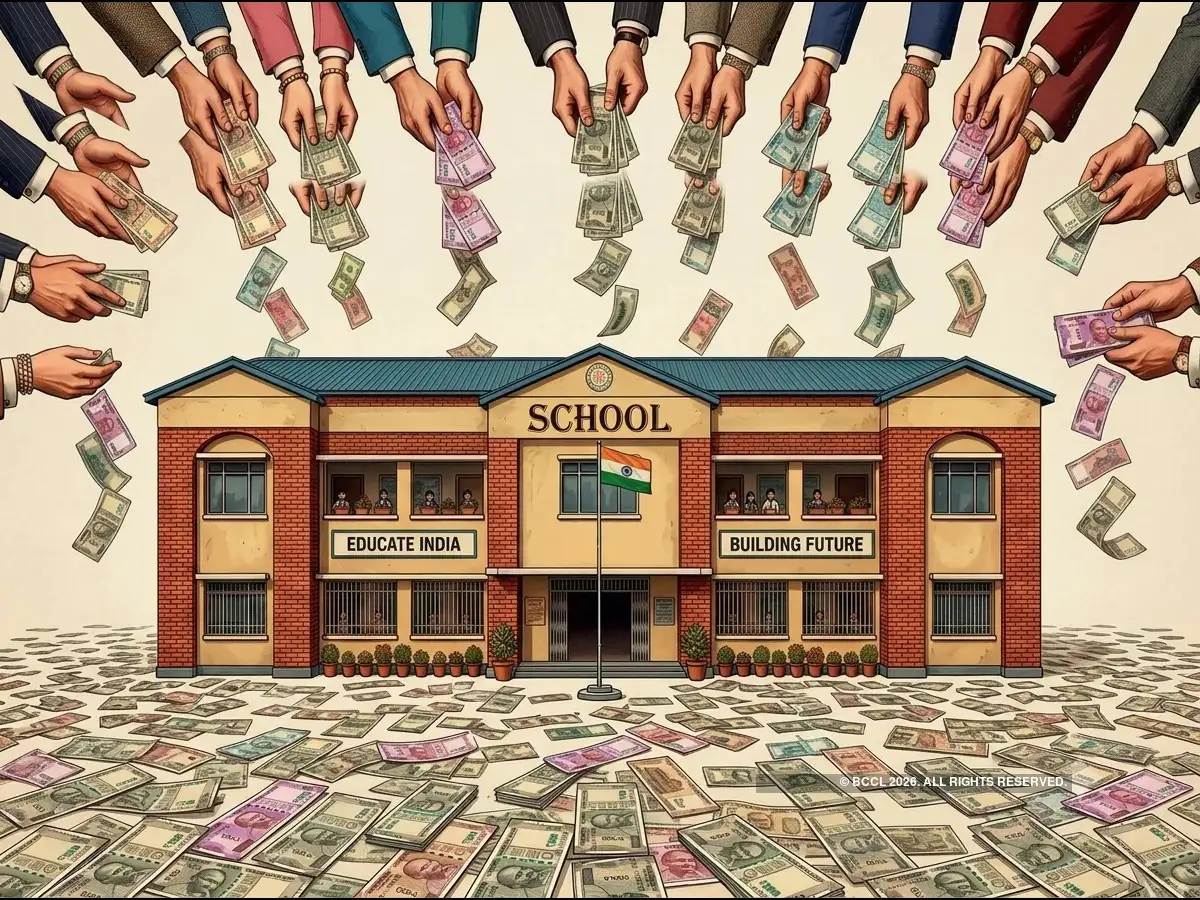
If you woke up in 2026 after a decade in a coma, you would be surprised by the extent to which private equity players have made inroads into India's private hospitals. Most big private hospital chains have tasted PE money at some point. Major names like HCG are majority owned by KKR, while others like Manipal Hospitals have inducted global investors such as TPG and Temasek.For years, hospitals were set up as charitable trusts, which on paper meant promoters could not take money out of them directly But PE, a class of capital that seeks very high returns, has quietly established itself in this critical sector, navigating complex regulations such as price caps and quotas for economically weaker sections as it seeks to generate quick returns. They drove consolidation of hospitals and funded expansion.In the last few years, PE majors have set their sights on another one of those traditionally conservative sectors in India-school education. Hospitals and schools bear similarities in that they were both historically viewed as philanthropic activities, not meant to be profited from.Marquee names have made their moves. KKR has backed Lighthouse Learning, a platform that owns schools that operate under multiple brands such as Billabong High, Euro School, Heritage Xperiential and Centre Point Blackstone has bought into Jayshree Periwal International School. Kedaara Capital has backed K12 Techno Services, which operates Orchids schools. As much as $1.5-2 billion in PE money has flown into education in the last decade, according to industry sources.For PE, the attraction is obvious: fees arrive upfront, students tend to remain enrolled for years and parents rarely reduce education spend even during a downturn. Since schools operate through non profit entities, these investors participate through service, management and infrastructure companies built around them, which is not unlike how they cracked healthcare.The big question: Can PE replicate its hospital playbook in the class-room, and at what cost?ATTRACTIVE PROPOSITIONPE interest stems from how families treat schooling. "Parents don't pull their children out in the middle of an education cycle. Unlike health- care, where if the doctor moves, the patient follows, in education, the child stays through the full cycle of 12 years, regardless," says Jacob Kurian, former partner of New Silk Route, a PE firm that was a pioneer in investing in K-12 schools. It once owned a significant stake in Sri Chaitanya Schools, which it sold back to the promoters.132799260Once a child is enrolled, the relationship with a school can last over a decade.
Add to that a country where private schooling is in high demand and government spending has not kept pace, and it is easy to see why investors have gotten involved.Government spending on health and education, individually, is under 5% of GDP. And the population that needs schooling is enormous. India has close to 508 million, aged 3 to 23 years. That is a formal education cohort 1.4 times the size of China's, according to a DRHP filed by educational platform Elevate Campuses.For Jayshree Periwal, founder of Jayshree Periwal International School, PE capital has resulted in expansion. "We can reach out to more children and more cities. We can empower children," she says. Her schools in Jaipur include three large campuses and five kindergartens. Only one of the big schools runs an international curriculum, and it's residential as well, drawing students from Singapore, China, Taiwan, Japan, Italy, the UK, the Netherlands and Spain.MONEY FLOWTo understand PE money flow, it helps to understand how a school is set up.A school in India cannot be owned by a company. It has to be run by a trust, society, or something called a Section 8 company, all structures that are legally not for profit. This trust does two main things. It runs the school and it pays teacher salaries. Everything else can be out sourced. The school bus, uniforms, catering, IT support, HR, finance, marketing, teacher training-none of this has to sit inside the trust. Most schools hire outside companies to handle these.This is where PE has found its opening. A fund doesn't buy the trust. It builds a separate company that provides these outsourced services, and that company charges the school trust a fee. The trust stays non profit, exactly as the law re-quires. The company earning the profit sits one step away.According to a Bengaluru based lawyer specialising in education, structures are "set up with isolated buckets or silos for the not-for-profit trusts", which continue to operate the schools. "All the licences sit with those trusts and employees and teachers are employed by the trust. You essentially have service providers who come in to work with these trusts."132799267It also means clearing several layers of government approval before a single class can begin. "Broadly, this is a three-layered regulatory regime," the lawyer says. "State level compliance, which is what you need just to commence operations.
 The BriefWire