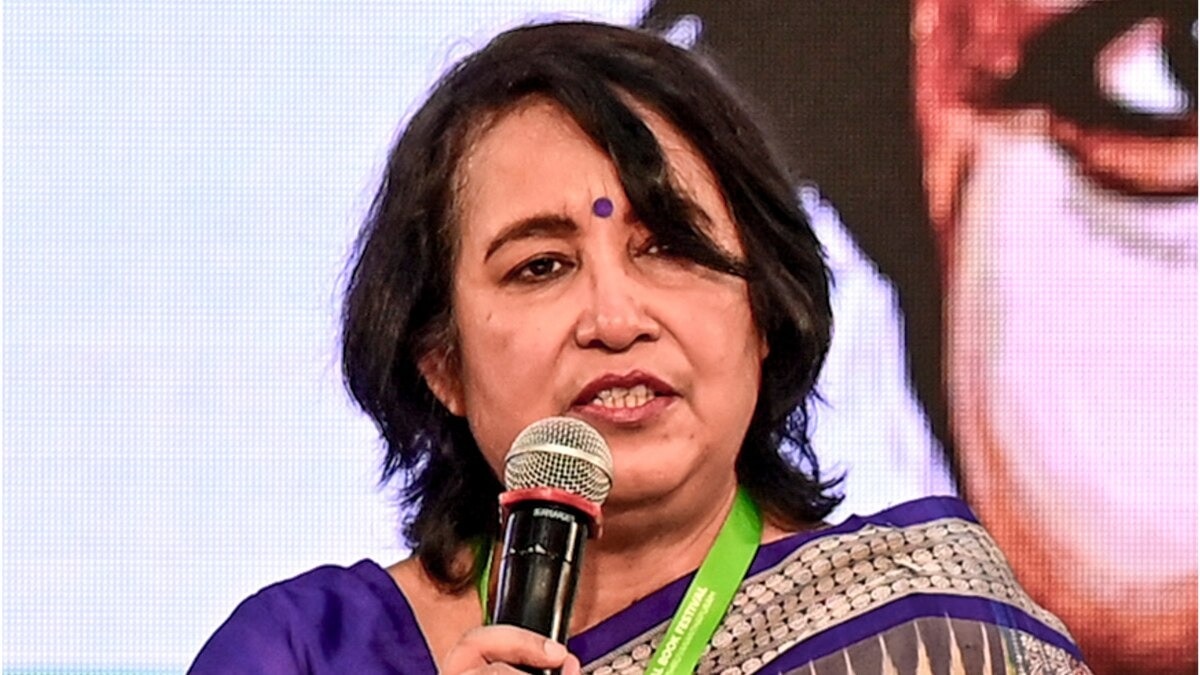
I am back: Taslima Nasrin renews free speech call in first public appearance
Bangladeshi author Taslima Nasrin returned to Kolkata after a gap of 19 years on Friday, describing the moment as the recovery of "a chapter of
Bangladeshi author Taslima Nasrin returned to Kolkata after a gap of 19 years on Friday, describing the moment as the recovery of "a chapter of my lost life" while delivering a forceful defence of free speech, secularism, women's rights and the right to criticise religious ideologies. The event, attended by West Bengal Chief Minister Suvendu Adhikari, marked Nasrin's first public address in Kolkata since leaving the city in 2007. During her speech, she thanked Adhikari and the West Bengal government for ensuring her security, while stressing that her gratitude should not be mistaken for political allegiance. Read Full Story Speaking at a public event in Kolkata, Nasrin reflected on decades of exile from both Bangladesh and West Bengal, saying her return was more than a personal milestone. She called it a reminder that "closed doors do not remain closed forever" and said the day represented a victory of free thought over fear and censorship. "I have not just returned to a city. I have returned to a chapter of my lost life," she said, adding that she was overwhelmed by the welcome she received after nearly two decades away from Kolkata. Nasrin thanked Secular Mission chairman Osman Gani Mallick for inviting her to the city and expressed gratitude to Chief Minister Suvendu Adhikari for facilitating her return and ensuring her security. "I have not come here to speak for any political party.
I have come to speak for equal rights of women, human rights, secularism, rationality, free thought and freedom of speech," she said. RECALLING YEARS OF EXILE The author recounted how she was forced to leave Bangladesh on August 8, 1994, after facing threats over her writings, and later had to leave Kolkata in 2007 despite not being convicted of any crime. Describing exile as both a personal and political experience, she said the state had failed to protect writers from extremist threats. "The state removed me from the country, but it could not remove the country from within me," she said, describing the Bengali language as her "portable homeland." Nasrin recalled discovering Kolkata through literature, radio broadcasts and correspondence long before she first visited the city. She said poetry and literature had connected the two Bengals even when political borders divided them. She also spoke about finding a home in Kolkata during her years in exile before being forced to leave in 2007 following threats from fundamentalist groups. 'FREEDOM OF SPEECH BELONGS TO EVERYONE' A major part of Nasrin's address focused on freedom of expression and the dangers of governments yielding to threats from extremist groups. She argued that exiling writers does not create lasting peace but instead strengthens those who seek to silence dissent. "In a civilised society, the answer to one argument is another argument, the answer to a book is another book," she said, urging people to challenge ideas through debate rather than violence or censorship.
 The BriefWire