The promise I made to Ismail al-Ghoul
The Al Jazeera journalist, who was a family friend, wanted me to use my voice to tell Gaza’s story. Two years after Israel killed him
The Al Jazeera journalist, who was a family friend, wanted me to use my voice to tell Gaza’s story. Two years after Israel killed him, I have not stopped. Two years ago, on July 31, 2024, I was spending the evening with my two sisters in Gaza City’s Remal neighbourhood, shopping for new clothes. For the first time in months, I felt hopeful, speaking with confidence about the day the war would end and we would return to our home in Jabalia to rebuild it. As I reached for an item of clothing, the shopkeeper suddenly interrupted us. Looking at his phone with tears in his eyes, he said, “Ismail al-Ghoul has been targeted by Israeli aircraft.” I froze and asked, “Are you sure?” His voice trembled as he replied, “Yes, … they’ve killed him.” I walked out of the shop in tears, repeating the same question to myself: Why? What had he done to deserve this? I wasn’t grieving Ismail simply because he was a journalist reporting Gaza’s story to the world. I was grieving because I had known him personally. To me, he was a man who loved life and dreamed of the day he would finally be reunited with his wife and young daughter, Zina, after the war had separated them. I first met Ismail while my family and I were sheltering at al-Shifa Hospital after being displaced. My father knew him and took me to see him, hoping Ismail might be able to help me charge my phone. It had been dead for more than three weeks because there was no electricity.
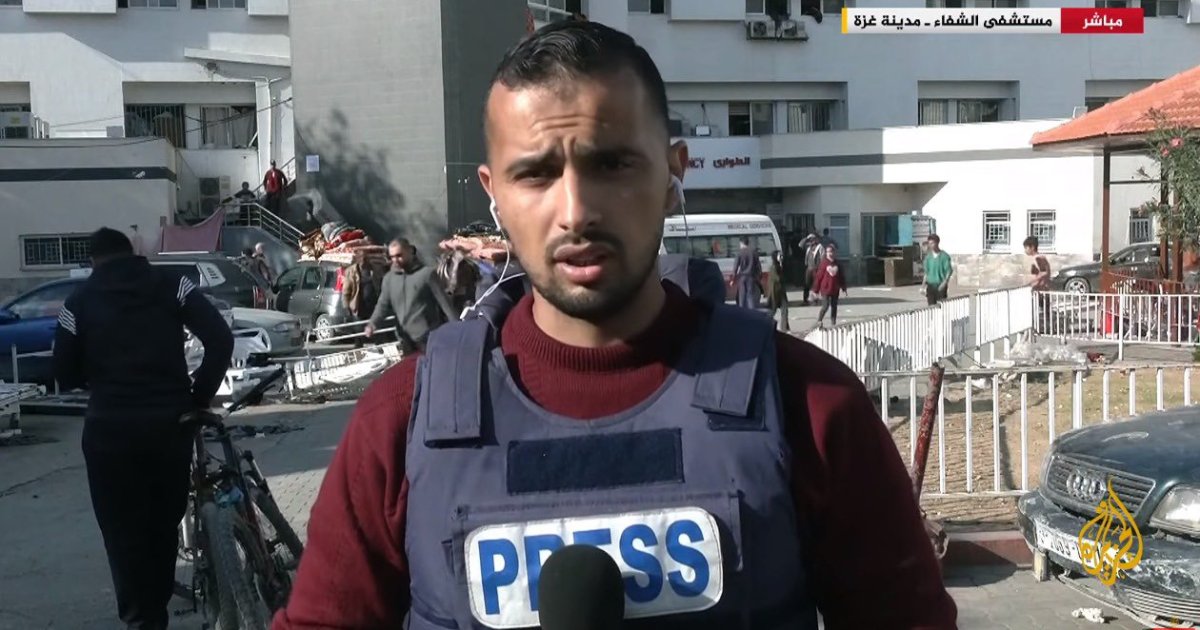
When we found him, he was standing in front of the camera, wearing his press vest and helmet and holding Al Jazeera’s microphone as he reported on what was happening in Gaza. After he finished the broadcast, my father introduced me to him. We spoke for only a few minutes. When he learned that I spoke English fluently, he said, “Invest in your English. Use it to carry our voice to the world.” At the time, his advice seemed impossible to follow. There was no electricity, no internet and no opportunity to write or work in journalism. Yet his words stayed with me. Over the months that followed, Ismail became a close friend of our family, not simply the journalist who had encouraged me to write. As we came to know him, we saw how deeply he missed his wife and daughter. Much of what he spoke about was his little girl, Zina, and his dream that the war would end soon so that he could return to his family. My father always called him “Abu Zina”, an affectionate Arabic form of address meaning “Zina’s father”, and prayed that Allah would reunite him with his wife and daughter, who had been displaced to southern Gaza. Whenever Ismail heard that prayer, he smiled and embraced my father. One day, he happily told my father that he had finally managed to speak to his wife and see Zina. Ismail was also a close friend of my older brother, Oday, and the two often spent time together. After my father was injured during our displacement at al-Shifa, Ismail came to visit him and see how he was doing.
 The BriefWire