Humanoid robots: Trump's latest China trade battle?
The US has banned foreign-made humanoid robots — a market dominated by Chinese tech firms. Although Washington cited national security risks, analysts think Trump is
The US has banned foreign-made humanoid robots — a market dominated by Chinese tech firms. Although Washington cited national security risks, analysts think Trump is buying time for US robot makers to catch up. In the latest sign of China's threat to the United States' tech dominance, the Trump administration on Tuesday banned new foreign-made humanoid and four-legged robotsfrom entering the country. The Federal Communications Commission (FCC) cited "unacceptable risks" to national security for the decision. The FCC noted how the robots "collect data that could be leveraged by malign actors to surveil Americans, enhance the capabilities of foreign intelligence services, or to remotely commandeer the robots." The move is widely seen as aimed squarely at China, which accounted for 85% of humanoid robot deployments last year, according to British bank Barclays. Humanoid robots steal the show at German trade fair To view this video please enable JavaScript, and consider upgrading to a web browser that supports HTML5 video How serious is the security threat from Chinese robots? US officials warn that Chinese humanoid and quadruped (four-legged) robots can collect detailed location and personal data, be controlled remotely and pose risks for critical US infrastructure. Specific concerns center on the robots' potential dual-use — civilian and military purposes. Unitree Robotics, a leading Chinese robot maker, appears on the Pentagon's list of firms with links to the Chinese military. Its robots have been used in army exercises. Researchers have also shown that Unitree robots have security flaws that let attackers take control with a voice command and then use one robot to control others.
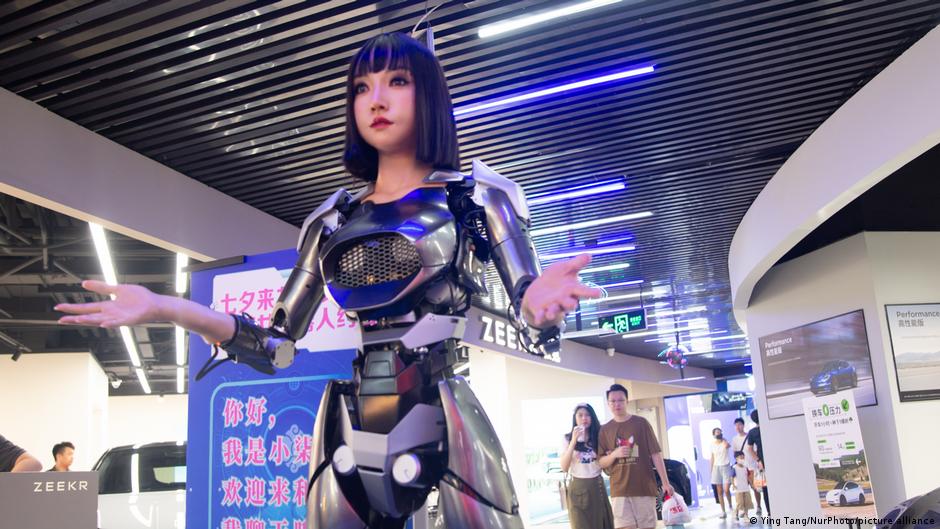
Washington is also concerned that a large cohort of low-cost Chinese robots could feed real-world data back to Chinese artificial intelligence (AI) systems, which are fast catching up with their US rivals. The threat, however, is largely theoretical as most commercial humanoid robots are in early stages of development. China has the edge over the US in humanoid robot deployment Image: Imaginechina/Sipa USA/picture alliance China has rejected the accusations, insisting Washington is using national security as a pretext for protectionism to suppress Chinese technology. Beijing is expected to impose countermeasures, which could include curbs on the raw materials US robotics firms urgently need to scale up production. The Trump administration has made no secret of its desire to help the domestic US robotics industry, which in turn supports the country's nearly trillion-dollar AI buildout. According to industry watchers, US President Donald Trump wants to ensure the likes of Figure AI, Tesla Optimus and Agility Robotics are protected from high-volume Chinese producers, whose robots often cost half the price or less of their US rivals. Washington has put similar curbs on Chinese drones and solar panels and now levies a 100% tariff on Chinese electric vehicles. Will the ban help US robot makers catch up? The ban is widely seen as an attempt by Washington to buy time, having been caught off guard by how quickly China scaled robotics production. According to Omdia, a tech research house, China has six firms in the Top 10 robotics rankings and they shipped nearly 11,600 humanoids last year, versus a few hundred by US firms.
 The BriefWire