The return of division talk in J&K and why it’s dangerous
On September 15, 1950, at Lake Success, the temporary home of the United Nations between 1946 and 1951, the United Nations Security Council (UNSC) received
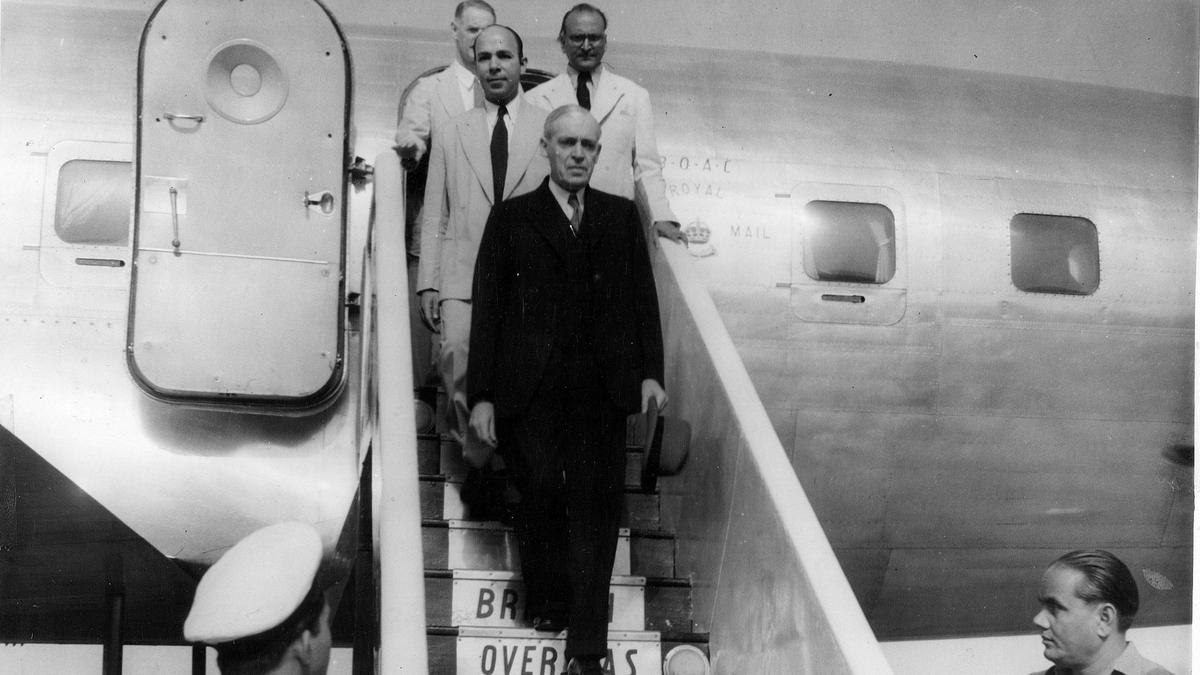
On September 15, 1950, at Lake Success, the temporary home of the United Nations between 1946 and 1951, the United Nations Security Council (UNSC) received a report on Jammu and Kashmir from Owen Dixon, former Chief Justice of Australia. Appointed by the UNSC to mediate between India and Pakistan, the 64-year-old jurist offered a set of categorical recommendations that, in effect, revived the logic of territorial partition. Dixon had travelled extensively across Jammu and Kashmir on both sides of what later became the Line of Control, shuttled between New Delhi and Karachi, and even brokered a meeting between the Indian and Pakistani prime ministers on July 20, 1950. His proposal suggested that the Hindu-majority plains of Jammu should go to India, while the culturally and linguistically contiguous Muslim areas of Rajouri–Poonch, located close to the Line of Control, should go to Pakistan. Ladakh was to remain with India, while Gilgit-Baltistan and what came to be known as Pakistan-occupied Kashmir (PoK) were allotted to Pakistan. Dixon suggested that only the Kashmir Valley (predominantly Muslim, but with strong Kashmiri identity) should hold a plebiscite supervised by the United Nations. Dixon report proved to be non-starter The Dixon Report proved to be a non-starter. It was widely seen as a de facto invitation to Partition-type violence, mass displacement, and demographic upheaval within Jammu and Kashmir itself. In hindsight, the report lacked the analytical rigour required to capture the former princely state’s intricate religious, linguistic, and ethnic geography — one that resisted neat binary classifications of majority and minority. Moreover, it defeated the idea of inclusive India. Yet, despite its failure, the idea of dividing Jammu and Kashmir did not disappear in a different context. It resurfaced periodically, though always framed within the context of Indian national sovereignty, and was presented not as secession but as administrative reorganisation. At different moments, this idea paradoxically brought together actors across regions and ideological lines who believed that territorial reconfiguration could offer relief from deep-seated political and structural grievances. Decades later, Inderjit Gupta, who served as India’s Union Home Minister from June 29, 1996 to March 19, 1998 in the United Front governments of H. D. Deve Gowda and I. K. Gujral, and was a senior leader of the Communist Party of India, also once proposed trifurcating Jammu and Kashmir into three distinct units namely Jammu, the Kashmir Valley, and Ladakh in the Parliament. After creating confusion, he had to retract his statement. The notion of division or trifurcation was also explicitly endorsed by the Rashtriya Swayamsevak Sangh, which advocated the reorganisation of Jammu and Kashmir in its Kurukshetra resolution of 2002. Ladakh, which was historically part of the former state of Jammu and Kashmir, was separated in 2019 under the Jammu and Kashmir Reorganisation Act, leaving behind two remaining administrative units within the reconstituted Union Territory: Jammu and the Kashmir Valley. Strong chorus calling for separation of J&K returned In the current context, a strong chorus calling for the separation of Jammu and Kashmir has returned. Recent statements across the political spectrum have been revealing. Much of this discourse, however, has the feel of a broken record spanning nearly eight-decades. Leaders in Jammu continue to articulate a narrative of discrimination and political neglect. The Kashmir Valley, in turn, contests the very framing of Jammu’s grievance. Valley-based leaders argue that Jammu is not the monolithic Hindu region it is often projected to be, pointing out that nearly 35% of Jammu’s population is Muslim. This is a reality they contend is routinely ignored in political mobilisation. Predictably, familiar patterns re-emerge. Muslim political leadership in Jammu opposes division, arguing that it would marginalise Muslim-majority hilly districts within the Hindu majority region. The debate circles back to hardened positions shaped by decades of mistrust. What is insufficiently recognised, however, is that 2026 is not the 1990s or early 2000s.
 The BriefWire