SC seeks police's graded use-of-force standing order in Jantar Mantar pellet row
The Supreme Court on Thursday heard a plea challenging the use of metallic pellet guns by police during the CJP protests at Delhi's Jantar Mantar
The Supreme Court on Thursday heard a plea challenging the use of metallic pellet guns by police during the CJP protests at Delhi's Jantar Mantar, observing that such force is permitted under police rules only in "exceptional circumstances" and directing Delhi Police to place on record the standard operating procedure (SOP) governing their use. A bench comprising Chief Justice of India Surya Kant and Justice Joymalya Bagchi issued notice to the Centre and sought its response on the rules and SOP regulating the deployment of pellet guns by police. Read Full Story Appearing for the petitioners, senior advocate Vrinda Grover contended that the weapons used against protesters fired "kinetic metallic projectiles", which are different from rubber or plastic pellets. "There can be rubber, plastic and metallic pellets. These were metallic and recovered from the bodies. Nature of the crowd will determine use of this as well. Was it a violent mob? No. These metallic pellets were fired," Grover told the bench, arguing that the protesters did not constitute a violent mob.
Justice Bagchi, however, noted that the existing police rules already contemplate the use of pellet guns in limited situations. "But police rules allow the use in exceptional circumstances unless you challenge the rules themselves. One of the steps of graded approach is use of pellet guns," he observed. The court said it was willing to examine whether the use of pellet guns was justified in the present case, but observed that the petitioners would first have to establish that their deployment violated the graded use-of-force framework prescribed under police rules. “We are not averse to examining the use of pellets in an individual case. You have to show us if graded response use of pellets can be allowed when even bullets are used in some situations," Justice Bagchi observed. Chief Justice suggested that, instead of a blanket challenge, the petitioners could seek court-mandated guidelines on the use of pellet guns. Referring to the allegations of excessive force, the observed, "In light of the alleged excessive use, your prayer should be that the court lays down a protocol regarding the use." Justice Bagchi emphasised that the court favoured a non-violent approach to dealing with student protests, but observed that authorities may have to resort to graded use of force in appropriate circumstances.
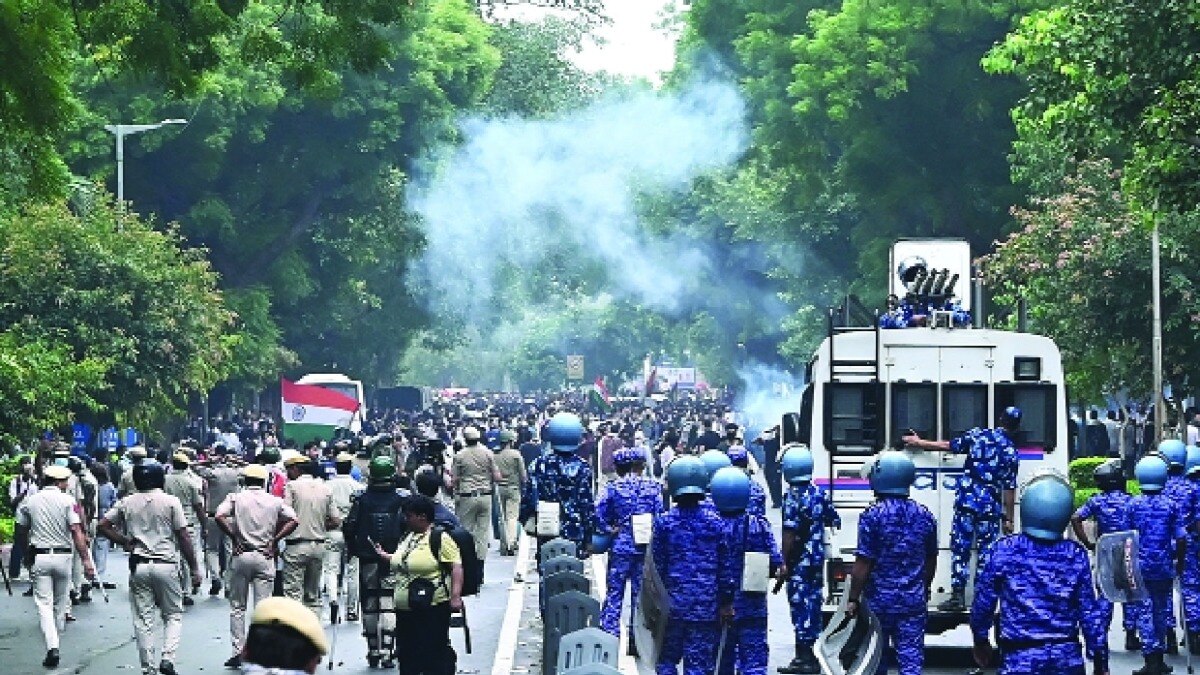
“We are in agreement with your prayer for no violence principle on persons expressing dissatisfaction or protesting. But graded response may be required in some cases. The best way is to arm police personnel; that gives them confidenceeveryone is a human being. If someone is coming with a lathi, you will take a few more moments before reaction," he said. The petition arises from the violence that broke out during the Cockroach Janta Party's (CJP) 'Chalo Sansad' march on July 20 over the NEET-UG paper leak controversy. Clashes erupted between demonstrators and security personnel at multiple locations around Jantar Mantar, leaving several protesters and police personnel injured. The security operation later triggered a political controversy over the alleged use of plastic pellets after reports claimed that several protesters had suffered grievous injuries. Official records submitted by the police show that the Rapid Action Force (RAF) used 55 non-electrical shells, 15 electrical shells, five tear smoke grenades, two rounds from anti-riot guns and two rounds of plastic pellets to disperse the crowd.
 The BriefWire