9 hours, 4 adjournments, fiery debate: How anti-paper leak bill cleared Lok Sabha
After nearly nine hours of debate, the government succeeded in getting the Public Examinations (Prevention of Unfair Means) Amendment Bill, popularly referred to as the
After nearly nine hours of debate, the government succeeded in getting the Public Examinations (Prevention of Unfair Means) Amendment Bill, popularly referred to as the anti-paper leak bill, passed in the Lok Sabha on Wednesday despite repeated disruptions, slogan-shouting and fierce protests by the Opposition. The legislation, which seeks to further strengthen the legal framework against paper leaks and examination malpractice, was passed after a politically charged day marked by adjournments, heated exchanges, high-level meetings and procedural interventions. Read Full Story Here is a detailed timeline of how the Bill was passed through the Lower House. PROTEST POLITICS SETS TONE BEFORE PARLIAMENT CONVENES Even before Parliament assembled for the day, the political battle had shifted to the Parliament complex. The Opposition and the ruling NDA staged parallel protests. Samajwadi Party MPs, led by party chief Akhilesh Yadav, raised allegations of irregularities in donations collected for the Ayodhya Ram Temple. At the same time, BJP MPs held demonstrations accusing Opposition-ruled states of failing to curb paper leaks, with the focus shifting to the alleged examination leak in Jharkhand. Unlike previous protests, the INDIA bloc did not appear fully united. While the Samajwadi Party aggressively pursued the Ram Temple donation issue, several other Opposition parties remained focused on different political matters. The BJP, meanwhile, continued its strategy of attacking the Opposition over paper leaks. After targeting Punjab over an alleged examination leak a day earlier, the ruling party used Wednesday's protests to highlight the Jharkhand case. Following nearly an hour of demonstrations near the Makar Dwar entrance, MPs entered the Parliament building shortly before the House convened.
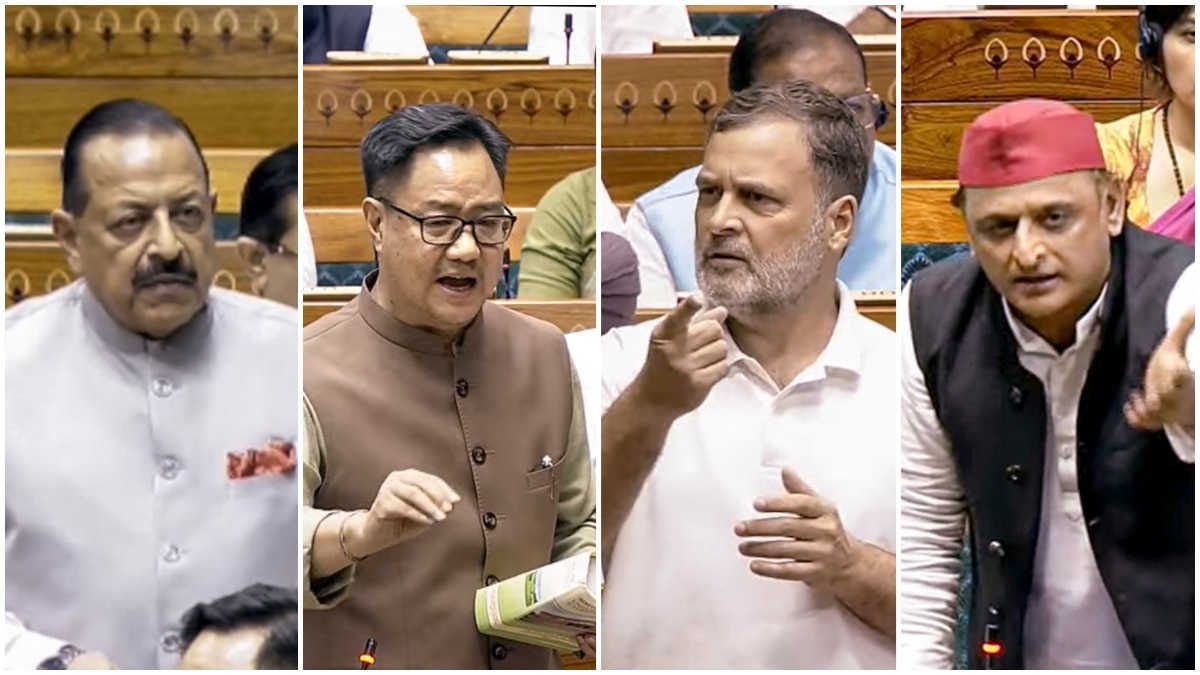
PROCEEDINGS BEGIN AMID UPROAR The Lok Sabha met at 11 am, but normal business could not begin. As soon as proceedings commenced, Opposition members launched loud protests, forcing repeated interruptions. With the House unable to function, Speaker Om Birla adjourned proceedings until 12 noon. DEBATE ON THE BILL BEGINS When the House reassembled around 12 pm, discussion on the Public Examinations (Prevention of Unfair Means) Amendment Bill, 2026 commenced. Members from both the ruling side and the Opposition participated in the debate. Several Independent MPs also spoke on the proposed legislation, expressing their views on the need for stronger safeguards against paper leaks and examination fraud. The debate continued for several hours before the Leader of the Opposition, Rahul Gandhi, rose to speak at around 1 pm. RAHUL GANDHI'S SPEECH TRIGGERS REPEATED DISRUPTIONS Rahul Gandhi spoke for nearly an hour, but his speech repeatedly sparked protests from the Treasury benches. According to the ruling side, Gandhi referred to several issues that were not directly connected to the legislation under discussion and made allegations against Home Minister Amit Shah that, they argued, were unrelated to the Bill. Speaker Om Birla intervened multiple times, requesting Gandhi to confine his remarks to the subject of the legislation. Treasury bench members maintained that the Leader of the Opposition ignored the Chair's repeated advice and continued making allegations without presenting supporting evidence. During the debate, Parliamentary Affairs Minister Kiren Rijiju stood up to object, saying allegations of such a serious nature should not be made in the House without factual proof.
 The BriefWire