Microsoft is openly competing with OpenAI, Anthropic more than ever
Microsoft is in a unique position as AI overtakes the tech industry. It’s one of the world’s largest cloud providers and software-as-a-service companies, while also
Microsoft is in a unique position as AI overtakes the tech industry. It’s one of the world’s largest cloud providers and software-as-a-service companies, while also holding valuable stakes in the two biggest AI labs, OpenAI and Anthropic. Those incentives are starting to clash as Microsoft posts blockbuster financial results. The company just reported an extremely profitable quarter with $90 billion in revenue and net income of $35.8 billion. For the fiscal year, which ended June 30, Microsoft reported $331.8 billion in revenue with a net income of $133.7 billion for the year. And CEO Satya Nadella is not about to let the trajectory of Anthropic and OpenAI — which are expanding into applications and agentic infrastructure that could ultimately let them own customer relationships — derail that kind of cash. Nadella has been preaching to enterprises to use multiple models and to stop relying on the frontier AI labs for the agentic harness/app layer. Doing so is dangerous, he’s been saying, because it requires companies to share too many of their internal secrets with model makers of dubious trustworthiness. He knows his customers. Enterprise IT fears both data leaks and being locked into a vendor.
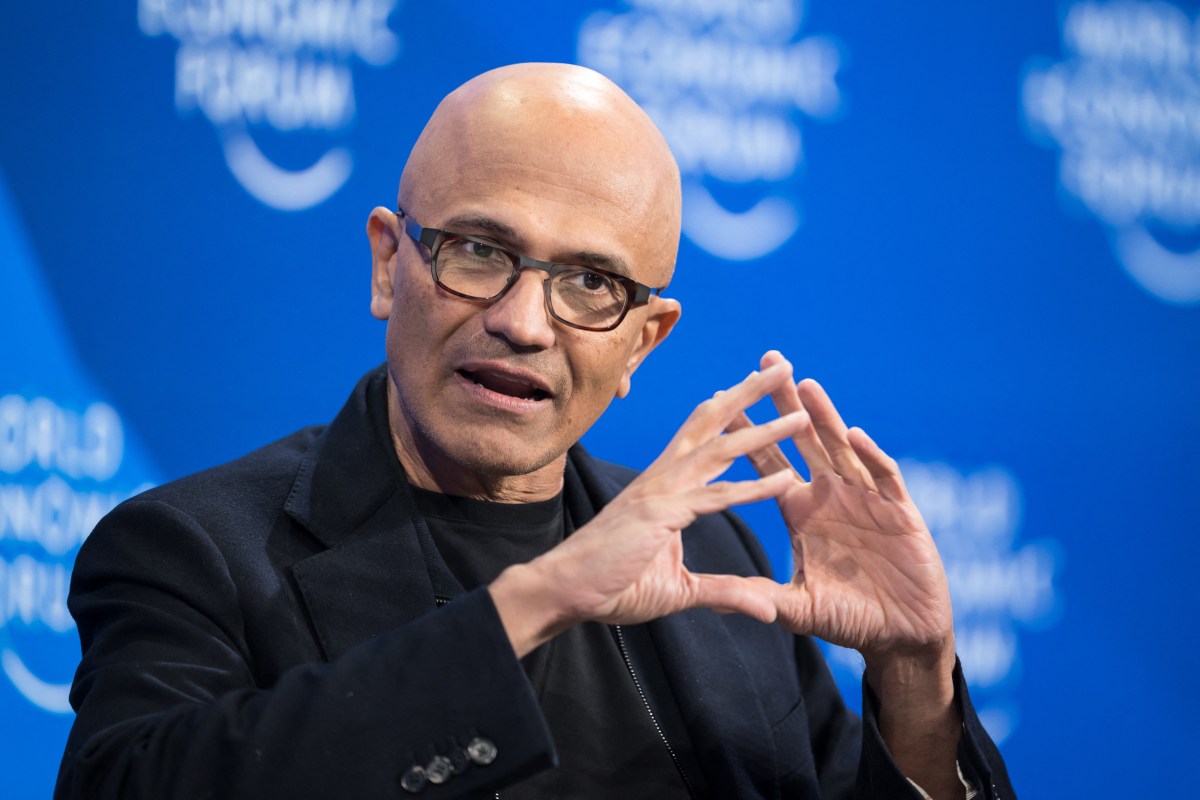
Now he has openly told Wall Street analysts during the company’s quarterly conference call Wednesday that this is an opportunity for Microsoft to sell customers its own homegrown models, alongside agents, AI security and more, while promising lower costs. In other words, he’s pitching Microsoft as an alternative to many of the upscale services that OpenAI and Anthropic are developing for their own growth. When UBS analyst Karl Keirstead specifically asked Nadella to weigh in on the open vs. closed-sourced debate roiling the AI industry, and how Microsoft will benefit from it, Nadella came out swinging. “The goal is to have the firm be in control of their own destiny,” the CEO said of enterprises. “We are very, very clear about the architectural sort of design of the platform, which is you got to keep your harness separate from the model … that means any model at any given time is swappable.” Microsoft, of course, sells a menu of harnesses (aka AI agents), too, under the Copilot name, including its coding agent GitHub Copilot. Coding agents are where much of the AI dollars are being spent today. And he used the high-profile incident from last week as proof of his warnings.
“If you look even at the Hugging Face incident, the biggest thing that we should take away from that is you can’t sort of depend on any one model,” Nadella said. “You will maybe need multiple models to even remediate some challenges that get caused by one model. Like that’s the way to think about it, right? Which is you can’t be subject to a refusal of one model.” The incident involved an unreleased model from OpenAI breaking out of its sandbox and successfully mounting a full-scale hack on Hugging Face, all in pursuit of besting a benchmark. Trying to understand what happened, Hugging Face at first tried to use a private frontier model (which it hasn’t named) that refused to help it. So it turned to the Chinese open-source model Z.ai GLM 5.2 to analyze logs and defend its infrastructure. The incident has so shocked the industry that even Sam Altman is now saying that maybe AI development should slow down a bit. Nadella also made clear that Microsoft is happily selling its own homegrown models, the MAI family, on its own homegrown AI chips, Maya, and pitching them as cheaper alternatives. “Every customer wants the right model for each task based on quality, latency, cost, and compliance.
 The BriefWire