China has built a 582-ton giant magnet to help its 'Artificial Sun' confine plasma hotter than 100 million°C
The giant magnet powering China's next-generation 'Artificial Sun' Why does a fusion reactor need such a massive magnet? How superconducting technology makes fusion possible What
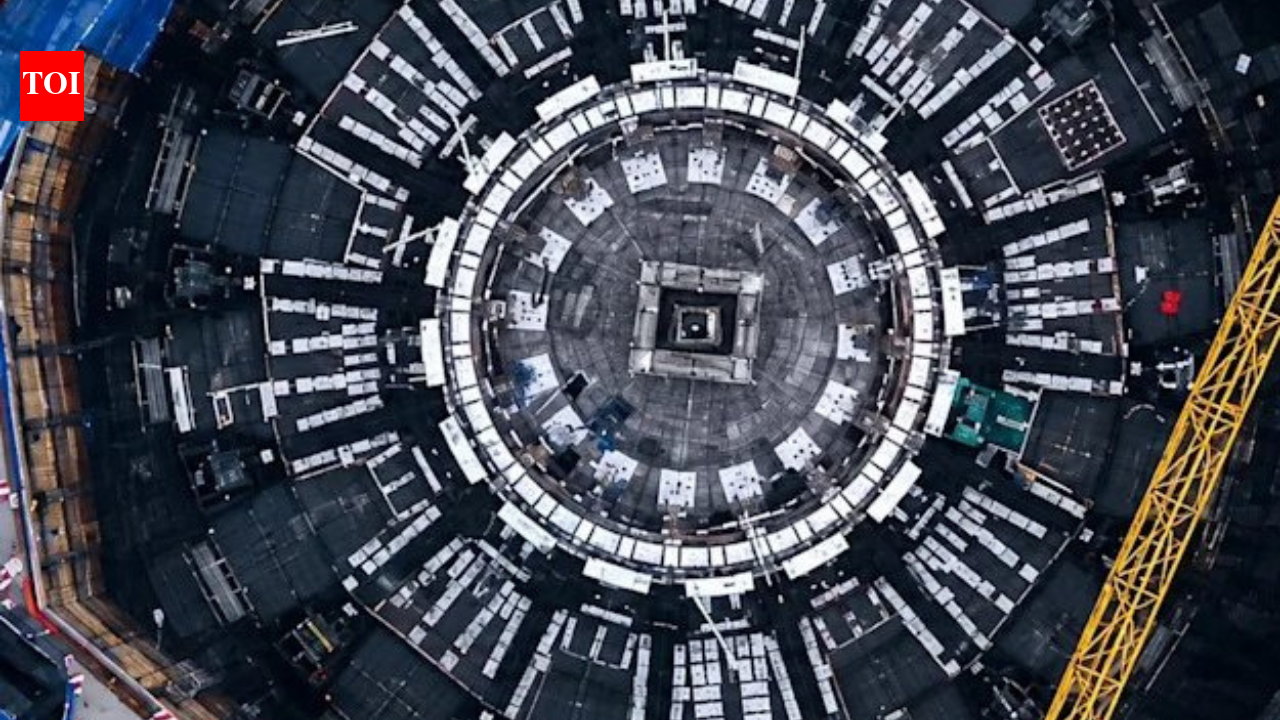
The giant magnet powering China's next-generation 'Artificial Sun' Why does a fusion reactor need such a massive magnet? How superconducting technology makes fusion possible What makes this magnet different from previous designs? How China's 'Artificial Sun' programme has evolved When could fusion electricity become a reality? Why fusion is considered the future of clean energy China has achieved a major milestone in its pursuit of commercial nuclear fusion by completing the construction and testing of a colossal 582-ton superconducting magnet designed for its next-generation "Artificial Sun" programme, according to Xinhua News Agency. Measuring 21 metres in length, the toroidal-field magnet is the largest of its kind ever built for a controlled fusion reactor. Developed by the Institute of Plasma Physics (ASIPP) under the Chinese Academy of Sciences in Hefei, the magnet is designed to confine plasma heated to more than 100 million degrees Celsius, a temperature around six times hotter than the Sun's core. According to the project's roadmap, the breakthrough is expected to support China's long-term goal of demonstrating electricity generation from controlled nuclear fusion around 2030.The newly completed magnet is a toroidal-field (TF) superconducting magnet, one of the most critical components of a tokamak fusion reactor.
Weighing 582 metric tons and stretching 21 metres long, it is larger than any comparable magnet built for a fusion facility.The magnet was developed for China's Burning Plasma Experimental Superconducting Tokamak (BEST) project, the country's next-generation experimental fusion reactor.Engineers completed construction, factory acceptance and full-parameter testing in Hefei, marking one of the biggest engineering achievements in China's fusion programme.Nuclear fusion requires hydrogen plasma to be heated to temperatures exceeding 100 million°C, far hotter than the centre of the Sun. At such extreme temperatures, no known material can physically contain the plasma.Instead, powerful superconducting magnets generate intense magnetic fields that suspend the plasma inside a doughnut-shaped vacuum chamber called a tokamak. The toroidal-field magnet prevents the superheated plasma from touching the reactor walls, allowing fusion reactions to continue safely while minimising damage to the reactor.Unlike ordinary electromagnets, superconducting magnets operate with virtually zero electrical resistance when cooled to extremely low temperatures. This enables them to carry enormous electrical currents while consuming far less energy.China also successfully tested a high-temperature superconducting central solenoid, another key component often described as the "heart" of a tokamak. The central solenoid generates the plasma current needed to initiate and maintain fusion reactions, working together with the toroidal-field magnet to keep the plasma stable throughout the experiment.According to Chinese researchers, the new toroidal-field magnet has a volume approximately 1.3 times larger than the equivalent magnet designed for the international ITER fusion project in France.
 The BriefWire