Know Your Laws: Should plainclothes cops identify themselves during a lathicharge?
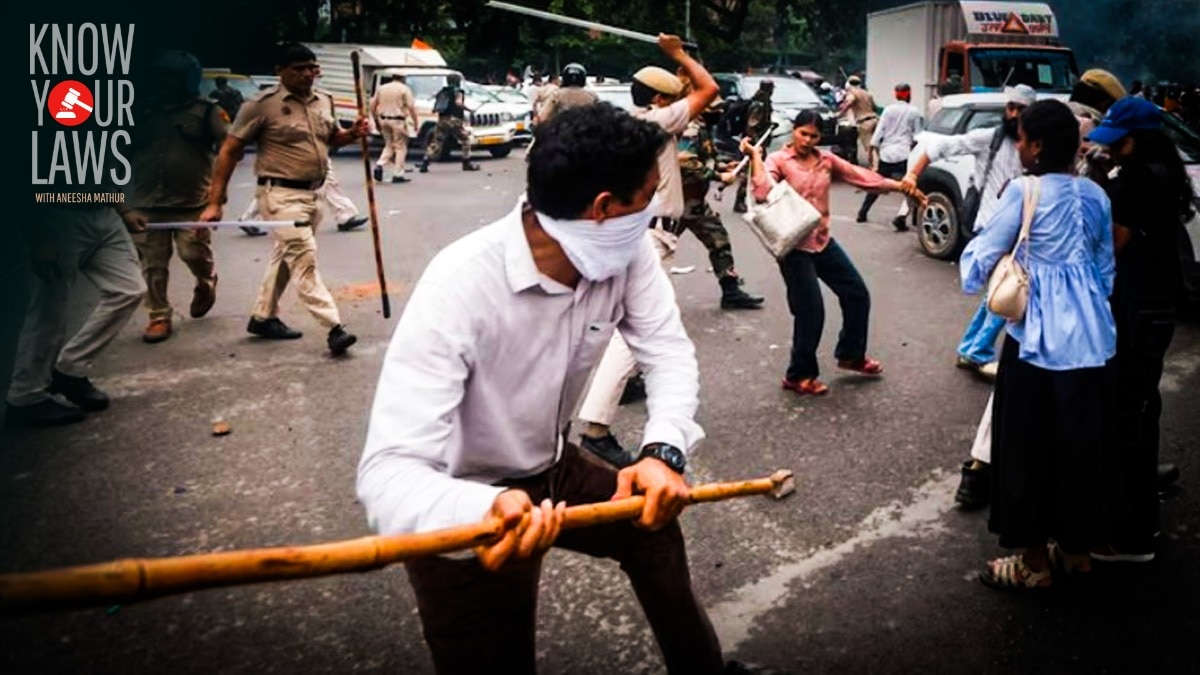
The use of plain-clothes police personnel during the May 20 lathicharge on student protesters at Jantar Mantar and in the days that followed has raised
The use of plain-clothes police personnel during the May 20 lathicharge on student protesters at Jantar Mantar and in the days that followed has raised serious legal questions about police identification, accountability and compliance with established legal safeguards. Videos showing police personnel, some without visible name tags and others dressed in civilian clothes, wielding lathis against protesters have prompted legal experts to question whether such deployment conforms to the law governing policing and crowd control. Read Full Story The Bharatiya Nagarik Suraksha Sanhita (BNSS), which governs criminal procedure, lays down a clear requirement regarding police identification. Section 36 provides that every police officer making an arrest must bear "an accurate, visible and clear identification of his name which will facilitate easy identification." The provision seeks to ensure accountability by allowing members of the public to identify officers exercising coercive powers. LAW ON POLICE IDENTIFICATION Supreme Court judge Justice Madan B Lokur said the law requires police personnel to carry proper identification and questioned the deployment seen during the protest. According to Justice Lokur, a combination of police personnel without name tags and officers in plain clothes carrying out a lathicharge is "completely illegal". Justice Lokur said the Commissioner of Police or the Deputy Commissioner of Police of the area must explain why such a situation was permitted.
He pointed out that apart from statutory requirements, there are administrative rules, directions issued by the Human Rights Commission (NHRC), and Supreme Court guidelines requiring police personnel to display clear identification while performing their duties. PLAIN CLOTHES DEPLOYMENT UNDER SCRUTINY Senior Advocate Siddharth Luthra drew a distinction between different categories of police deployment. According to him, police personnel assigned only to security duties may be deployed in plain clothes. However, officers responsible for maintaining law and order should not be in civilian attire. Luthra said that if the plain-clothes personnel present during the protest were performing intelligence duties, an important question arises as to why they were carrying lathis. He maintained that it is not the role of officers deployed in plain clothes, whether for intelligence gathering or security, to wield batons during crowd-control operations. According to Luthra, police personnel engaged in law and order duties must wear proper police uniforms displaying visible name tags indicating both their names and ranks. He said this requirement is supported not only by police rules but also by directions issued by the Supreme Court. Senior Advocate Sanjay Parikh also emphasised that police officers must be identifiable while performing official duties. He said a police officer should be in proper uniform so that members of the public can immediately identify that the person is a police officer.
 The BriefWire