Leaked, but at what stage? Analysis maps India's exam security weak links
When a paper leaks, the first casualty is trust. The second is time. Lakhs of candidates who spend months, and often years, preparing for competitive
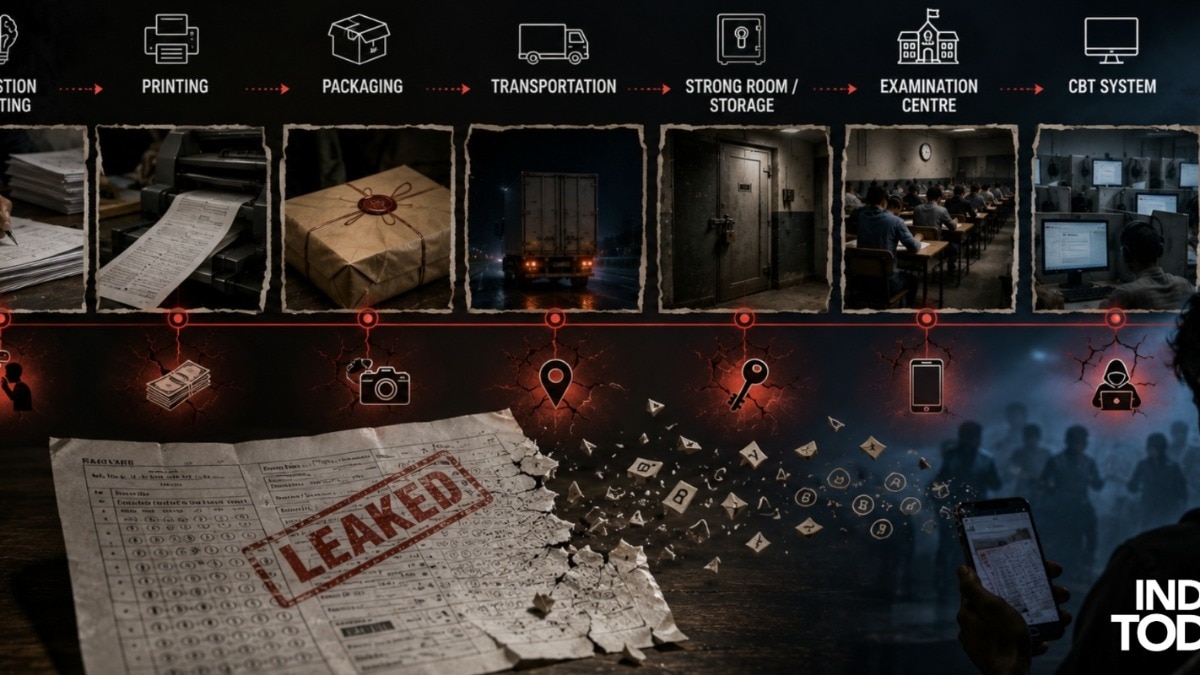
When a paper leaks, the first casualty is trust. The second is time. Lakhs of candidates who spend months, and often years, preparing for competitive examinations are left waiting once again for a re-examination, a court verdict, or the outcome of an investigation. Every cancelled examination brings arrests, political blame, and promises of reform. Yet one question often remains unanswered: Where did the system actually fail? Read Full Story To answer that question, India Today's Open Source Intelligence (OSINT) team reviewed hundreds of reported examination integrity breaches over the past decade. Of those, 17 cases met a strict evidentiary threshold: courts or investigating agencies had officially established how and where the confidentiality of the question paper had been compromised. The dataset covers major examination integrity breaches between 2015 and 2026 that resulted in judicial intervention or official investigations and contained sufficient documentary evidence to identify the point of compromise Each of the 17 cases was mapped to the stage at which the breach occurred, from question setting and printing to packaging, transportation, district strong rooms, examination centres and computer-based testing (CBT) systems. LEAKED, BUT AT WHAT STAGE? Of the 17 examined documented paper leak cases that went till the prosecution stage, examined by India Today OSINT team, five involve national-level examinations: AIPMT (2015), SSC CGL (2017–18), CBSE Class XII Economics (2018), NEET UG (2024) and NEET UG (2026). The remaining 12 span major recruitment and entrance examinations across Bihar, Uttar Pradesh, Rajasthan, Gujarat, Uttarakhand and Jharkhand. Together, they show that vulnerabilities have emerged at nearly every stage of the examination lifecycle. Among the 17 documented paper leak cases analysed by India Today, five were traced to the printing stage, the single most common breach point The All India Pre-Medical Test (AIPMT), 2015 demonstrated that even after question papers had reached candidates, an examination could still be compromised inside the examination hall itself. In Tanvi Sarwal v. Central Board of Secondary Education & Ors.
(2015), the Supreme Court reproduced the Special Investigation Team's findings that answer keys were transmitted using a "Bluetooth device to facilitate transmission of answer keys through such appliances to the users thereof," with concealed electronic devices hidden beneath clothing. Holding that the integrity of the examination had been irreparably compromised, the Court observed that "the examination has become suspect" and ordered a nationwide re-test. In the case of SSC CGL Tier II Examination (2017–18), the CBI charge sheet stated that "the computers of some candidates were remotely accessed by unknown persons with the help of software which was not supposed to be installed in the PCs of the candidates." The compromise lay within the computer-based testing infrastructure itself. Investigators also found that screenshots of examination questions had circulated on social media, exposing weaknesses in vendor oversight and CBT security. The CBSE Class XII Economics Examination (2018) highlighted another weak link: the custody of confidential question papers after they had reached the examination centre but before the test began. In Smt. Khazani Devi Educational Society v. Central Board of Secondary Education & Ors. (2019), the Delhi High Court reproduced the Deputy Commissioner of Police's investigation, which stated that the "printed question paper of Economics of XII class was leaked 1 hour before commencement of exam from Mother Khazani School, Bawana, Delhi." The investigation further recorded that teachers Rohit and Rishabh "managed to take photographs of the question paper through their mobile, prior to the start of the examination" and sent them to Md. Tauqueer. While stopping short of determining criminal guilt, the Court held that "the possibility of the examination paper having been leaked, from within the premises of the petitioner-school, cannot be irrevocably foreclosed." Major exam reform push by Judiciary, Executive and Legislative In NEET UG 2024, 2024, the Supreme Court noted that the leak at Hazaribagh and Patna was "not in dispute" and reproduced the CBI's finding that about 155 students from centres in the two cities appeared to be beneficiaries.
 The BriefWire