The pig that almost started a war: How a pig shot in 1859 turned a San Juan Island farm dispute into a 12-year Britain-America standoff
PC: AI Generated How the 1846 Oregon Treaty created a territorial dispute over the San Juan Islands Rising tensions over the San Juan Island land
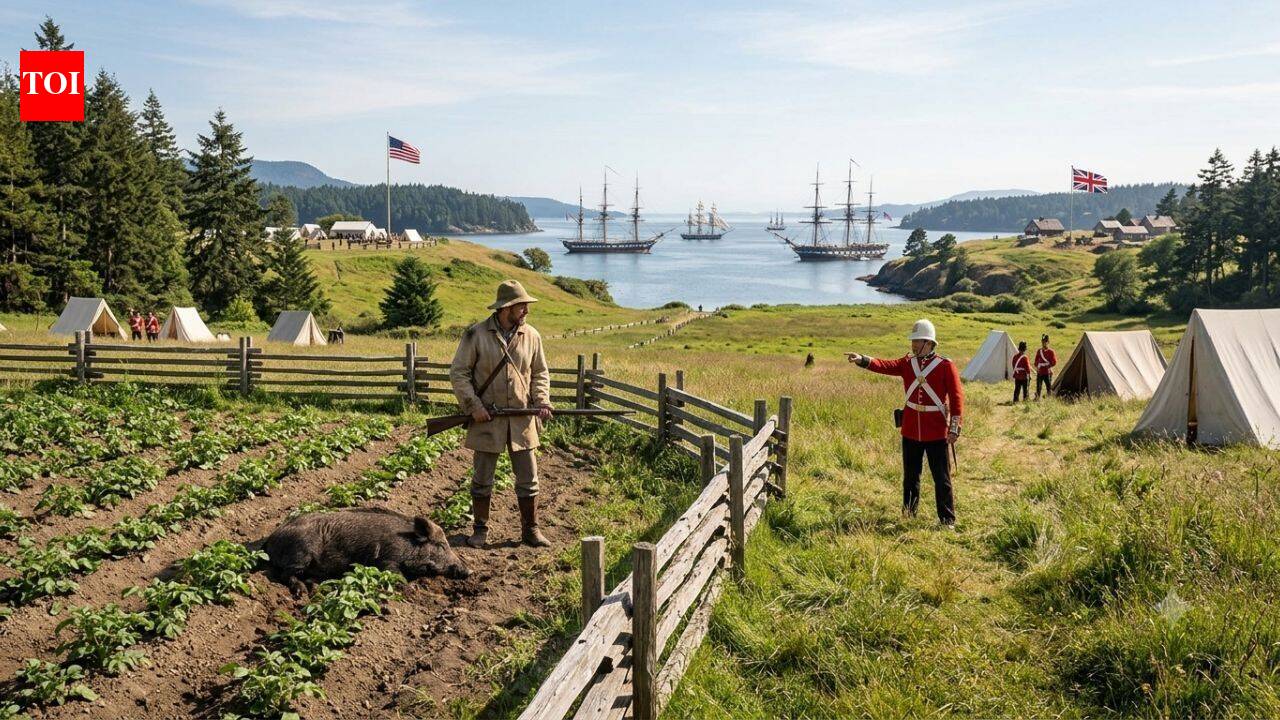
PC: AI Generated How the 1846 Oregon Treaty created a territorial dispute over the San Juan Islands Rising tensions over the San Juan Island land dispute A pig turns into an international crisis The San Juan Island dispute turns into a military standoff The Pig War’s unusual standoff between rival armies The peaceful negotiations that ended the Pig War standoff How the San Juan Islands dispute was settled without a battle End of the pig war In 1859, a single pig turned a quiet island dispute into a tense confrontation between two powerful nations. What began as a farmer’s frustration over a wandering animal on San Juan Island quickly escalated into a military standoff involving British warships, American soldiers and competing territorial claims. The disagreement was rooted in a much older problem; an unclear boundary created by the 1846 Oregon Treaty. For 12 years, Britain and the United States maintained rival camps on the island but avoided open conflict. Known as the Pig War, the unusual crisis was eventually resolved through diplomacy and arbitration, leaving behind one of history’s strangest border disputes.As reported by the Park Service (NPS), the roots of the dispute stretched back to 1846, when Britain and the United States signed the Oregon Treaty to settle competing claims in the Pacific Northwest. The agreement placed the boundary between the two countries along the 49th parallel, but its wording created a problem.The treaty referred to a channel separating the mainland from Vancouver Island before the boundary continued westward. The difficulty was that there was more than one possible interpretation of that description. The Haro Strait and the Rosario Strait both matched parts of the wording, but they followed different routes.The San Juan Islands sat between these waterways, leaving both Britain and the United States convinced they belonged to them. At the time, the islands were not a major settlement centre.
Their value came from their location, fertile land, and access to resources. The Hudson’s Bay Company, a powerful British trading organisation operating from Fort Victoria on Vancouver Island, moved early to strengthen its position.Reportedly, by 1851, the company had established salmon-processing operations on San Juan Island. Two years later, it created Belle Vue Sheep Farm on the island’s southern end, partly as a commercial venture and partly as a statement of British interest in the territory.As reports about the island’s fertile land reached American communities, settlers began arriving. By 1859, several Americans had claimed areas that were already being used by the Hudson’s Bay Company for grazing.The settlers believed their claims were legitimate under American law. British officials saw them differently, considering them unauthorised occupants on British territory.There was no clear authority controlling everyday disputes on the island. A disagreement over land, animals, or property could quickly become a political argument because neither side accepted the other’s legal rights.The atmosphere became increasingly tense. The British continued to support the Hudson’s Bay Company’s activities, while American settlers looked towards the United States government for protection. Then came the incident that gave the confrontation its unusual name.On 15 June 1859, American settler Lyman Cutlar discovered a pig repeatedly damaging his garden. The animal belonged to the Hudson’s Bay Company. After earlier complaints failed to solve the problem, Cutlar shot the pig.On San Juan Island, it became a question of authority. British officials threatened legal action against Cutlar and warned that American settlers could be removed as trespassers. The settlers appealed for military support from Brigadier General William S. Harney, commander of the US Army’s Department of Oregon. Harney responded by sending troops.Captain George E. Pickett, who would later become a Confederate general during the American Civil War, arrived on San Juan Island in July 1859 with a company of US soldiers.
 The BriefWire