Hopeful Of LCA-2 Induction In Good Numbers After September: Defence Secretary | Exclusive
Hopeful Of LCA-2 Induction In Good Numbers After September: Defence Secretary | Exclusive Reported By, Last Updated: July 27, 2026, 20:26 IST In an exclusive
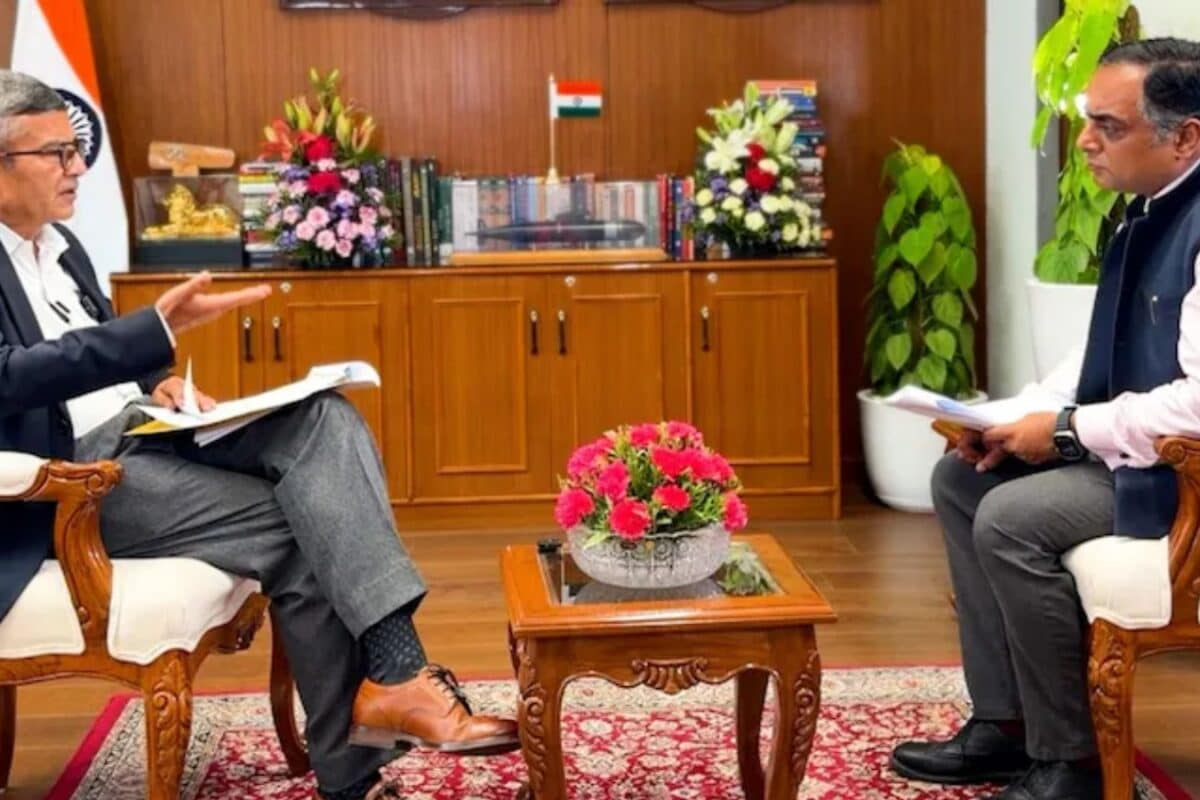
Hopeful Of LCA-2 Induction In Good Numbers After September: Defence Secretary | Exclusive Reported By, Last Updated: July 27, 2026, 20:26 IST In an exclusive interview with Moneycontrol, the defence secretary said the government's job is to develop a drone ecosystem of global levels in the country. Defence secretary Rajesh Kumar Singh spoke exclusively to Moneycontrol’s managing editor Nalin Mehta (right) Defence secretary Rajesh Kumar Singh speaks exclusively to Moneycontrol’s Nalin Mehta on how India is building a drone ecosystem of global levels, rising private sector investments and the transformation of India’s defence ecosystem. Singh also holds additional charge as Secretary, Department of Defence Research and Development and as Chairman, DRDO. Edited excerpts. Q: You have forcefully argued that technology is the foundation of strategic power, and India is looking for strategic autonomy. Can you outline some of the key policy measures in the defence sector that have enabled the shift into a level playing field for the private sector, ease of doing business, long term visibility and orders? What has changed in the last 2-3 years? I continue to believe strongly that technological sovereignty and industrial strength will decide your military capabilities as well and our job is to ensure that we increasingly design, develop and produce our own weapons and platforms. The structural transformation we are trying to do, really, is that we create a level playing field for the private sector as well as for startups. Create visibility in terms of orders on the demand side, given that it is a single buyer market, and we create ease of doing business on the supply side so that both new entrants and existing players feel confident and make investment in our defence ecosystem. We have also tried to ensure indigenization in terms of making sure that in our system of procurement, 75% of our budget is earmarked for domestic orders and that imports become an exception rather than a norm, and also ensuring that within these domestic procurement, it is the IDDM category- which is indigenous design, development and manufacturing – which gets top priority. Q: India has about 16 defence PSUs, 500 licensed defence companies, 17,000 MSMEs roughly. What kind of growth do you foresee for companies working in this sector and what is your message for investors? This is a sector which has reached a certain critical mass. It is growing well. It is backed up given the fact that there is a monopsony. The government buying will matter and government buying is going to step up. Our budget has increased significantly in the last financial year. So there is a budget support. Overall, geopolitical conflicts have risen at the highest rate, perhaps since World War 2, across the world. There is an upside in this market and therefore there is investor interest. From our side, we are supporting it on the demand side through visibility in orders and, on the supply side, through greater ease of doing business. Some of the interest that is being reflected is shown, for example, by the fact that we had about 250 odd industrial licenses issued till 2015. Thereafter, in the last 10-11 years the number has gone to over 800. We have multiple licenses coming in every day. Investor interest is there. The venture capitalists are coming in, the startups are moving in, and the government is trying to ensure that in this sector, we support them through orders that are placed as quickly. To ensure that particularly the startups who have a funding issue, who have funding constraints, we give them orders so that they are able to capitalize on the investments and on the technology development that they have done. Q: Given that the government is the only buyer in this case, can you outline specific measures on how do you encourage startups in terms of research funding and expansion? How does that work and how is it changing? From the DRDO, we now have an internal earmarking that 25% of our R&D budget is reserved for industry, for startups and for academia. We also have this scheme of centers of excellence. We have some 11 centers of excellence across different academic institutions where we work, along with the academia in specific domains in defence. As far as procurement is concerned, defence is the only department which has a scheme called IDEX, which actually promotes startups, ensuring that they are supported till they build prototypes. Thereafter, of course, they have to go through a bidding process. But in our revived defence procurement procedure, we are trying to bring in systems where if something is developed in consultation with or in conjunction with the services or with us, that we should give him some repeat orders, at least for a certain period of time, say five years until and thereafter make it open. All those reform measures are either completed or they are on the anvil under the new procedure that we have, the draft of which is already available in the public domain." Q: What are the lessons India learnt from Operation Sindoor? We saw drones dominating the conflict. With countries like Ukraine producing about 11 million drones a year, how are we changing the way we look at drone production? What has changed since then? Obviously, we have to ensure that we keep up with the trends. In modern warfare, it is very clear that increasingly we are going to see much more usage of unmanned systems of precision, long range standoff weaponry of different types, and a much greater focus on autonomous systems of different types, land, and may be underwater as well. And of course, drones is what everybody talks about and how it has made a significant difference in the Middle East and the Ukrainian conflicts. Our job is to ensure that we develop a drone ecosystem of global levels in this country. We’ve tried to, again, do that by ensuring that for drones and for low cost, but fast moving weather is fast moving. We provide a system of quick inductions, quick trials, and that you will see we’ve already done that through the emergency procurement right after Operation (Sindoor) in which almost Rs 31,000 crore worth of equipment was ordered very, very quickly. The bulk of it was on drones and counter-drone systems and lightweight radars. Over time, you will see that in these areas, government support will be through the orders that it places. But, for drones for different items of new age warfare, we will ensure that quick inductions are done through fast tracked procedures to give support to this fast evolving drone and unmanned ecosystem in this country.
 The BriefWire