Dutch scientist created bacteria that repair cracked buildings by turning cracks into stone, making concrete heal itself and saving billions in repair costs
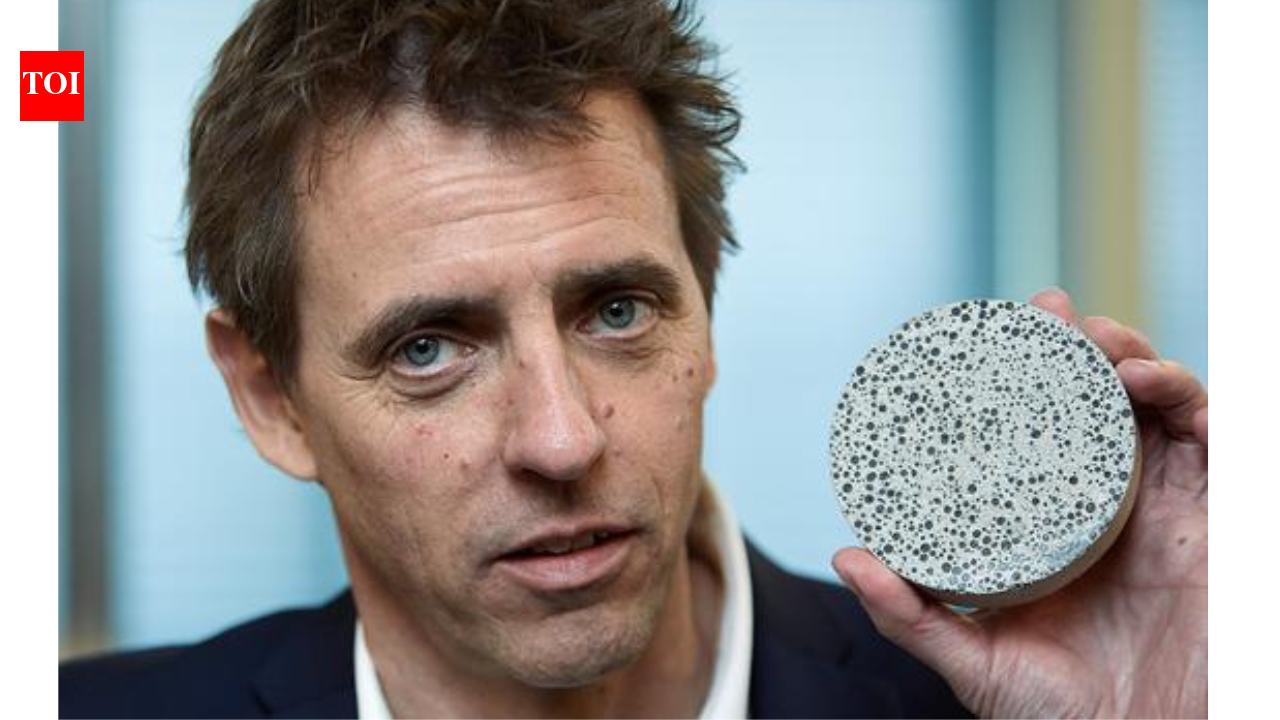
Dutch microbiologist Professor Henk Jonkers holds a sample of self-healing concrete, an innovation that uses bacteria to repair cracks automatically. Who is the Dutch scientist
Dutch microbiologist Professor Henk Jonkers holds a sample of self-healing concrete, an innovation that uses bacteria to repair cracks automatically. Who is the Dutch scientist behind self-healing concrete? How do bacteria repair cracked buildings? What studies proved that self-healing concrete works? How much damage can the bacteria repair? Could this technology save billions in repair costs? Has self-healing concrete been used outside the laboratory? Why could self-healing concrete transform construction? Concrete is the backbone of modern civilisation, supporting everything from homes and skyscrapers to bridges, tunnels and dams. Yet even this remarkably strong material has a costly weakness. Tiny cracks inevitably develop over time because of ageing, weather, heavy traffic and earthquakes, allowing water to penetrate and corrode the steel reinforcement inside. Repairing damaged concrete infrastructure costs governments and businesses billions of dollars every year. What if these structures could repair themselves just as human skin heals after a cut? That once far-fetched idea became reality when Dutch microbiologist Professor Henk Jonkers developed self-healing concrete using bacteria that produce calcium carbonate, commonly known as limestone, enabling cracks to seal themselves naturally and potentially extending the lifespan of buildings while reducing maintenance costs.The breakthrough was pioneered by Professor Henk Jonkers, a microbiologist at Delft University of Technology (TU Delft) in the Netherlands. Unlike traditional civil engineers, Jonkers specialised in microbiology and wondered whether living organisms could solve one of construction's oldest problems.Inspired by the human body's ability to heal wounds, he spent years studying bacteria capable of surviving in extremely harsh conditions.His research eventually led to the development of self-healing concrete containing dormant bacterial spores that remain inactive until cracks appear.Jonkers' work gained international recognition after receiving support through European research programmes and has since become one of the world's best-known examples of bio-inspired engineering.The secret lies in a group of naturally occurring bacteria from the Bacillus family, including species such as Bacillus pseudofirmus and Bacillus cohnii.
These bacteria are specially selected because they can survive the highly alkaline environment inside concrete.During construction, bacterial spores are mixed into the concrete along with tiny capsules containing nutrients such as calcium lactate. Under normal conditions, the bacteria remain dormant for decades because there is no moisture inside healthy concrete.When a crack develops, rainwater enters the concrete and activates the bacteria. The microorganisms consume the nutrients and convert them into calcium carbonate, commonly known as limestone. This newly formed limestone gradually fills the crack, preventing further water penetration and protecting the steel reinforcement inside the structure.Once the crack has been sealed and moisture disappears, the bacteria become dormant again until they are needed.One of the earliest landmark studies was "Application of bacteria as self-healing agent for the development of sustainable concrete," published in the journal Ecological Engineering. The study was authored by Henk M. Jonkers, Arjan Thijssen, Gerard Muyzer, Oğuzhan Çopuroğlu and Erik Schlangen, and demonstrated that bacteria could successfully seal cracks by producing biologically formed limestone.Further research by TU Delft's Microlab and the university's Department of Materials and Environment showed that the bacteria remained viable inside concrete for many years and could repeatedly heal small cracks after exposure to water.Another influential publication, "Bacteria-based concrete: From concept to market," by Henk M. Jonkers, explained how the technology progressed from laboratory experiments to pilot-scale applications, highlighting its ability to improve the durability and watertightness of reinforced concrete structures while reducing maintenance requirements.Researchers around the world, including teams in the United Kingdom, Belgium, China, South Korea and India, have since validated and expanded upon Jonkers' work, making self-healing concrete one of the fastest-growing areas of sustainable construction research.Current versions of bacterial concrete can typically repair cracks measuring up to around 0.5 to 1 millimetre wide, depending on the concrete mixture and environmental conditions.Although that may sound small, these hairline cracks are often the starting point for much larger structural problems.
 The BriefWire