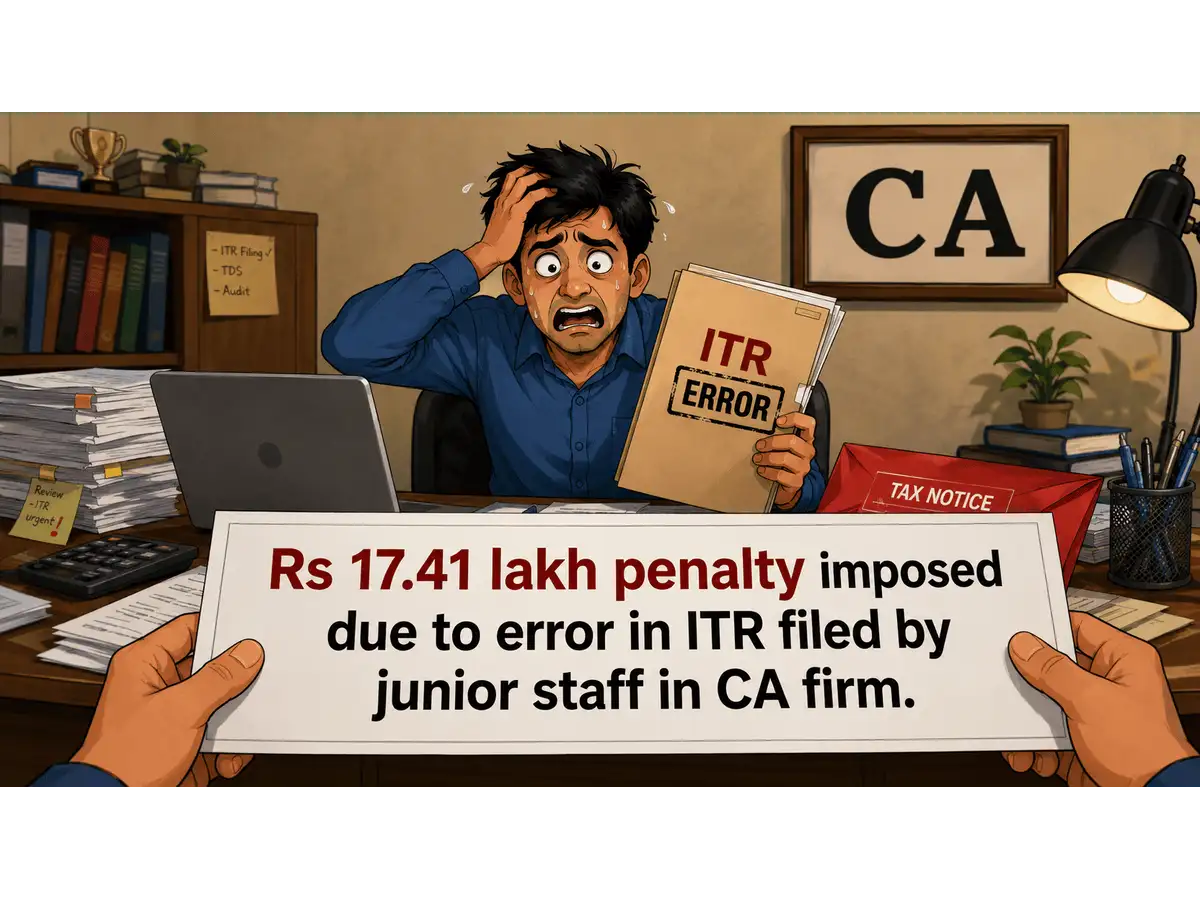
Rs 17.41 lakh penalty for ITR filing error
Summary of the judgement Why did the taxpayer win the case? A revised income tax return (ITR) filed on April 7, 2018, by a taxpayer
Summary of the judgement Why did the taxpayer win the case? A revised income tax return (ITR) filed on April 7, 2018, by a taxpayer from Kalbadevi, Mumbai, for the assessment year (AY) 2017-18, triggered a prolonged tax dispute after it raised red flags within the income tax system. The taxpayer had originally filed the return on November 28, 2017, reporting a loss of Rs 1.59 lakh, but in the revised ITR, the taxpayer declared a loss of Rs 1.06 crore, a huge jump that led to an anomaly in the tax system and ultimately resulted in a long tax dispute.Thus, the ITR was selected for scrutiny under Computer-Assisted Scrutiny Selection (CASS), and the income tax department issued notices under Sections 143(2) and 142(1).Responding to the taxpayer department's query regarding the discrepancy, the taxpayer explained to the tax department that the exempt share of profit had been inadvertently deducted while preparing Schedule BP, even though it had not been credited to the Profit and Loss Account. The taxpayer said that the error was clerical and unintentional and accepted that the current year's loss figure required re-computation.The taxpayer said the error occurred only in Schedule BP, where the exempt income was inadvertently deducted again, resulting in an inflated loss. The taxpayer also submitted that the lapse was committed by the clerical staff of the CA firm that filed the ITR and provided an affidavit from the proprietor of the said CA firm.The income tax assessing officer rejected the explanation on the ground that the mistake had resulted in substantial increase in loss to the benefit of the taxpayer and that the taxpayer had repeated the same error even in the revised ITR.Thus, the Income Tax Assessing Officer treated the reduction of loss, including the disallowance under section 14A, as under-reported income in consequence of misreporting, quantified under-reported income at Rs 1.05 crore, and levied a penalty of Rs 69.67 lakh, being 200% of tax payable on this alleged under-reported income.Feeling aggrieved, the taxpayer filed an appeal with the commissioner of appeals (CIT A) who after hearing the case reduced the penalty from Rs 69.67 lakh to Rs 17.41 lakh.
Still aggrieved, the taxpayer appealed before the Income Tax Appellate Tribunal (ITAT) Mumbai.On June 23, 2026, the ITAT Mumbai's B Bench heard the case and on July 8, 2026, the ITAT Mumbai passed an order in the taxpayer's favour deleting the penalty entirely. This ruling was delivered by Mr Saktijit Dey, Vice President, and Mr Makarand Vasant Mahadeokar, Accountant Member of the ITAT Mumbai.Keep reading to know how the taxpayer won the case.Chartered Accountant Suresh Surana said to ET Wealth Online that the Mumbai B Bench of the ITAT, in this case, dealt with the levy of a penalty under Section 270A of the Income-tax Act, 1961, in a case where the assessee's ITR declared loss was reduced during assessment due to an error in the return.The assessee (the taxpayer) in the original ITR for AY 2017-18 reported a loss, and in the revised ITR, the taxpayer declared a higher loss. During scrutiny assessment, the assessing officer noticed that the assessee was a partner in a firm and had earned an exempt share of profit from the firm amounting to Rs 1.04 crore, says Surana.Although this exempt income was disclosed in Schedule EI and reflected in the balance sheet, the assessee had also wrongly deducted the same amount in Schedule BP (Computation of income from business or profession), even though it was not credited to the Profit and Loss Account. This resulted in an inflated loss in the ITR, she says.Surana says that during assessment proceedings, the assessee accepted the mistake and explained that the error was clerical and inadvertent, arising at the time of return preparation.Surana says: "The assessee also placed on record an affidavit of the Chartered Accountant stating that the mistake had occurred due to an error by junior staff handling the ITR filing."The assessing officer, however, treated the reduction of loss as under-reporting due to misreporting and levied a penalty equivalent to 200% of the tax payable under Section 270A.On appeal, the CIT(A) reduced the penalty from 200% to 50% by treating the matter as under-reporting covered by Section 270A(2)(g) but sustained the penalty to the extent of Rs 17.41 lakh.Surana says that the ITAT Mumbai deleted the penalty and held that this case was not suitable for the imposition of a penalty under Section 270A.The tax tribunal noted that the primary facts were already disclosed in the ITR itself.
 The BriefWire