SpaceX eyes tower catch for next Starship after auspicious end to 13th flight
SpaceX was more than lucky Friday, sending its 13th full-scale Starship test flight halfway around the world from South Texas to an on-target, intact splashdown
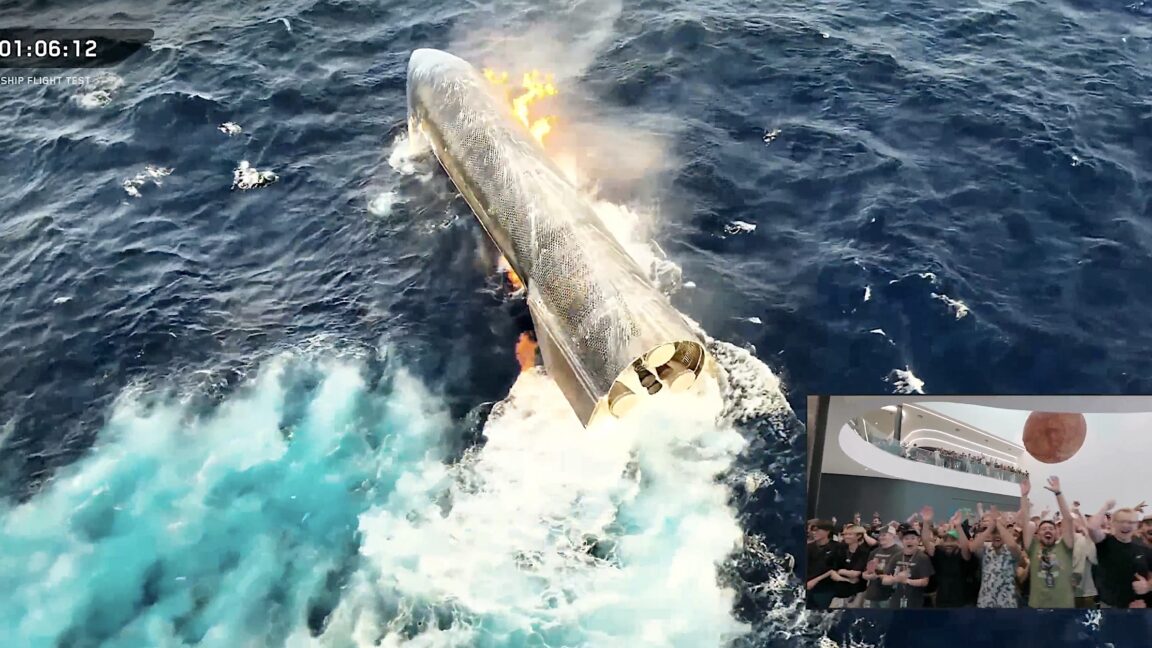
SpaceX was more than lucky Friday, sending its 13th full-scale Starship test flight halfway around the world from South Texas to an on-target, intact splashdown in a remote section of the Indian Ocean. Starship has made precise splashdowns before. This time, however, the ship gently tipped over and came to rest floating in a remote stretch of ocean west of Australia. Previous splashdowns ended with conflagrations, an outcome SpaceX officials have come to expect with each water landing of Starship. The buoyant Starship looked to be in fine shape after reaching the Indian Ocean. SpaceX engineers flew drones over the vehicle to inspect its heat shield, getting their best look yet at how more than 18,000 ceramic tiles insulating the ship's stainless steel airframe weathered the trip to space and back. The tiles withstood temperatures up to 2,600° Fahrenheit (1,430° Celsius) as Starship streaked back into the atmosphere at the end of its hour-long flight from Starbase, Texas. Encouraged by the picture-perfect end to Friday's flight, SpaceX is likely to take the next leap with Starship on the next launch, according to the company's founder and CEO, Elon Musk. That would entail hurling Starship on a longer-range trajectory, perhaps into low-Earth orbit, to bring the vehicle back to the launch site. Mechanical arms on the launch tower will attempt to capture the ship as it slows to a hover. SpaceX has already done this with the rocket's massive Super Heavy booster, which is larger and heavier than Starship itself, but comes back at a fraction of the speed. "Unless we discover problems after mission data review, SpaceX will attempt to catch the ship with the tower on next flight," Musk wrote on X Friday evening. Starship's six Raptor engines afloat in the Indian Ocean. Credit SpaceX Hungry for data Engineers have long identified the performance and durability of the heat shield as one of the toughest challenges for the Starship program. SpaceX's ambition for Starship includes rapid turnarounds, and eventually multiple flights per day. If this is to be achievable, the heat shield has to be robust against the vibrations and extreme temperatures it sees during launch and reentry.
It can't be refurbished or replaced after every flight. "This is the first time we’ve put an intact Starship in the water," said Dan Huot, a SpaceX communications manager providing commentary on the company's live webcast. "This is a dream scenario for the team that’s trying to get this heat shield data." The intact splashdown Friday also opens up the possibility for SpaceX to tow the rocket back to shore, probably somewhere in Australia, for more detailed inspections. Starship is designed for reuse, but not after exposure to salt water. "This is so critical for refining the heat shield and everything else. The really good news is … you’re looking at a pretty intact-looking heat shield," Huot said. "We were flying at a significantly higher dynamic pressure, so putting way more stress on this vehicle on the way uphill, and it's sitting there in the water." SpaceX continued receiving signals from Starship after splashdown through the company's Starlink satellite broadband network. A camera onboard Starship showed no signs of external damage to the vehicle's six Raptor engines as water lapped against the lens. Friday's test flight was the 13th launch of SpaceX's Starship on top of its massive Super Heavy booster, and the second flight of the latest iteration of the world's most powerful rocket—Starship Version 3. Starship and its Super Heavy booster lift off from SpaceX's launch site in South Texas at 5:51 pm CDT on July 24, 2026. Credit Reginald Mathalone/NurPhoto via Getty Images The 408-foot-tall (124-meter) rocket lifted off from Starbase, Texas, a few miles north of the US-Mexico border, at 5:51 pm CDT (6:51 pm EDT; 22:51 UTC). Thirty-three methane-fueled Raptor engines on the Super Heavy booster steered the rocket east over the Gulf of Mexico and into the upper atmosphere, where the booster separated from Starship's upper stage after burning most of its cryogenic propellant. The only thing left incomplete on SpaceX's checklist for Flight 13 was the controlled splashdown of the Super Heavy booster. It was supposed to relight its engines for a landing burn off the coast of Texas, simulating maneuvers required to return the booster back to the launch pad for recovery and reuse.
 The BriefWire