Three meetings, three photos: Story of the govt-CJP negotiations
Dharmendra Pradhan's resignation as Union Education Minister changed everything for the Cockroach Janta Party (CJP). And on July 25, that shift was written all over
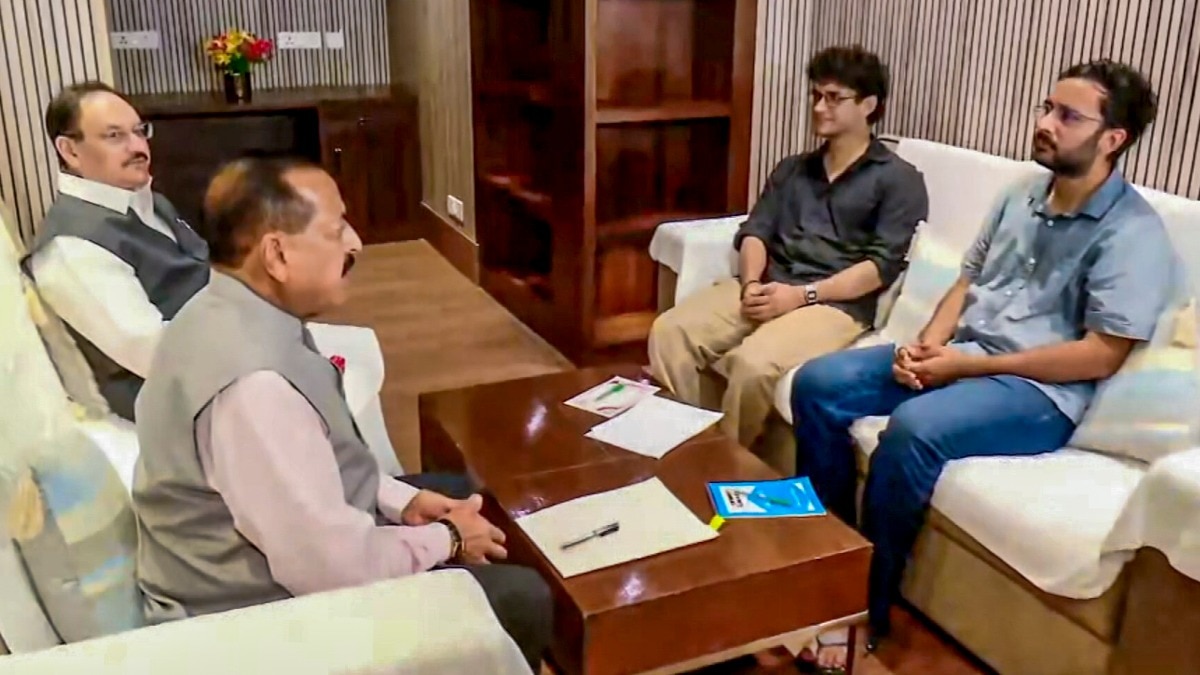
Dharmendra Pradhan's resignation as Union Education Minister changed everything for the Cockroach Janta Party (CJP). And on July 25, that shift was written all over the body language of its representatives, Saurav Das and Abhishek Ranka. Just 24 hours earlier, the picture had been the exact opposite. During the second round of talks on July 24, Union ministers JP Nadda and Jitendra Singh occupied the sofa, relaxed and cheerful. Das and Ranka sat upright on chairs opposite them, serious and restrained. Visually, they were still the ones asking the government for something. The second round of talks was held on July 24. Read Full Story By the third meeting on July 25, hours after Pradhan's resignation, the equation had flipped entirely. Das and Ranka now sat visibly relaxed on the sofa.
Das smiled through much of the interaction. Nadda and Singh, by contrast, looked pensive and serious as the marathon meeting got underway. Pradhan's resignation had been the CJP's central demand, a condition it had set for the dialogue to continue at all. Once that demand was met, the optics of the meeting changed completely. The third meeting was held on July 25. The first meeting, on July 20, had set an entirely different tone. Das and Ranka sat huddled together on a sofa. Nadda sat comfortably across from them, going through the CJP's charter of demands. The government looked to be in the driving seat. The protesters looked like they were making their case. The first-ever meeting between the CJP and the government took place on July 20.
The government had refused to accept Pradhan's resignation at that stage and instead tried to defuse the protests through fast-track courts and other measures aimed at students' concerns. But sources told India Today that during the July 24 round, the protesters handed the government a 72-hour deadline. Pradhan's resignation became non-negotiable. If it did not happen, they threatened to march on Parliament again. The ultimatum came when the government was already under pressure. Prime Minister Narendra Modi, who had largely stayed out of directly addressing the protests, released two back-to-back selfie videos aimed at Gen Z. By July 25, the demand that looked impossible to meet a day earlier had been met. Das and Ranka no longer looked like petitioners waiting on the government. They looked like representatives who had won.
The clearest signal came at the end of the meeting. As the two sides shook hands, Das's grip was confident, almost assertive, a small but telling marker of how much had shifted in just 24 hours. The CJP called off its stir after the Modi government accepted its demands. On July 20, the government held the upper hand. On July 24, that had not changed. By July 25, after Pradhan's resignation, it was the CJP representatives who looked confident, and the government's ministers who looked pensive. British Prime Minister Harold Wilson once said, "A week is a long time in politics." The photographs from these five days of talks make the case better than any quote could. Ends
 The BriefWire