Youth is not wasted on the young: How Gen Z is rewriting the protest playbook
Sometimes journalists ask stupid questions. ‘Are you scared?’ was mine. I shouted it out to three young protesters as they scurried along Sansad Marg with
Sometimes journalists ask stupid questions. ‘Are you scared?’ was mine. I shouted it out to three young protesters as they scurried along Sansad Marg with a cluster of others, weaving through the chaos. It was July 20, and they were marching toward Parliament in New Delhi. This particular group had already tried to breach a police barricade three times. Each attempt had been pushed back by the Delhi Police and the Rapid Action Force. The fourth attempt was met with three rounds of tear gas. Then came the lathis. Read Full Story The air was thick with cries of "Dharmendra Pradhan istifa do" (Dharmendra Pradhan, resign), thick with tear gas that burned the throat more than it stung the eyes, and thick with a resilience that kept drawing them back for a fifth attempt, then a sixth. Through the haze, I spotted the three. Their eyes were streaming from the gas, their faces flushed with adrenaline. One had a fresh welt across his back where a lathi had landed. "Are you scared?" I asked. They looked at me with disdain. "No. Why should we be scared?" one shot back. "We are disgusted." Even as I walked away, I knew I had asked the wrong question. It should never have been, “Are you scared?” Four days later, though, I would know the answer to that question with absolute certainty. They were not scared. This generation is not defined by fear. Whatever one may think of their politics or their methods, fear is not what drives them. At 3 pm on July 20, near Le Meridien, the Delhi Police crackdown reached its peak. The standoff between protesters and police was coming to a head, with tensions mounting on both sides. Having covered enough protests as a journalist, I thought I knew what to expect. But what I witnessed in those moments of intense friction was both surprising and, oddly enough, deeply amusing. As rows of police officers clad in riot gear braced for a possible charge, and groups of protesters gathered at the barricades looking for an opening, a very different scene was unfolding in the middle of the chaos.
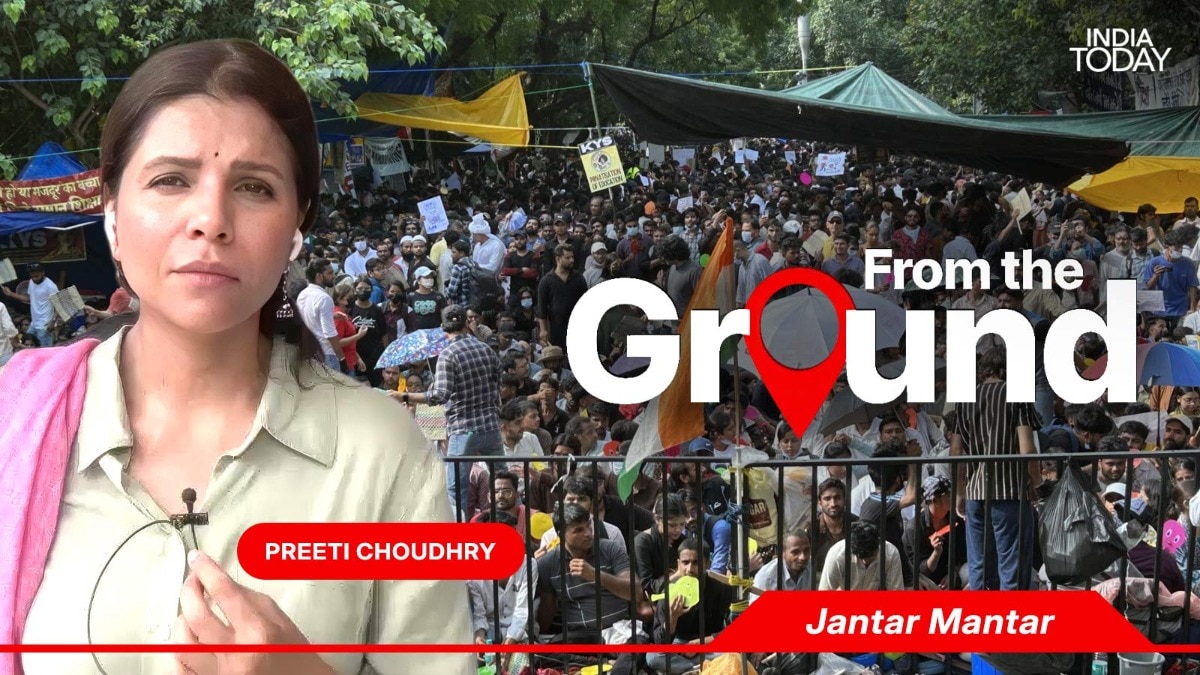
One young woman was calmly filming a reel about how getting her nails done before attending a protest had turned out to be a terrible idea. Just beside her, a friend had already spotted the day's most It was a surreal juxtaposition: the gravity of an imminent confrontation met with the instincts of the social media age. Even as the situation threatened to erupt, phones remained raised and cameras kept rolling. The next day, the street face-off had retreated to Jantar Mantar. My cameraperson and I made our way to the protest site, where the chants reached us long before the crowds came into view. The slogans echoed through the air well before we encountered the snaking queues of people waiting to enter. The familiar call-and-response style of protest slogans remained, but with a distinctly Gen Z twist. Many were witty, irreverent, and unapologetically sharp -- some colourful enough to warrant an 18+ disclaimer. The same could be said for several posters and placards hoisted above the crowd. The humid, oppressive Delhi heat hung heavily over the site. Plastic hand fans fluttered constantly, while bottles of mineral water passed through the crowd, courtesy of both volunteers and fellow protesters. If someone looked overwhelmed by the heat, it was not unusual for a complete stranger to step in, fanning them as they waited their turn to pass through a flimsy metal-detector barricade. On July 24, the crowds entering from the Kerala Bhavan side had become almost unmanageable, even at the media entrance. For a while, I found myself caught in a crush beneath the metal detector, hemmed in by people packed so tightly that there was barely room to move. Having covered multiple protests over the years, I have experienced my share of overcrowded demonstrations. Yet what stood out that day was something unexpected: despite the sheer density of the crowd, not a single stray hand took advantage of the situation. My experience is, of course, anecdotal, but the respect people showed for one another’s personal boundaries -- even when there was virtually no personal space -- was unlike anything I had encountered at a protest of this scale.
 The BriefWire