Builder ordered to fix water issue in new house
Why did the homebuyer win this case? Telangana RERA's order and discussion RERA law imposes a five-year defect liability period on the builder General routine
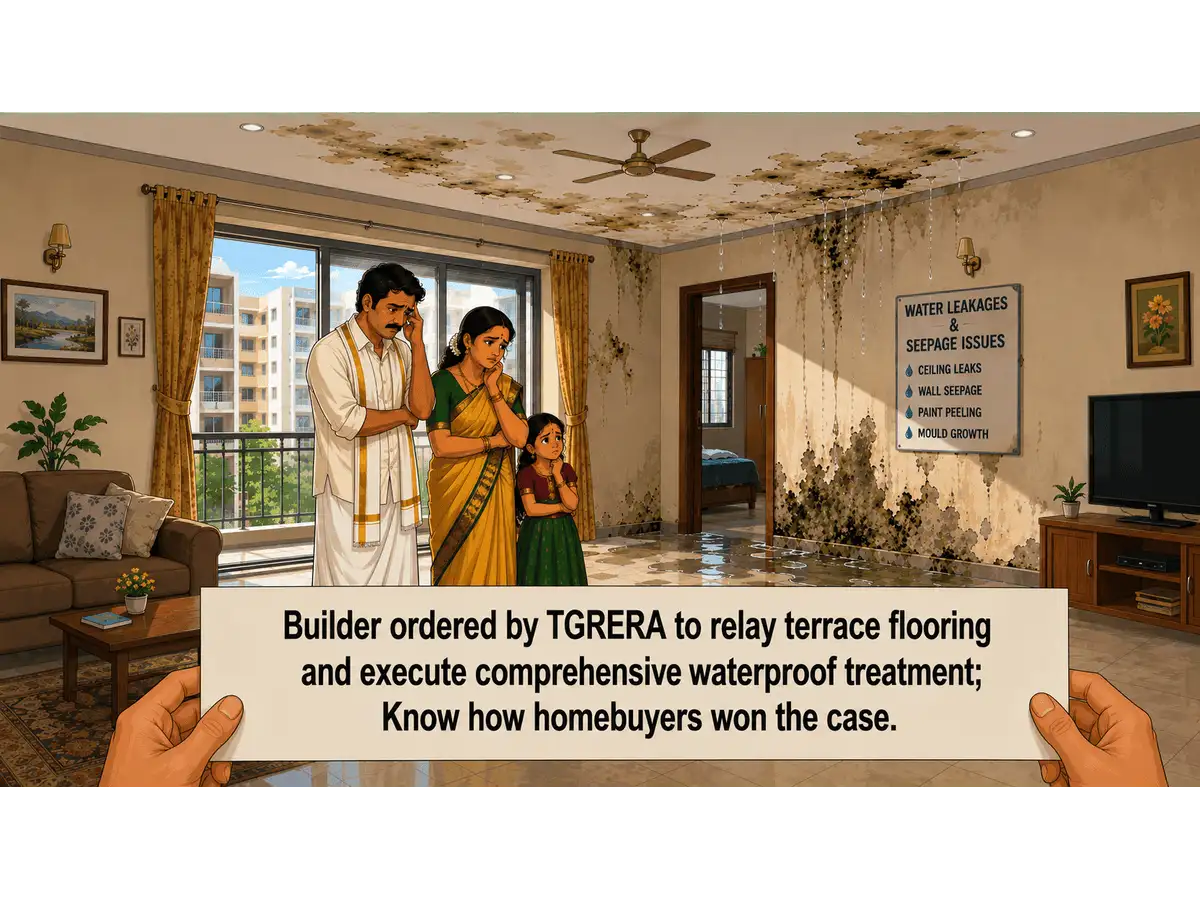
Why did the homebuyer win this case? Telangana RERA's order and discussion RERA law imposes a five-year defect liability period on the builder General routine maintenance is not builder's liability In a significant ruling, the Telangana Real Estate Regulatory Authority (TGRERA) recently held that water leakage from a terrace into the floor below is a clear indication of poor terrace flooring and inadequate waterproofing by the builder who is based out of Kondapur.On this ground, the TGRERA authority ordered the builder to ensure that the building's envelope is fully watertight by relaying the flooring and carrying out comprehensive waterproof work to permanently address the water seepage issue. The homebuyer had reported the problem barely three months after taking possession of the property.The Telangana RERA also cited Section 14(3) of the Real Estate (Regulation and Development) Act, 2016, which imposes a mandatory five-year defect liability period from the date of handing over possession, specifically for structural defects or any other defect in workmanship.This judgement came in a case filed by Mr Pasumarti from Bachupally, a rapidly developing residential suburb in north-west Hyderabad, regarding water-seepage issues in his newly purchased flat from a reputed Hyderabad builder.As per the submission, Mr Pasumarti purchased the flat in Bachupally on November 14, 2022, for Rs 48.64 lakh. The flat measures 1,555 sq. ft, and is registered with RERA (Registration No. P02200002830). Even after receiving the full agreed-upon sale consideration of Rs 48.64 lakh from Pasumarti, the builder, however, failed to execute a sale deed; only a sale agreement was signed.When Pasumarti sent a legal notice to the builder regarding the absence of a sale deed, the builder responded by saying that they are in the process of transitioning to an LLP structure, and their designated partner has exited the company, which may result in some delays. On August 31, 2024, the builder finally executed the sale deed.As per Pasumarti's contentions, he noticed severe structural and construction-related defects within weeks of taking possession of the flat. Among major issues was water leakage from the ceiling of his bathrooms situated directly below Flat No. 401. He also alleged significant water seepage from the terrace into the children's bedroom and guest bedroom, resulting in rust on the window grills and persistent dampness.So, Pasumarti complained to the builder about this through both WhatsApp and email.
However, the builder did not provide him with a permanent resolution regarding the issue. Consequently, he hired private technicians for temporary repairs, which ultimately proved to be ineffective.Pasumarti refused to pay the maintenance charges, citing this gross negligence. He also alleged that the society was formed under the influence of the builder in a manner that disregarded his legitimate concerns.Pasumarti also said that by the time the sale deed was signed, the structural defects worsened, leading to significant wall cracks in all three bathrooms and health issues for the occupants due to the moisture-laden environment.To support his allegations, Pasumarti hired a private company to conduct inspection and thermal scanning of the property. The agency's report confirmed deep-seated seepage and plumbing defects and recommended professional-grade waterproofing and relaying of the terrace flooring to prevent further structural deterioration.Accordingly, Pasumarti filed a complaint with Telangana RERA for directions, asking the builder to make the necessary repairs. He sought permanent rectification of the aforesaid defects instead of temporary repair work.The builder countered Pasumarti's contentions by saying that the alleged cracks in the flat are only hairline cracks arising due to normal settlement and usage of the building and do not constitute structural damage. Nevertheless, the builder told Telangana RERA that he is willing to undertake external crack-filling works wherever seepage is observed.Regarding the complaint about epoxy grouting in the bathrooms, the builder said that proper grouting work was done during construction and that any subsequent deterioration is due to normal wear and tear from usage; therefore, he is not liable for this, claimed the builder.After hearing their arguments and contentions, Telangana RERA on May 5, 2026, passed its order partly in the homeowner's favour.Aradhana Bhansali, Senior Partner, Rajani Associates said to ET Wealth Online: In the recent case of SVS Square Spaces LLP v. Vijay Kumar Pasumarti, the Telangana Real Estate Regulatory Authority (TGRERA Authority), the complaint against the promoter/builder (M/s SVS Square Spaces LLP) was on workmanship issues in the residential project with a direction against the promoter to rectify structural defects and workmanship issues, specifically regarding water seepage and leakages, in the project.Despite several complaints to the promoter to rectify the structural defects which went unheeded leading to significant wall cracks bathrooms and health issues for the occupants due to the moisture-laden environment and therefore the complaint was made.The TGRERA Authority observed that water leakages stemming from the terrace into the below floor constitute a clear instance of defective workmanship of the terrace flooring and an inadequate waterproofing course.
 The BriefWire