Retired police officer discovers an exceptionally rare white rattlesnake in Arizona, “once-in-a-lifetime” find
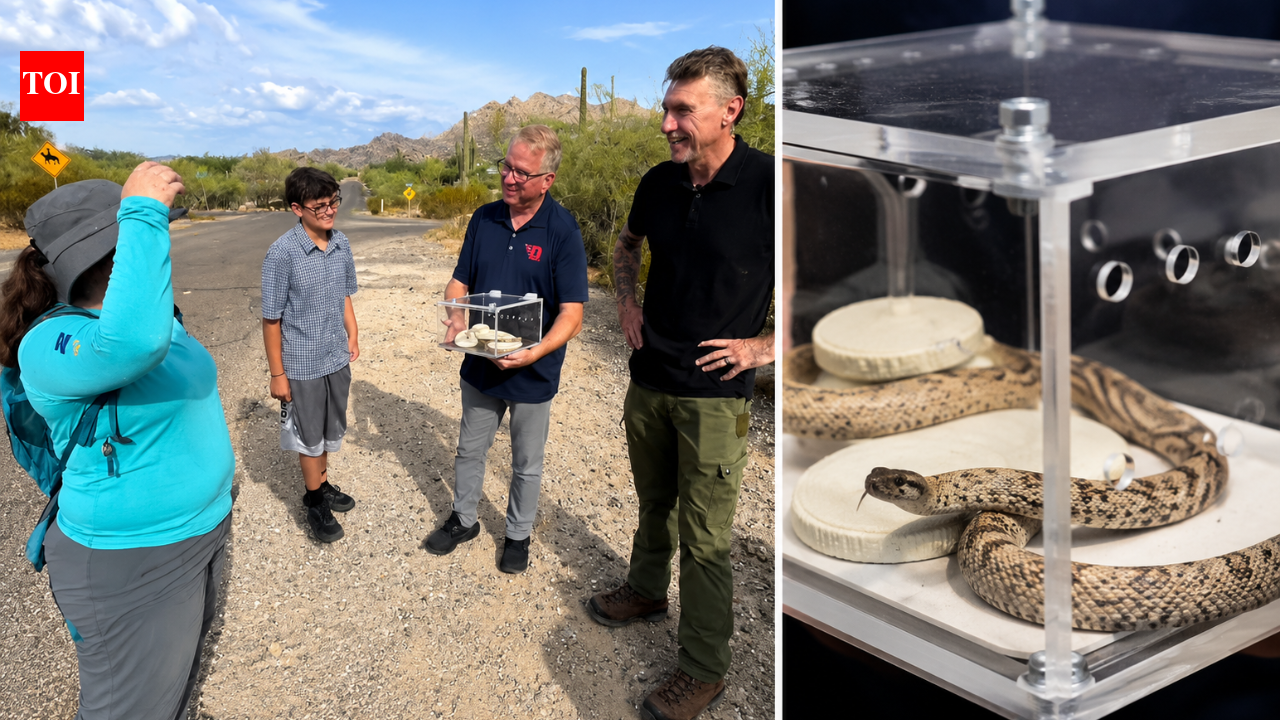
Image(s): Left/WRAL- AOL/Right/AI Generated How a routine outing led to an extraordinary discovery of a rare rattlesnake Why this rattlesnake discovery is so unusual, happens
Image(s): Left/WRAL- AOL/Right/AI Generated How a routine outing led to an extraordinary discovery of a rare rattlesnake Why this rattlesnake discovery is so unusual, happens "once-in-a-lifetime, " said Roberts Rare colour mutations are seldom seen in the wild Roberts says the experience was unforgettable Wildlife enthusiasts often spend decades searching for unusual colour variations in snakes without ever finding one. That is why a chance encounter in the Arizona desert has attracted widespread attention. Retired police officer Phil Roberts recently came across an extraordinarily pale rattlesnake whose striking white appearance stunned even experienced reptile experts. Although it initially looked almost ghost-like, the snake was not albino. Instead, specialists believe it displays an exceptionally rare genetic colour mutation. Roberts later described the discovery as something many lifelong snake experts never get to witness, with several telling him it was a "once-in-a-lifetime" find.As reported by AOL, Phil Roberts, a retired police officer and wildlife enthusiast, spotted the unusually coloured rattlesnake while exploring an area in Arizona.Recognising that the animal looked unlike any rattlesnake he had previously encountered, Roberts carefully documented the sighting before safely capturing and relocating the snake.
Photographs shared online quickly drew attention because of its almost entirely white body, interrupted only by faint markings.Speaking about the discovery, Roberts said many experienced snake specialists had told him the encounter was exceptionally uncommon."A lot of people far more knowledgeable on snakes than I will ever be have said this is a once in a lifetime capture," he said.Despite its snowy appearance, experts believe the snake is not a true albino. Albino reptiles completely lack melanin, resulting in white or cream-coloured skin accompanied by distinctive pink or red eyes. TheArizona rattlesnake, however, retained normally coloured eyes, indicating that another rare genetic mutation is responsible for its appearance.Specialists suggest the snake may exhibit leucism, a condition that causes a partial loss of pigmentation while leaving eye colour largely unaffected.
Such mutations are exceptionally uncommon in wild rattlesnakes, making sightings extremely rare.Because lighter-coloured snakes are often more visible to predators and prey, these genetic traits rarely persist for long in natural environments.Colour abnormalities such as leucism occur in many animal species, including birds, mammals and reptiles, but they are rarely documented in wild snake populations.For venomous snakes like rattlesnakes, camouflage is essential for both hunting and avoiding predators. An unusually white body can make concealment more difficult, potentially reducing an individual's chances of survival.That is one reason why reptile researchers and wildlife photographers consider naturally occurring white rattlesnakes to be remarkable finds.The discovery has generated considerable interest among wildlife enthusiasts, many of whom described the snake as one of the most unusual rattlesnakes they had ever seen.Roberts said he was humbled by the reaction from experienced herpetologists, noting that people with decades of experience studying snakes regarded the encounter as extraordinarily rare.While the snake's appearance may seem almost unbelievable, experts emphasise that it remains a wild venomous rattlesnake and should never be approached or handled by the public.
 The BriefWire