Why Iran's Pickaxe Mountain is a tough target for the US
Donald Trump has threatened to attack a suspected Iranian nuclear site buried deep under a mountain. Iran's Pickaxe Mountain remains one of the biggest unanswered
Donald Trump has threatened to attack a suspected Iranian nuclear site buried deep under a mountain. Iran's Pickaxe Mountain remains one of the biggest unanswered questions surrounding the country's nuclear program. A mysterious underground complex near Iran's Natanz nuclear facility is drawing global attention after US President Donald Trump suggested on Tuesday it could become the target of a military strike, with Trump claiming there may be uranium centrifuges located at the site. "We'll be hitting that area very probably pretty soon. And there's not a thing they can do about it," Trump said in remarks to reporters at the White House. Iran has threatened to "expand" the war if the US targets nuclear facilities. Tehran has released almost no information about the complex burrowed under what is known in Farsi as "Kuh-e Kolang Gaz La," or Pickaxe Mountain. Inspectors from the International Atomic Energy Agency (IAEA) have never been allowed inside, and much of what is known comes from satellite imagery and intelligence assessments rather than direct observation. Although the site has surfaced repeatedly in reports over the past few years, its purpose remains unclear. That uncertainty has made it one of the most closely watched locations linked to Iran's nuclear activities. What do we know about Pickaxe Mountain? The underground complex is located south of Tehran in Iran's Isfahan province, excavated inside a mountain about 2 kilometers (1.24 miles) from the Natanz uranium enrichment plant, one of the country's most important nuclear facilities.
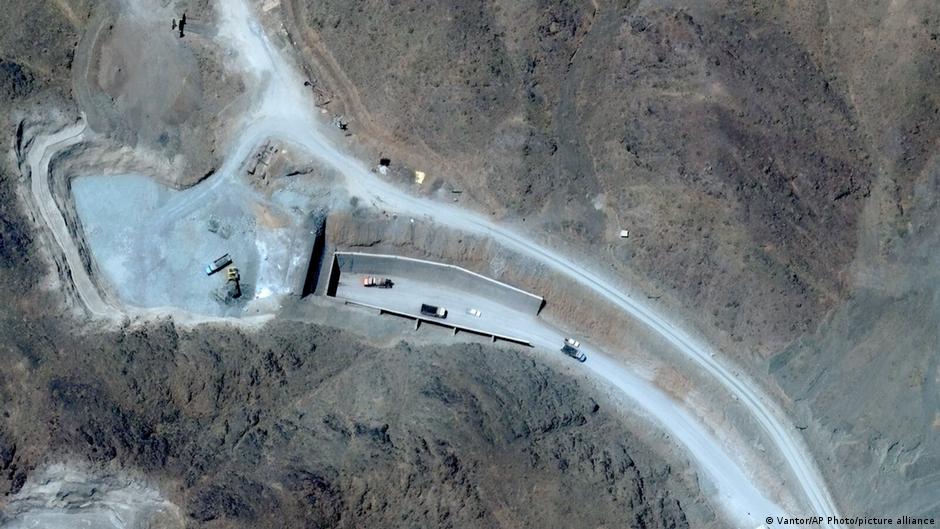
Commercial satellite images, including those published by Maxar Technologies, have shown continuous construction since 2020. They show new tunnel entrances, access roads, security installations and large amounts of excavated rock. Construction appears to have accelerated after an explosion damaged Iran's advanced centrifuge assembly workshop at Natanz in July 2020. Iranian authorities described the blast as an act of sabotage. Months later, Tehran announced plans for a new underground facility where advanced centrifuges could be assembled in a more secure location. Officials said the replacement site would be larger, more advanced and better protected than the one that had been damaged. The Washington-based Institute for Science and International Security estimates that parts of the facility may be buried 80 to 100 meters (330 feet) beneath the mountain. If accurate, the complex would be deeper than many of Iran's known nuclear sites and considerably more difficult to damage with an air strike. IAEA Director General Rafael Grossi has repeatedly said that agency inspectors have never been granted access to the site. Without inspections, the agency cannot verify whether nuclear material, centrifuges or other sensitive equipment are present. Reports of centrifuges in the Pickaxe complex In June 2026, The Wall Street Journal reported that Israeli intelligence has assessed that Iran may have transferred "thousands of uranium-enrichment centrifuges" components or other sensitive equipment to the complex in the months following the 12-day bombing campaign from the US and Israel in June 2025. Trump was asked about the report on Tuesday, and said that Iran "may have" moved the centrifuges to Pickaxe Mountain, but "we don't have it on record." Some analysts also believe the complex could eventually support the production or assembly of advanced centrifuges if Iran decides to restore or expand those capabilities.
 The BriefWire