The Manhattan Project town of Los Alamos now has America's highest share of doctorate holders. Nearly 1 in 5 adults has a PhD and almost 70% hold a bachelor's degree
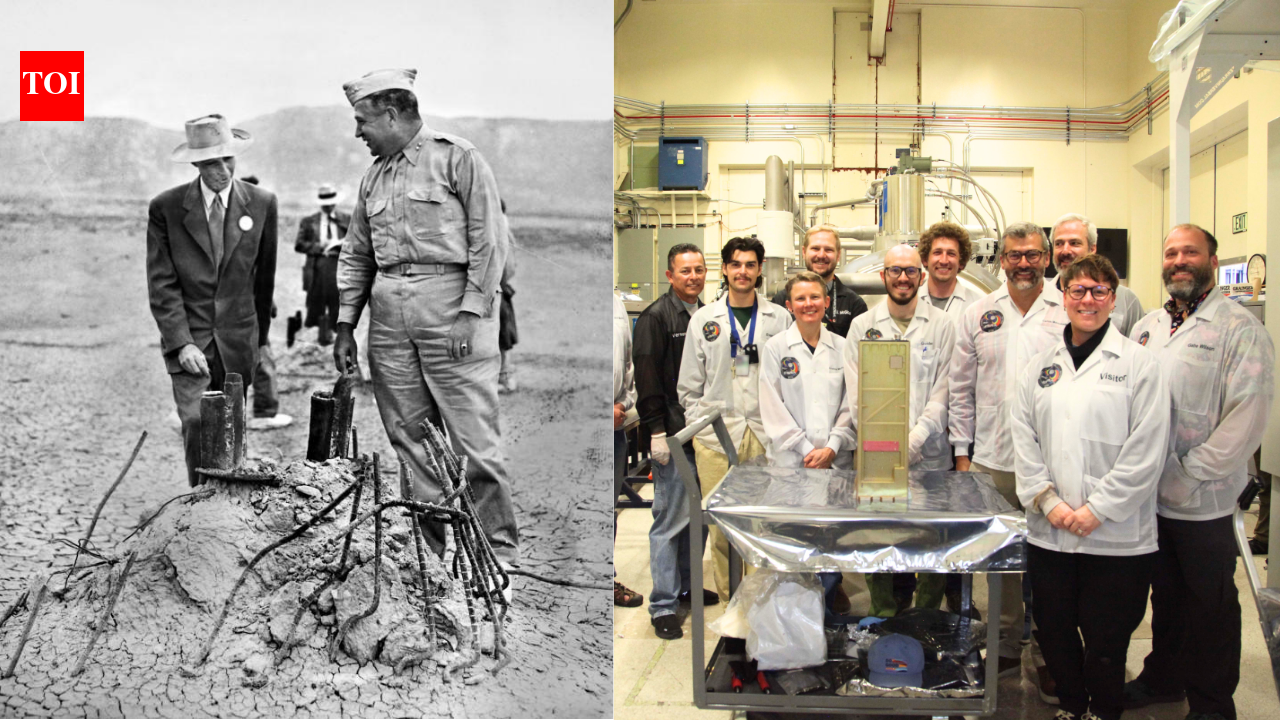
J. Robert Oppenheimer and Major General Leslie R. Groves inspect Ground Zero after the Trinity Test in New Mexico, July 1945 (left), Members of the
J. Robert Oppenheimer and Major General Leslie R. Groves inspect Ground Zero after the Trinity Test in New Mexico, July 1945 (left), Members of the Los Alamos Laboratory team behind the design, assembly and testing of the Autonomous Ion Mass Spectrometer (AIMS) Sentry instrument (right). How the Manhattan Project turned Los Alamos into America's most educated county Nearly one in five adults has a doctorate Los Alamos Laboratory. Almost 70% of residents have at least a bachelor's degree The role of Los Alamos Laboratory A county built around science and innovation Nobel Prize connections and scientific breakthroughs Why Los Alamos continues to attract the world's brightest minds More than a historic town Hidden among the mesas of northern New Mexico lies a community unlike any other in the United States. Los Alamos, once a secret town built to support the Manhattan Project during World War II, is now recognised as America's most educated county by one remarkable measure: nearly one in five adults aged 25 and older holds a doctoral degree. Its academic profile goes even further, with almost 70% of residents having at least a bachelor's degree, nearly double the national average. The transformation of this once-classified scientific outpost into a global hub for research, innovation and advanced education continues to shape its economy, workforce and reputation decades after the first atomic bomb was developed there.Los Alamos was established in 1943 as the secret headquarters of the Manhattan Project, the top-secret US programme that developed the world's first nuclear weapons during World War II. Physicist J. Robert Oppenheimer selected the remote New Mexico mesa because of its isolation, making it an ideal location for highly classified research.The project brought together some of the greatest scientific minds of the 20th century, including Enrico Fermi, Richard Feynman, Hans Bethe, Edward Teller, Stanislaw Ulam and many other renowned physicists, chemists, engineers and mathematicians.
Thousands of scientists, military personnel and support staff worked behind barbed wire under strict secrecy, with many residents unaware of the project's true purpose.Following the war, the laboratory remained operational instead of shutting down, evolving into one of the United States' premier national research centres. That decision permanently changed the region's identity, attracting generations of highly educated researchers whose presence continues to define Los Alamos today.According to the US Census Bureau's American Community Survey, 19.7% of adults aged 25 and older in Los Alamos County hold a doctoral degree, the highest proportion among all US counties.To put that into perspective, the national average is roughly 2.5%, meaning Los Alamos has nearly eight times the national share of doctorate holders. Few places anywhere in the country come close to concentrating so many highly educated professionals within a single community.The figure reflects the county's unique workforce, where physicists, chemists, engineers, computer scientists, mathematicians and national security specialists make up a significant share of residents. Many employees hold PhDs because their research involves advanced scientific disciplines ranging from nuclear physics to artificial intelligence and quantum information science.The county's educational profile extends well beyond doctoral degrees. Census data show that 69.7% of residents aged 25 and older have at least a bachelor's degree, compared with 35.7% nationwide.That means nearly seven out of every ten adults in Los Alamos have completed university education, making the county one of the most academically accomplished communities in the United States.The high level of educational attainment reflects decades of recruitment by research institutions and federal agencies seeking highly qualified professionals. Scientists, engineers, software developers, statisticians and technical specialists continue to relocate to Los Alamos from leading universities across the US and abroad, contributing to a workforce with unusually high academic credentials.The biggest reason behind these extraordinary numbers is Los Alamos Laboratory (LANL), one of the world's leading scientific research institutions.Originally created during the Manhattan Project, the laboratory now operates under the US Department of Energy's Nuclear Security Administration.
 The BriefWire