Canada-EU: Closer trade ties to counter Trump?
Given they share the world's longest land border, Canada and the US have historically enjoyed fruitful trade relations. But with Donald Trump escalating his tariff
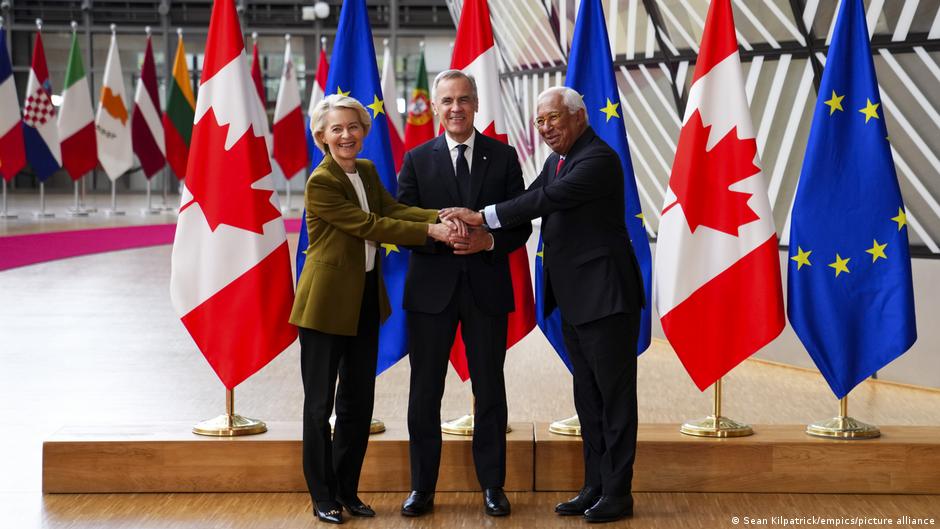
Given they share the world's longest land border, Canada and the US have historically enjoyed fruitful trade relations. But with Donald Trump escalating his tariff war, Canada is looking to the EU and further afield. The latest salvo in US President Donald Trump's freewheeling trade war could have disastrous effects for Canadian business. But the new tariff threats may also open up trade opportunities elsewhere, with China and the EU in a strong position to benefit. Trump's planned 50% tariff on a range of imported goods ranges from wine to hockey sticks but does not include other key sectors such as energy, potash and fish. It is expected to impact about 5%, or $20 billion (€17.5 billion) worth, of goods and "the impact could be devastating for the people in businesses involved," Julian Karaguesian, an economics lecturer from Canada's McGill University, told DW. Trump hits Canada with 50% tariffs in major trade escalation To view this video please enable JavaScript, and consider upgrading to a web browser that supports HTML5 video Canada's Prime Minister, Mark Carney, has promised to take "any measures necessary" to protect Canadian workers, farmers and businesses, likely by moving away from a single major trading partner. Canada seeks to further diversify trade after Trump tariffs "The Canadian policy has, for a while now, been to diversify trade with non-US trading partners. So this new threat is not going to change that," Mark Camilleri, from The Canada EU Trade and Investment Association, told DW. "With Mark Carney as Prime Minister, we've seen a much more ambitious trade diversification strategy, in particular with Europe and also the Indo-Pacific.
Camilleri emphasized that trade diversification in this context was not about decoupling with the US, but about reducing Canada's over-reliance on a single export market. Canada's trade relationship with the EU has been strengthened significantly in the last decade, largely thanks to the introduction of the Comprehensive Economic and Trade Agreement (CETA), signed in 2016 and provisionally applied since 2017. This removed nearly 98% of tariffs on trade between Canada and the bloc and means that trade between the two parties stood at €130.8 billion in 2025, up 81.2% since 2016, according to EU figures. The bloc also reports that the "EU's GDP has increased by €3.2 billion each year because of the deal." Raw materials, rare earths and energy key to future Canada-EU trade Machinery, pharmaceuticals and minerals are among the major drivers of trade between the two parties. Canada's natural resources, such as rare earths and minerals, are appealing to the EU, which is seeking to reduce its reliance on China for rare earths while also meeting environmental targets. "This has really been one of the main areas of enhanced cooperation between Canada and the EU," said Camilleri. "That will be a big part of that relationship that will continue. It's also happening at the bilateral level as well. Canada and a number of the EU member states are also engaging, including Germany and France, in raw materials partnerships. Canada has these raw materials, rare earths materials, and the EU needs them." Though tariffs have all but gone, EU regulations on some goods remain a barrier for Canadian exporters, said Karaguesian.
 The BriefWire